00192169-01.pdf - 第11页
Order No. 00192 169-01 User Manual - Productivity Lift E_SPLFS03_V40_11_0300_200300_V1_14.doc Last update: 20.03.2000 - Version V 1.14 Page 11 3.2.4 Danger areas We have defined three danger areas when it comes to using …

Order No. 00192 169-01 User Manual - Productivity Lift
E_SPLFS03_V40_11_0300_200300_V1_14.doc Last update: 20.03.2000 - Version V 1.14 Page 10
Service engineer
The service engineer is employed by the manufacturer and is responsible for fault clearance
and installation when the device is in special operating mode. During repair and maintenance
tasks on the equipment, the service engineer has to use the transport locks and security
features as described in capture 3.5.
He is a qualified employee who has completed either a mechanical or electrical engineering
vocational training.
N.B.
Work on the device and its control functions may only be carried out by the manufacturers
service engineers or by personnel authorised by the manufacturer.
Qualified person
The qualified person serves the device in the normal operation mode as well as the special
operating mode according to the prescribed usage. During repair and maintenance tasks on
the equipment, the Qualified person has to use the transport locks and security features as
described in chapter 3.5.
The manufacturer trains the person and he observes the instructions and surveys the user
role.
User
The user is only allowed to operate those modes, which are necessary in the normal operating
mode in order to grant an automatic operation. All other necessary activities are usually
performed in co-operation with a qualified person. The user is also allowed to e.g. remove
jammed PCBs from the device if this is possible without using a tool. If for the repair tools are
necessary this counts as special operating mode and can only be performed by a qualified
person.
NOTE
Limitation of operator tasks.
1. The user is only allowed to take out PCBs from the user side from the inner area of the lift
so that the user can reach them easily with his arm. If the user must bend his upper body
then he needs to ask for advice from a qualified person.
2. Removing a PCB from the Productivity Lift Conveyor. If it is necessary to pull the locked
underfloor conveyor into the Productivity Lift to remove a PCB, the operator has to be
assisted by a Qualified person or a Service engineer. Although the task can be performed
without a tool, it is a significant action within the production line.
3. The Qualified person or Service engineer has to follow the defined instruction as
described in chapter 3.5.
N.B.
The user is obliged to read chapter 2 security.
N.B.
The users also have to observe the chapters user classifying, operation safety and
training in the user manual of the placement system.

Order No. 00192 169-01 User Manual - Productivity Lift
E_SPLFS03_V40_11_0300_200300_V1_14.doc Last update: 20.03.2000 - Version V 1.14 Page 11
3.2.4 Danger areas
We have defined three danger areas when it comes to using the device:
Device
The device danger area incorporates the entire device including connecting cables and control
elements.
Device environment
The device environment danger area incorporates the area surrounding the device, if it is
affected by the device, including everything from connecting cables through to connecting
socket and transport path, as well as third parties (those passing by or not directly involved).
User
The user danger area incorporates anyone working with the device.
3.2.5 Areas of responsibility
In order for the device to be operated safely, the user roles are responsible for certain danger
areas.
Operator
The operator is responsible for the user danger area. They may only authorise those users
who fulfil all the requirements of the user roles affected to operate the device. For this
purpose, they shall pay particular attention to the following points:
• They ensure that all device users have read chapter 3 Safety thoroughly and understood
it, and thus act in a responsible manner.
• They ensure that no unauthorised personnel carry out work on the device.
• They provide the user with information regarding the possible risks and dangers
associated with using the device.
• They heed the legally prescribed minimum user age.
• They ensure that the personnel to be trained, or those undergoing general training, are
under the constant supervision of an informed and authorised person.
Service engineer
The service engineer is responsible for the device danger area. He ensures that the device
is free from technical defects, safe and functional at all times.
Qualified person
The qualified person is responsible for the device environment danger area. They must
ensure that the device does not harm people and that people can not damage the device.
Order No. 00192 169-01 User Manual - Productivity Lift
E_SPLFS03_V40_11_0300_200300_V1_14.doc Last update: 20.03.2000 - Version V 1.14 Page 12
3.2.6 General safety regulations
Please comply with the following general safety regulations:
• Follow the operating instructions
• In addition to the operating instructions, please also observe the relevant legal conditions
and regulations regarding accident prevention and environmental protection for the
country where the device is being used.
• Do not modify the device in any way without the written consent of the manufacturer.
• It is strictly forbidden to operate the device if protective equipment such as safety limit
switches, light barriers, emergency stopping switches or covers are dismantled or bridged.
• Only original spare parts obtainable from the manufacturer may be used for repairs.
• The service engineer or the qualified person must perform a test run after every
adjustment that is made to the device (maintenance, repair, etc.).
3.3 Other dangers
The device described here poses few other dangers. Please note the information on other
dangers and possible countermeasures in the following chapters.
3.3.1 Residual hazards for personnel
Please note the following residual hazards and possible countermeasures when working with
the device.
The danger of tripping over mains cables that have been laid incorrectly
ATTENTION
Lay the connecting cable in such a way that nobody can trip over it. Stick it firmly to the floor if
it can not be fed directly to the equipment either from above or below.
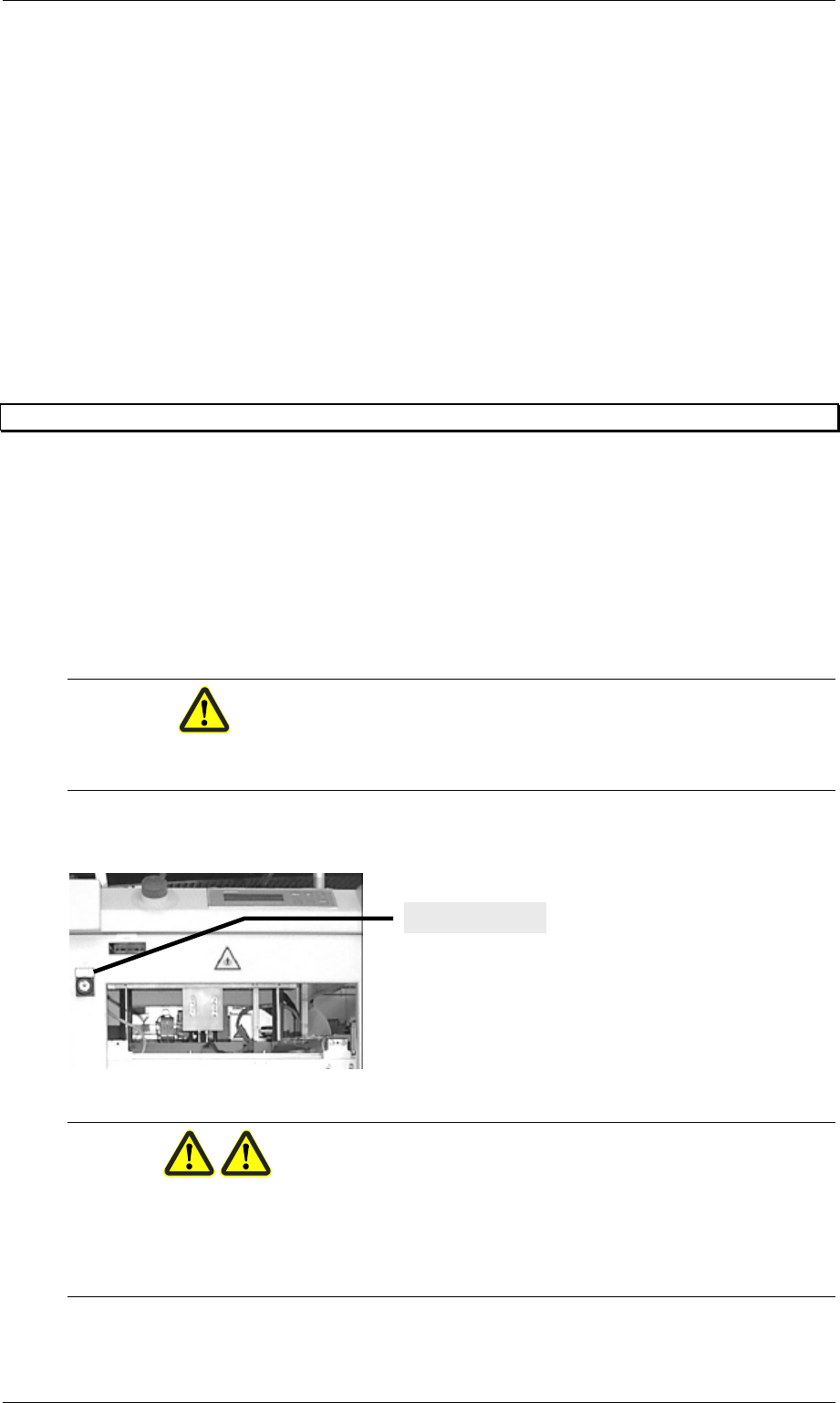
Key switch for bridging safety equipment
Figure 1: Key Switch
WARNING
Protective equipment such as covers and doors that are secured by safety key switches
interrupt the automatic operating mode if they are opened. This safety equipment can be
removed from service using a key switch in order to perform special operating functions, or to
provide the qualified person or service engineer with a better view for installation purposes.
These people are personally responsible for the safekeeping of the key.
Key Switch