'操作说明 Hotflow THREE_26_zh.pdf - 第466页
T ranslation of the original ENGLISH 1. FOR YOUR SAFETY 451820.66.03_EN 2020-05-05 9 1.5 Safety notes The following regulations and safety notes must be complied with when installing, operating and carrying out maintenan…
1. FOR YOUR SAFETY ENGLISH Translation of the original
8
451820.66.03_EN
2020-05-05
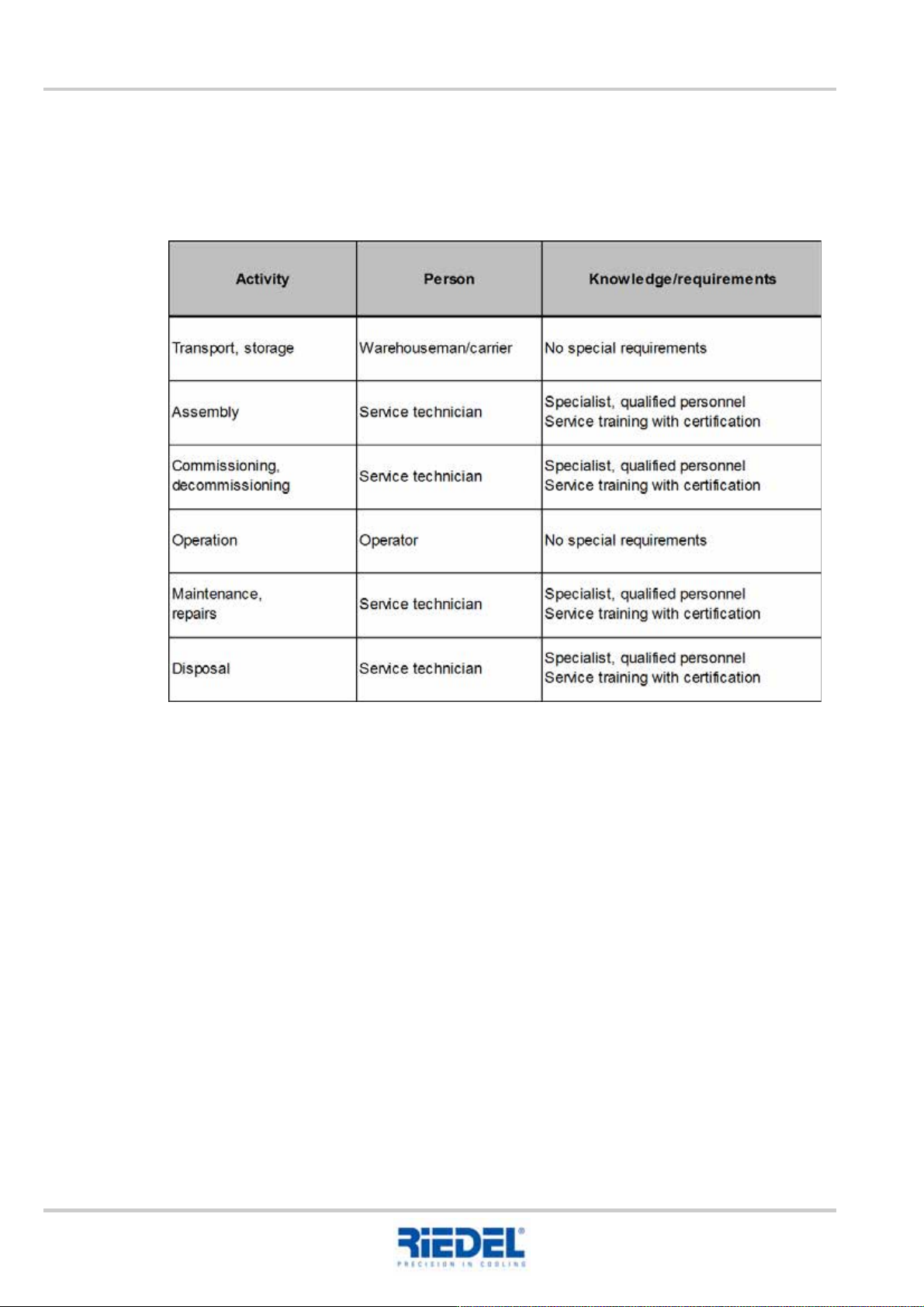
1.4 Personnel qualification
All activities on the cooling unit must be performed by personnel with appropriate technical training,
unless execution of such activities by other persons (owner, user) is required.
The relevant personnel must possess the following knowledge or meet the following requirements:
Translation of the original ENGLISH 1. FOR YOUR SAFETY
451820.66.03_EN
2020-05-05
9
1.5 Safety notes
The following regulations and safety notes must be complied with when installing, operating and
carrying out maintenance work on the cooling unit:
• Work on the cooling unit must only be performed by qualified personnel.
• The accident prevention regulations must be complied with.
• Never stand under the load when lifting and lowering the cooling unit – remain outside
the danger zone.
• The cooling unit must be secured to prevent the risk of tipping.
• The product must not be used without the safety features.
• When connecting the cooling unit to the electrical power supply, the relevant VDE, EN
and IEC standards must be observed/fulfilled. The technical connection requirements
of the electrical utility companies also apply.
• Always disconnect the power supply before carrying out any work on the cooling unit.
• National regulations in the country of installation must be complied with.
• The closed refrigerant circuit contains refrigerant and refrigeration machine oil. These
substances must be disposed of professionally when carrying out maintenance and
when decommissioning.
• The cooling water additives are caustic on contact with eyes and skin. Wear protective
goggles and gloves when working with cooling water additives. Follow the instructions
on the product packaging.
• Personal protective equipment regulations must be followed when working on the
refrigerant circuit.
• The cooling unit must only be used for cooling water in accordance with the relevant
specification.
1.6 Handling refrigerant
The legal regulations and directives must be followed when handling refrigerant. Refrigerant
must only be handled by qualified personnel.
Protective goggles and gloves must be worn!
The operator of the cooling unit is responsible for ensuring that refrigerant and system components
that are no longer suitable for use are disposed of correctly.
1. FOR YOUR SAFETY ENGLISH Translation of the original
10
451820.66.03_EN
2020-05-05
1.7 Safety requirements
for operating cooling units within the European Union
The following information applies for cooling units operated within the European Community that
feature a closed refrigerant circuit. Further requirements may apply in some member states
(e.g. due to environmental policy).
The cooling units contain components with operating pressures that require compliance with the
Pressure Equipment Directive and EN 378.
In addition to the manufacturer requirements regarding the design, equipment and testing of the
cooling unit prior to delivery, the operator of this type of system also has additional obligations in
accordance with the standard EN 378 or other nationally valid regulations. These apply to
installing, operating and retesting cooling units.
1.7.1 Installation
When installing the cooling unit in basement floors or upper floors of a building without sufficient
emergency routes, requirements are placed on the installation location for the protection of persons
in accordance with EN 378.
With regard to the existing refrigerant and the refrigerant fill quantity (see type plate) of the cooling
unit, a specific minimum room volume must be maintained.
It is thereby ensured that a refrigerant leakage in the event of an accident and resulting oxygen
displacement will not have any effect on human health.
Formula:
Min. room volume [m³] = refrigerant fill quantity [kg] / practical limit value [kg/m³]
Example calculation (refrigerant fill quantity)