00198521-01_UM_LDU_E_EN.pdf - 第43页
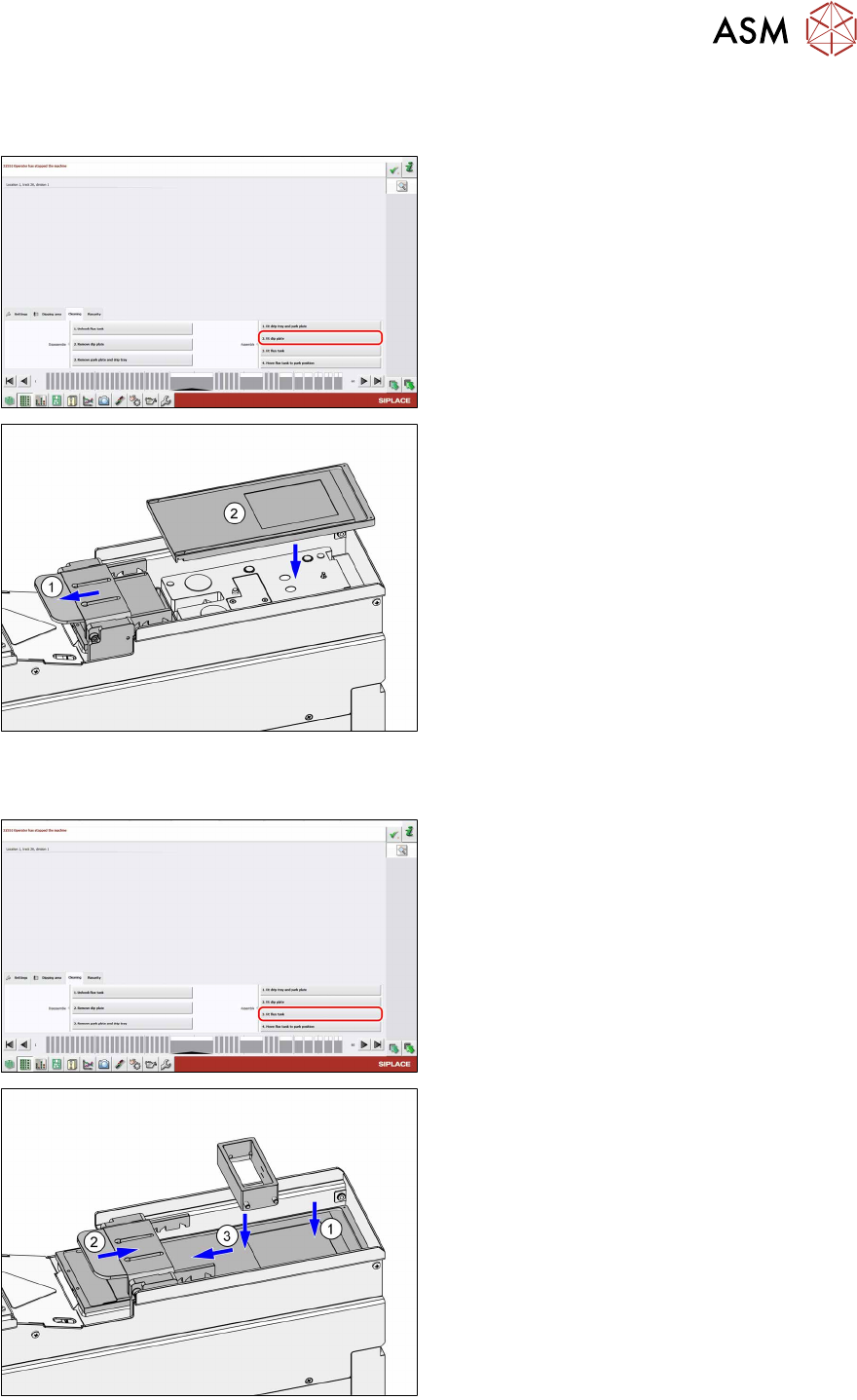
4 Operation 4.5 Fitting User Manual SIPLACE Linear Dipping Unit E 12/2018 43 Fitting the dip plate Prerequisites: The drip tray and the park plate are fitted. The dip plate is not yet fitted. ► Click on the Fit dip plate…
4 Operation
4.5 Fitting
42 User Manual SIPLACE Linear Dipping Unit E 12/2018
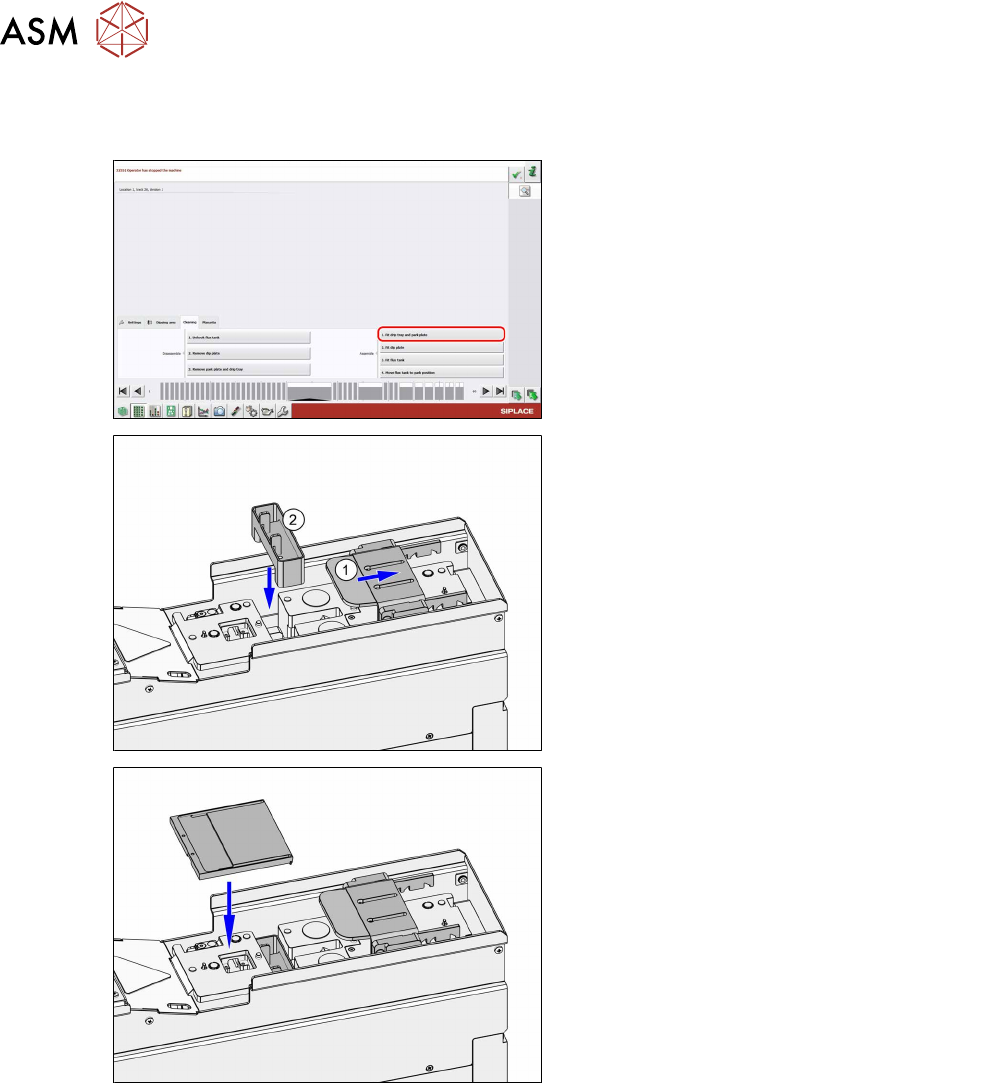
Fitting the drip tray and the park plate
Prerequisites: The park plate and the drip tray are not yet fitted.
► Click on the Fit drip tray and park plate
button.
(1) The LDU moves the squeegee axis to the
front over the lift axis.
► (2) Fit the drip tray.
► Fit the park plate.
4 Operation
4.5 Fitting
User Manual SIPLACE Linear Dipping Unit E 12/2018 43
Fitting the dip plate
Prerequisites: The drip tray and the park plate are fitted. The dip plate is not yet fitted.
► Click on the Fit dip plate button.
(1) The LDU moves the squeegee back over the
park plate and moves the lift axis up.
► (2) Fit the dip plate in the orientation
shown.
Fitting the flux tank
Prerequisites: The park plate and the dip plate are fitted.
► Click on the Fit flux tank button.
(1) The LDU moves the lift axis down.
(2) The LDU moves the squeegee to the front.
► (3) Place the flux tank onto the dip plate
and push it under the downholder to the
fixed stop.
4 Operation
4.6 Performing a height measurement
44 User Manual SIPLACE Linear Dipping Unit E 12/2018
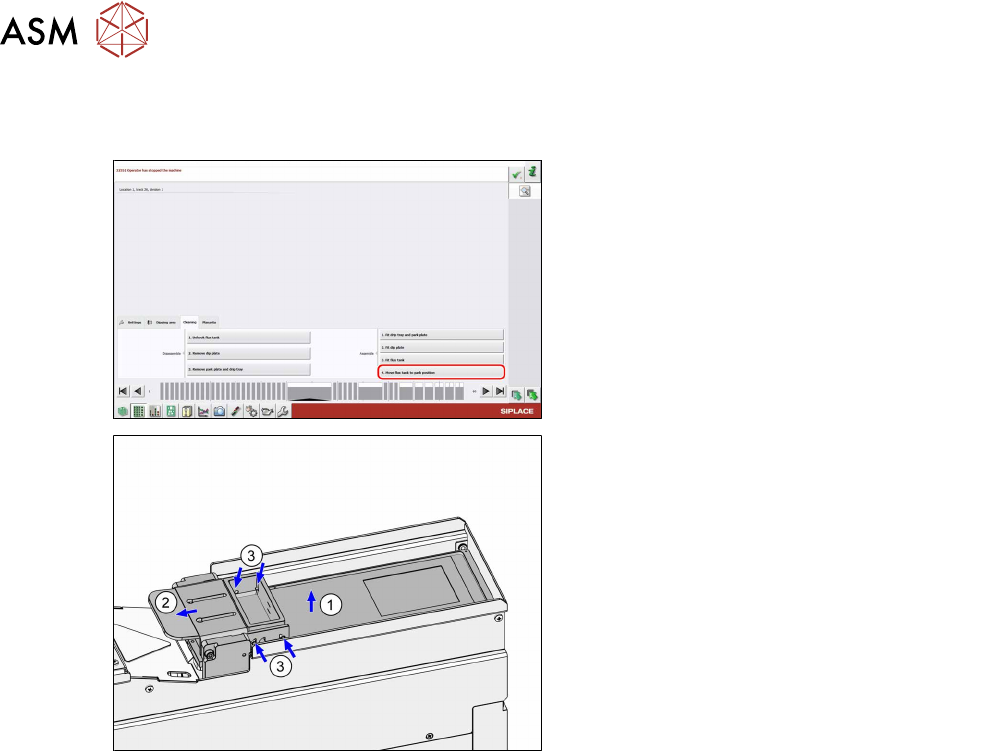
Moving the flux tank to the park position
Prerequisites: The park plate and the dip plate are fitted.
► Click on the Move flux tank to park posi-
tion button.
(1) The LDU moves the lift axis to the zero posi-
tion while the downholder locks the flux tank.
(2) The LDU moves the squeegee back over the
park plate.
► (3) Ensure that the four pins of the flux
tank engage correctly in the retaining
clamp of the downholder.
4.6 Performing a height measurement
To ensure that the components can be dipped into the medium over the entire dipping area, it is
important that the dipping area is not tilted. You therefore need to align the LDU parallel to the
gantry or to the placement head of the placement machine. The LDU has two adjustment screws
for this purpose. The correct position of the cavity can be checked with the help of the measure-
ment run in the station software.
The measurement run sets the dip plate parallel to the gantry. It does NOT determine the level of
the dip plate compared to the ground. It is therefore important that the machine in which the LDU is
used is standing absolutely level. If the machine is not level and the dip plate is aligned parallel to
the gantry, the dip plate will then not be level in relation to the ground.
Height measurement procedure
The placement head moves over the first measuring point in the cavity of the dip plate. After this,
the Z-axis moves slowly downwards until the nozzle springs into place and the Z-axis sensor re-
ports that the nozzle is now down on the dip plate. The Z-axis then moves up again. The system
calculates the absolute height of the first measuring point.
The gantry now moves to the second measuring point. The Z-axis performs height measurement
again and now determines the relative height difference to the first measuring point. If the measure-
ment for the second measuring point is positive, measuring point 2 is higher than measuring point
1. If it is negative, this means that it is lower. If the relative measurement is zero, this means that
both measuring points are at the same height. The same procedure is applied to the third measur-
ing point.