Nordson_EFD_P-Jet_SolderPlus_Operating_Manual.pdf - 第19页
Liquidyn P-Jet SolderPlus Jet Valve 19 www.nordsonefd.com info@nordsonefd.com +1-401-431-7000 Sales and service of Nordson EFD dispensing systems are available worldwide. 2. If you have not already done so, turn the forc…
Liquidyn P-Jet SolderPlus Jet Valve
18 www.nordsonefd.com info@nordsonefd.com +1-401-431-7000 Sales and service of Nordson EFD dispensing systems are available worldwide.
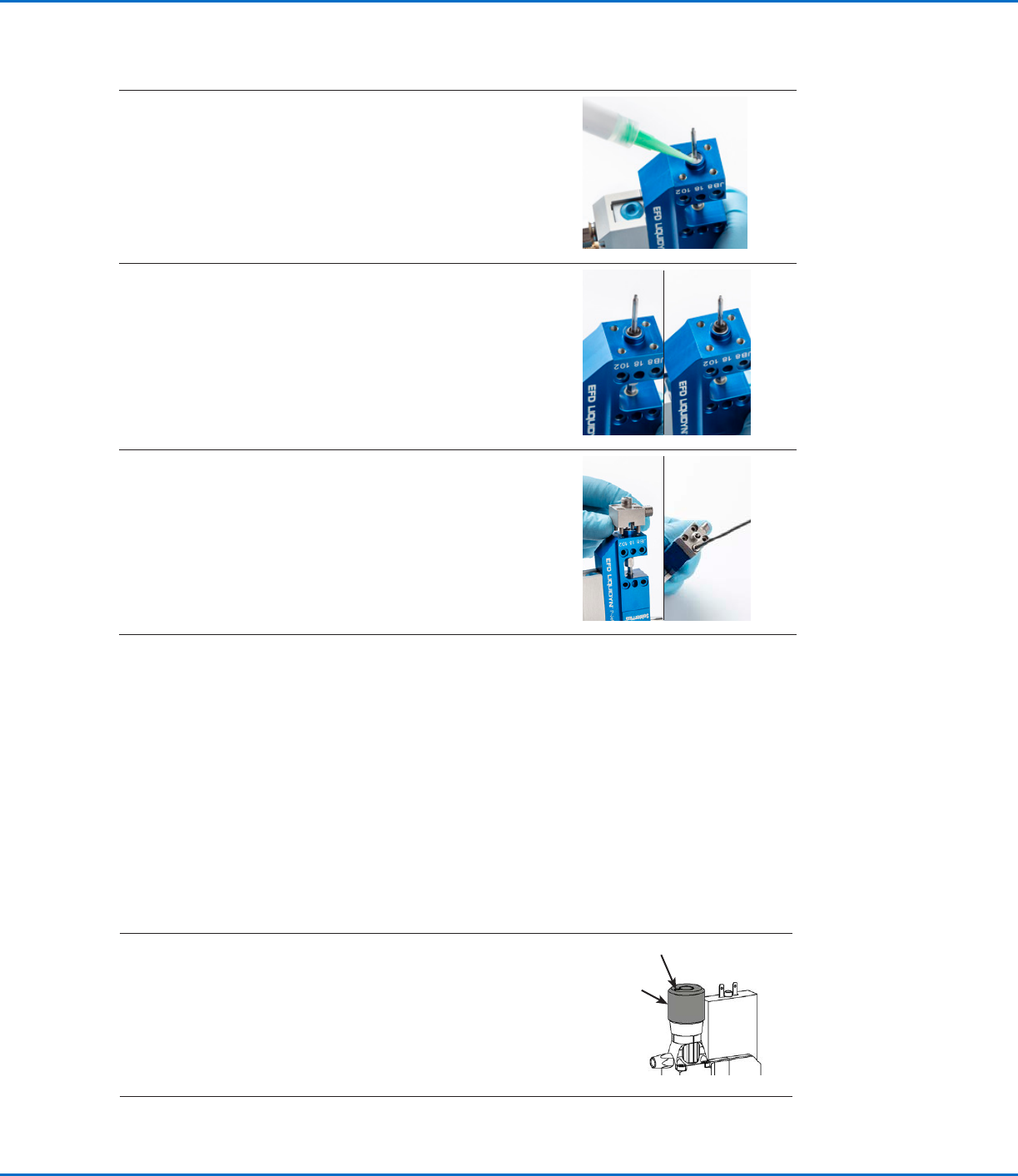
8. • Using a wooden pick, apply a small amount of barrier
grease at the base of the replacement tappet and
distribute this around the annulus.
9. • Install a new O-ring (standard material: NBR) on the
tappet and press the O-ring down into the greased
annulus.
• Distribute the grease evenly so that the entire sealing
surface of the O-ring is covered.
• Install the second (grease-free) O-ring on the tappet on
top of the initial O-ring.
10. • Mount the initial or replacement fluid body precisely over
the tappet without tilting it. Tighten the screws crosswise.
Torque: 0.8 N•m (5.9 ft-lb) maximum
11. • Continue to the next procedure to set the tappet
concentricity.
Change the Fluid Body or Tappet (Optional) (continued)
Set the Tappet Concentricity
Follow this procedure to set the tappet concentricity (common center) as follows:
• Anytime the tappet is changed or replaced.
• Whenever the dispensing performance deteriorates.
You will need the following items:
• Concentricty tool
• Nozzle retaining nut
Refer to “Tools and Supplies” on page41 for component part numbers.
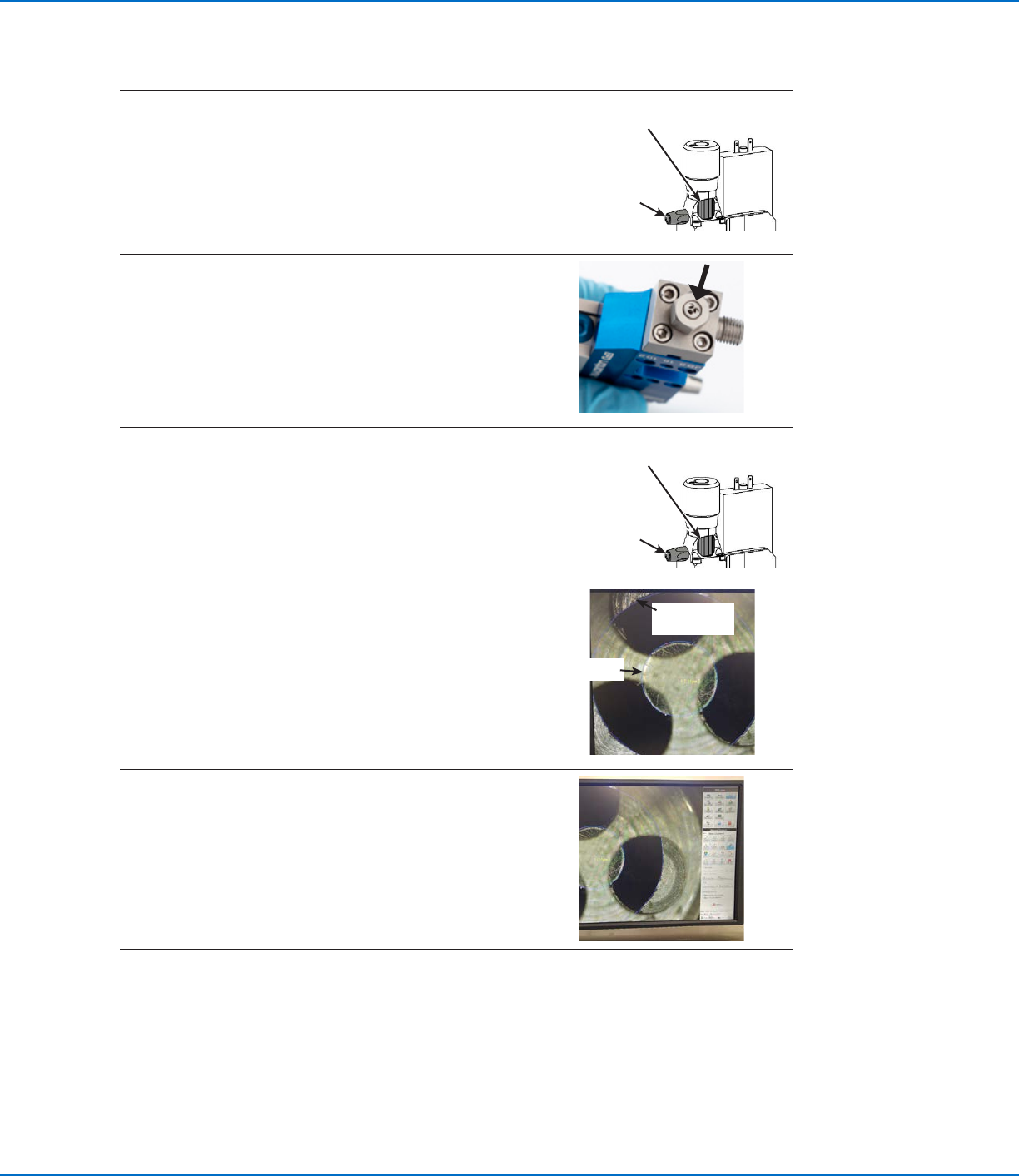
1. Turn the stroke adjustment knob fully counterclockwise as
follows (so that it is not forcing the tappet into a forward
position):
• Use a hex wrench to loosen the locking set screw.
• Turn the stroke adjustment knob counterclockwise until it
stops.
• Tighten the locking set screw to secure the knob.
Locking set screw
Stroke
adjustment
knob
Continued on next page
Liquidyn P-Jet SolderPlus Jet Valve
19www.nordsonefd.com info@nordsonefd.com +1-401-431-7000 Sales and service of Nordson EFD dispensing systems are available worldwide.
2. If you have not already done so, turn the force screw fully
counterclockwise as follows (to eliminate any spring force
on the tappet):
• Completely loosen the raster element.
• Turn the force screw counterclockwise until it stops.
• Completely tighten the raster element to secure the force
screw.
Force
screw
Raster
element
3. • Remove the nozzle, if present.
• Install the concentricity tool onto the fluid body where the
nozzle would mount.
• Install the nozzle retaining nut to secure the concentricity
tool.
4. • Turn the force screw one (1) click counterclockwise so
that there is a low spring force pushing the tappet onto
the concentricity tool.
Force
screw
Raster
element
5. • Place the valve upright under a measuring system (such
as a digital microscope with measurement capability).
• Adjust the magnification to 100 times (100x) and focus on
the flat surface of the tappet, which is at the same height
as the concentricity tool.
Tappet
Concentricity
tool
6. • Use the measuring system’s center-to-center tool to
measure the concentricity of the tappet to the inside ring
of the concentricity tool.
NOTE: The three holes in the concentricity tool act as
windows to view the inner diameter.
7. • Repeat the concentricity measurement three times
by repeating steps 1–6 (including turning the stroke
adjustment knob back when removing / installing the
concentricity tool).
• Average all three measurements. An acceptable tappet
concentricity is <75 µm.
Set the Tappet Concentricity (continued)
Liquidyn P-Jet SolderPlus Jet Valve
20 www.nordsonefd.com info@nordsonefd.com +1-401-431-7000 Sales and service of Nordson EFD dispensing systems are available worldwide.
Install a Nozzle Heater (Optional)
The nozzle heater is an optional component; however, because most solder applications require a nozzle heater,
it was included as a step under “Assemble the Valve (Initial Assembly)” on page15. This section is included for
additional reference as needed.
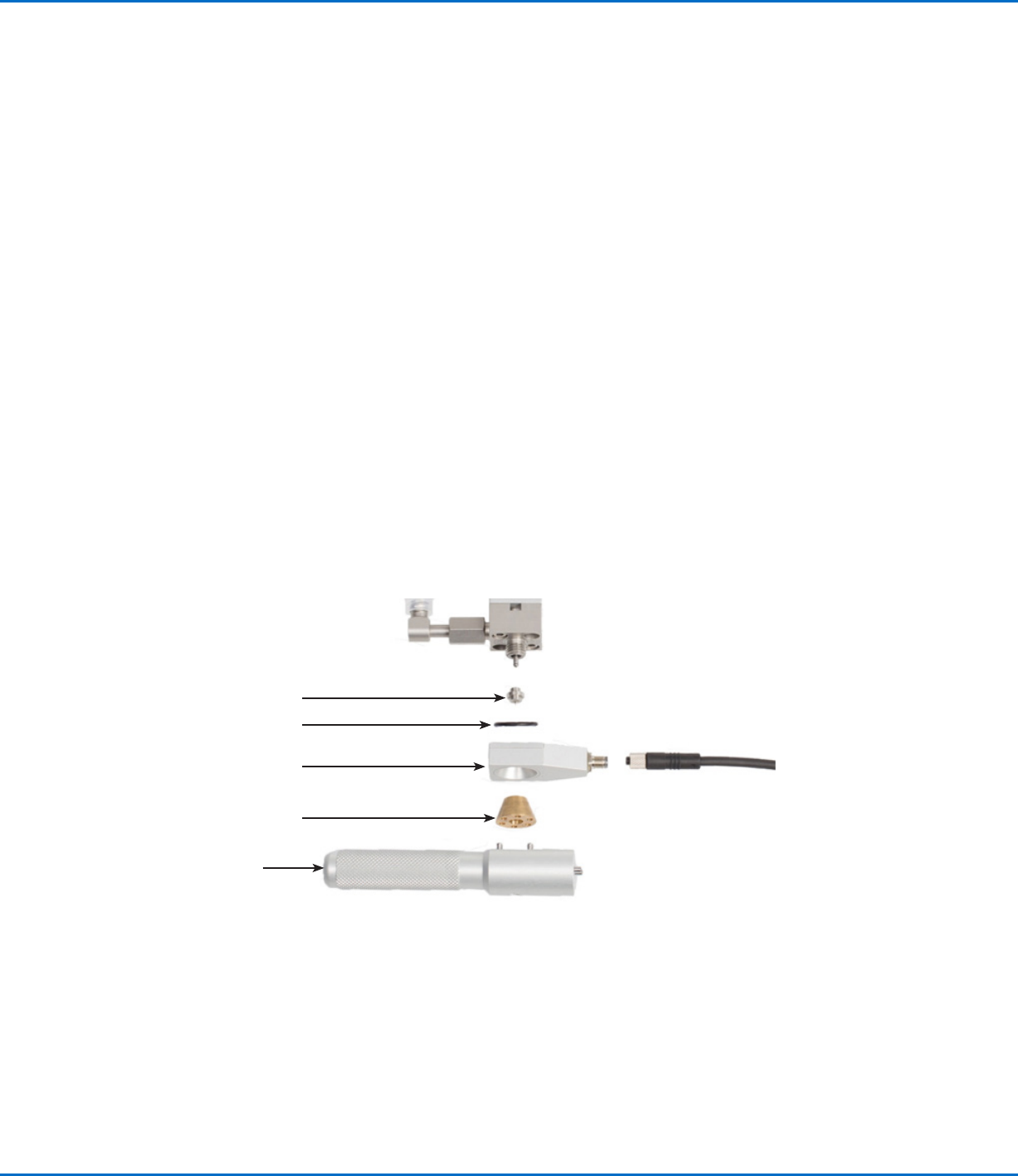
The illustration below shows the installation of a nozzle heater. A nozzle heater controls the temperature of the
material in the nozzle. The nozzle is secured minimally by the nozzle heater with an elastomer (heater O-ring)
between it and the valve. The nozzle is fully secured by the retaining nut.
You will need the following items:
• Nozzle
• Nozzle heater
• Nozzle heater O-ring (NBR or EPDM)
• Retaining nut
• Heater key
• Heater cable
Refer to “Nozzle Heaters” on page39 for component part numbers.
NOTES:
• The nozzle retaining nut predominantly secures and seals the nozzle in place. The heater remains in contact with
the retaining nut through pressure supplied by a heater O-ring, which creates a partial space between the heater
and the fluid body. This ensures thermal contact and allows the heater to rotate slightly even when the retaining
nut is fully tightened.
• The image below is based on a Liquidyn P-Jet valve with a standard nozzle heater. The mounting process is the
same for all valves.
NOTES:
• The electrical connection for the
heater is supplied through the
provided heater cable.
• To attach or release the heater
cable, loosen or tighten the knurled
nut by hand. Be sure to connect
the heater cable plug in the correct
orientation.
Nozzle
Nozzle heater O-ring
Nozzle heater
Nozzle retaining nut
Heater key
Torque for a steel nozzle: 1.2 N•m (10.6 in.-lb)