YC8_Mainte_E.pdf - 第96页
A-4 Appendix 1.3.2 NEXT INTERF ACE connector When the following three conditions are satisfied, the NEXT INTERF A CE circuit in the machine allo ws the board to be carried out. 1. Machine is read y for carrying out the b…
A-3
Appendix
1.3 Connection between machines
To exchange signals such as board request and operation status with the downstream or upstream machine, the
"NEXT INTERFACE" and "PREVIOUS INTERFACE" connectors located on the rear of the machine are used. The
"NEXT INTERFACE" connector connects to the downstream machine, and the "PREVIOUS INTERFACE"
connector connects to the upstream machine such as a loader. In the case of standard right-to-left flow, the
PREVIOUS INTERFACE connector is located inside the lower right cover on the rear of the machine while the
NEXT INTERFACE connector is located inside the lower left cover on the rear of the machine.
1.3.1 PREVIOUS INTERFACE connector
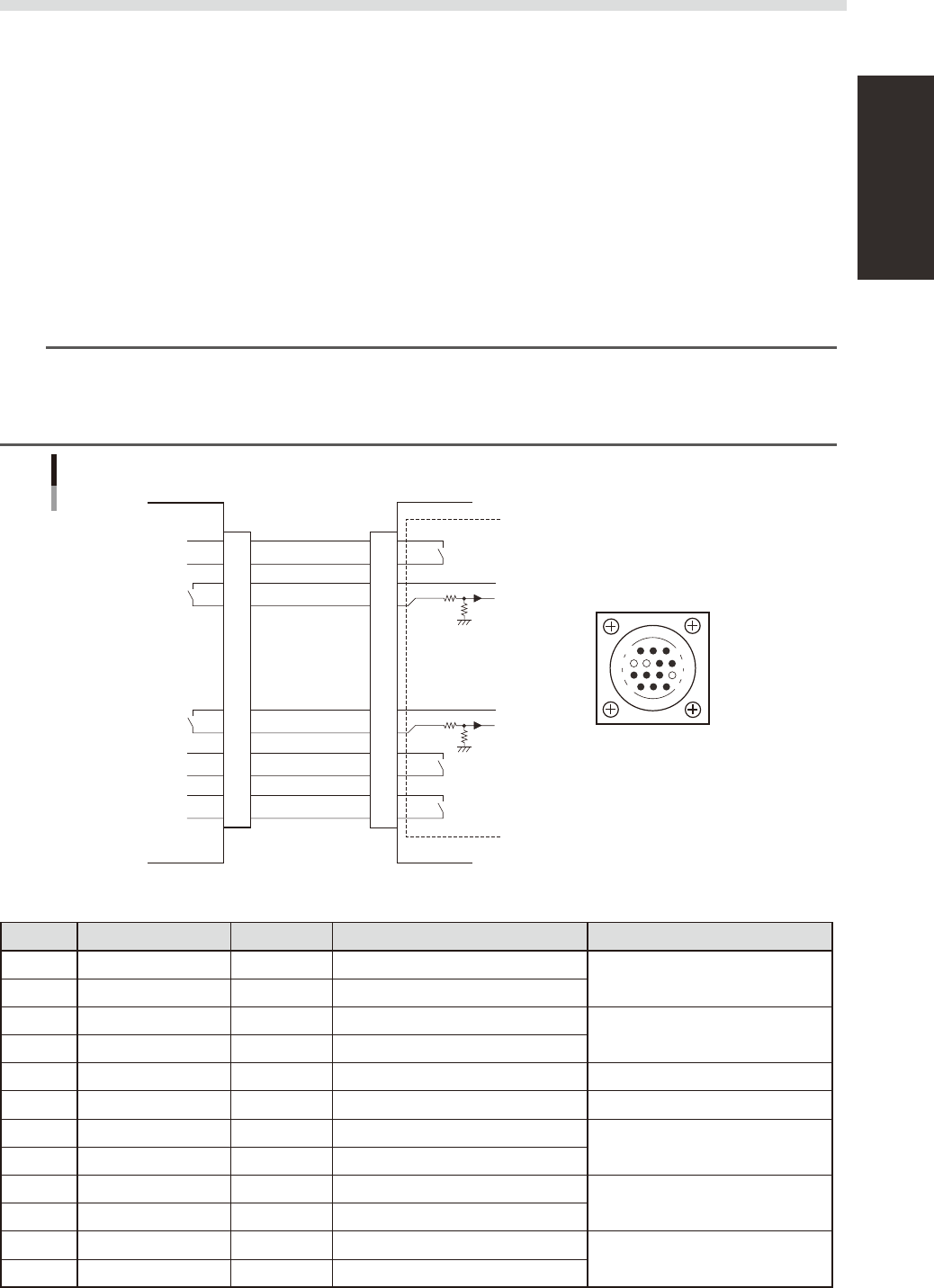
When the following three conditions are satisfied, the PREVIOUS INTERFACE circuit in the machine allows the
next board to be carried in. (ADVANCED GATE is selected.)
1. Machine is ready for carrying in a board. (BUSY OUT: ON)
2. Board carry-in signal is input from the upstream machine. (BA IN [N01007A1] : ON)
3. Auto operation signal is input from the upstream machine. (UR IN [N01007A3] : ON)
n
NOTE
• When the auto operation running signal (UR IN) from the loader turns off during board carrying-in, the machine
temporarily stops carrying in the board.
• When the board being carried in is detected by the entrance sensor, the BUSY OUT signal turns off.
• Carrying in the board is nished when both the BUSY OUT and BA IN turn off.
1
2
3
4
5
6
7
8
9
10
11
12
13
14
7
12
4
8
1
14
11
3
BUSY OUT
(T01000E4)
+24V
+24V
LR OUT
(T01000E7)
UR IN
(N01007A3)
BA IN
(N01000421)
Carrying-in input
Carry-out request
output
Auto operation running
output
Auto operation running
input
LE OUT
(T0100031)
Waiting for board between
machines input
I/O BOARD
PREVIOUS INTERFACE circuit
PREVIOUS INTERFACE of machineUpstream machine
PREVIOUS INTERFACE
connector
AMP 206043-1
(14-pin receptacle)
53A04-N8-00
n
Board transfer signal specifications (PREVIOUS INTERFACE)
Pin No. Signal name Address I/O specifications Signal specifications
BUSY OUT T01000E4 Relay contact output
Board carrying-in signal output
2 BUSY OUT T01000E4 Relay contact output
3 +24V Input common (+24V)
Board carry-out signal input
4 BA IN N01007A1 Voltage input
5 NC (with dummy pin) (Prevents incorrect insertion.)
6 to 8 NC
9 +24V Input common (+24V)
Auto operation running signal input
10 UR IN N01007A3 Voltage input
11 LR OUT T01000E7 Relay contact output
Auto operation running signal output
12 LR OUT T01000E7 Relay contact output
13 LE OUT T0100031 No-voltage output
Waiting for board between machines
signal input
14 LE OUT T0100031 No-voltage output
A-4
Appendix
1.3.2 NEXT INTERFACE connector
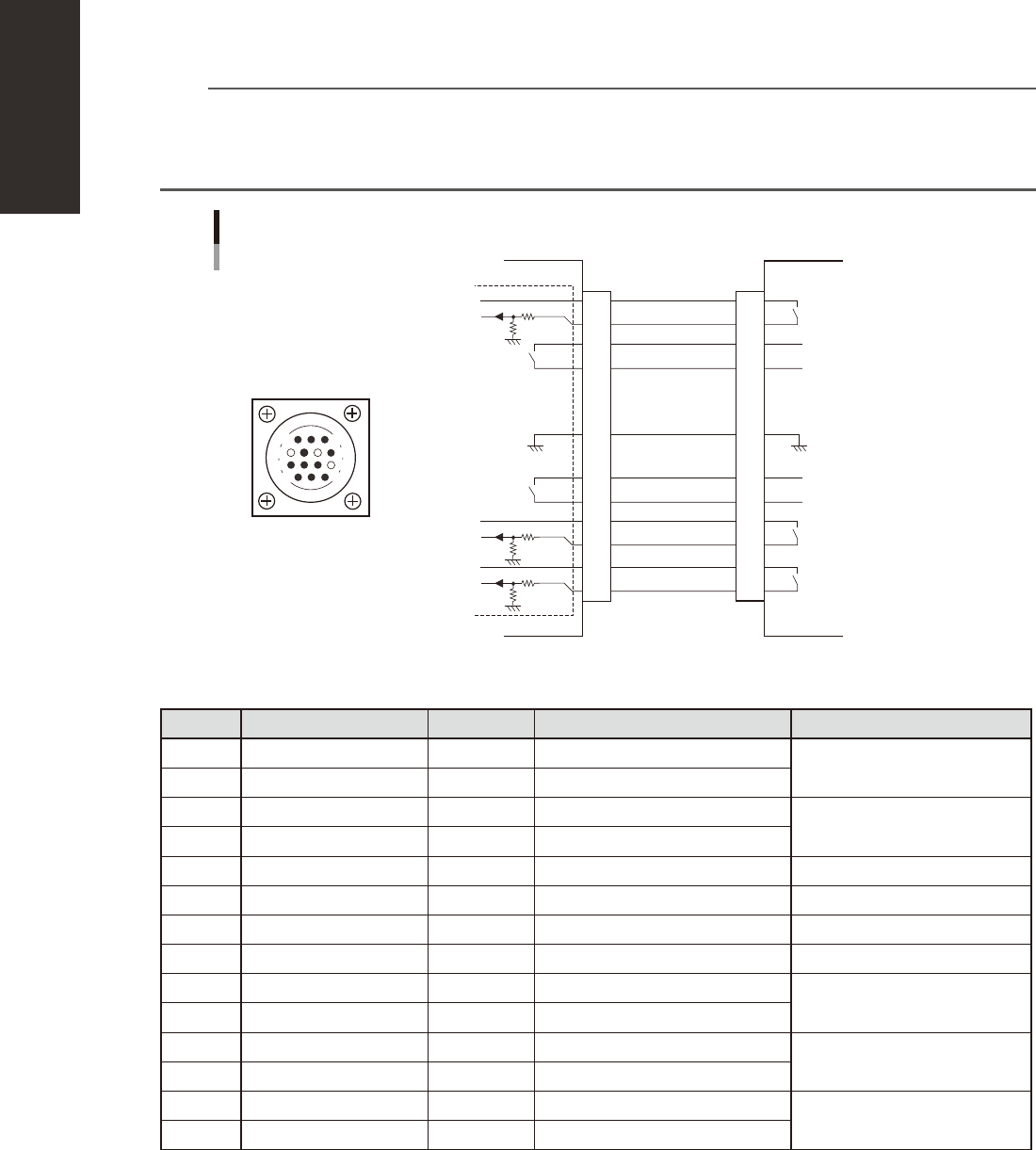
When the following three conditions are satisfied, the NEXT INTERFACE circuit in the machine allows the
board to be carried out.
1. Machine is ready for carrying out the board. (BA OUT: ON)
2. Board carry-in signal is input from the downstream machine. (BUSY IN [N01007A0] : ON)
3. Auto operation signal is input from the downstream machine. (LR IN [N01007A3] : ON)
n
NOTE
• When the auto operation running signal (LR IN) from the downstream machine turns off during board carrying-out,
the machine temporarily stops carrying out the board.
• When the board being carried out is detected by the exit sensor, the BA OUT signal turns off.
• Carrying out the board is nished when both the BUSY IN and BA OUT turn off.
1
2
3
4
5
6
7
8
9
10
11
12
13
14
BUSY IN
(N01007A0)
+24V
+24V
UR OUT(T01000E6)
LR IN
(N01007A3)
+24V
LE IM
(N01007A4)
BA OUT
(T01000E5)
Carrying-in output
Carry-out request input
Auto operation running
input
Auto operation running
output
Waiting for board between
machines output
I/O BOARD
GND GND
14
11
12
7
4
8
3
1
NEXT INTERFACE circuit
NEXT INTERFACE connector
NEXT INTERFACE of machine
Downstream machine
AMP 206043-1
(14-pin receptacle)
53A05-H0-00
n
Board transfer signal specifications (NEXT INTERFACE)
Part No. Signal name Address I/O specifications Signal specifications
1 +24V Input common (+24V)
Board carrying-in signal input
2 BUSY IN N01007A0 Voltage input
3 BA OUT T01000E5 Relay contact output
Board carry-out request signal
output
4 BA OUT T01000E5 Relay contact output
5 NC
6 NC (with dummy pin) (Prevents incorrect insertion.)
7 GND
8 NC
9 UR OUT T01000E6 Relay contact output
Auto operation running signal
output
10 UR OUT T01000E6 Relay contact output
11 +24V Input common (+24V)
Auto operation running signal
input
12 LR IN N01007A3 Voltage input
13 +24V Input common (+24V)
Waiting for output board between
machines signal input
14 LE IN N01007A4 Voltage input

A-5
Appendix
2. Warranty
The machine you have purchased is warranted against malfunctions as described below.
n
Warranty description:
If a failure or breakdown occurs due to defects in workmanship or materials used to manufacture this machine within
one year or 5,000 hours of operation (whichever comes first) after the incoming inspection is complete, then YAMAHA
will repair the defective parts free of charge.
n
Warranty period
The warranty period ends when any of the following applies:
1. After one year has elapsed from the time of installation.
2. After 5,000 hours of operation.
n
Items not covered by the warranty
The warranty does not cover any of the following conditions:
1. Damage as a result of deterioration due to age or wear (e.g., normal discoloration of painted or plated surfaces, wear
of replaceable parts, etc.).
2. Incidents associated with sensory perceptions which have no bearing on the quality or function of the machine (e.g.,
signal sounds emitted by the controller, rotating sounds of the motor, etc.).
3. Damage caused by the user environment (e.g., impurities in the air supply, dust, debris and oil mist in the machine).
n
Exception to warranty repairs
Warranty repairs will not be made if damage is caused by the following:
1. Earthquakes, typhoons, floods, lightning, accidents or fires, other natural or man-made disaster.
2. Modifications or conversions not approved by YAMAHA or its dealers.
3. Use of non-genuine parts, greases or lubricants.
4. Lack of proper maintenance and inspection procedures.
5. Maintenance handled by someone other than the approved dealers.
6. Damage or malfunction due to changes in the machine installation level that may be caused by changes in the
foundation or surrounding environment.
7. The machine was modified or changed in specifications after the incoming inspection is complete.
8. When defective parts replaced free of charge were not returned to the location specified by YAMAHA or YAMAHA
sales representatives within 30 days.
n
Note on network connections
A precondition for network connections with the YAMAHA surface mounters and related machines is that such
connections will be used in closed networks comprised of a YAMAMHA surface mounter (or related machine) and an off-
line PC. The customer must take responsibility for connections to company in-house networks and to external networks.
Please acknowledge that YAMAHA can bear absolutely no responsibility for networks configured by other than just a
YAMAMHA surface mounter (or related machine) and off-line PC nor can accept responsibility for problems occurring
due to network settings and connections.
n
About USB memory devices
• Use the USB memory device (supplied with the machine or purchased from YAMAHA sales reps) specified by
YAMAHA Motors Co., Ltd. Do not use any other type of USB memory device with YAMAHA surface mounters and
related machines. Any problems arising from using other than the specified USB memory device are not covered by
our warranty.
• Do not connect any USB device other than the specified USB memory device to the USB port on the machine. If a
device driver for a wrong device is installed, then the machine might not work correctly. We take no responsibility for
any problems caused by connecting a wrong or inappropriate device.