KE2040 Instruction Manual_ver1.30.pdf - 第357页
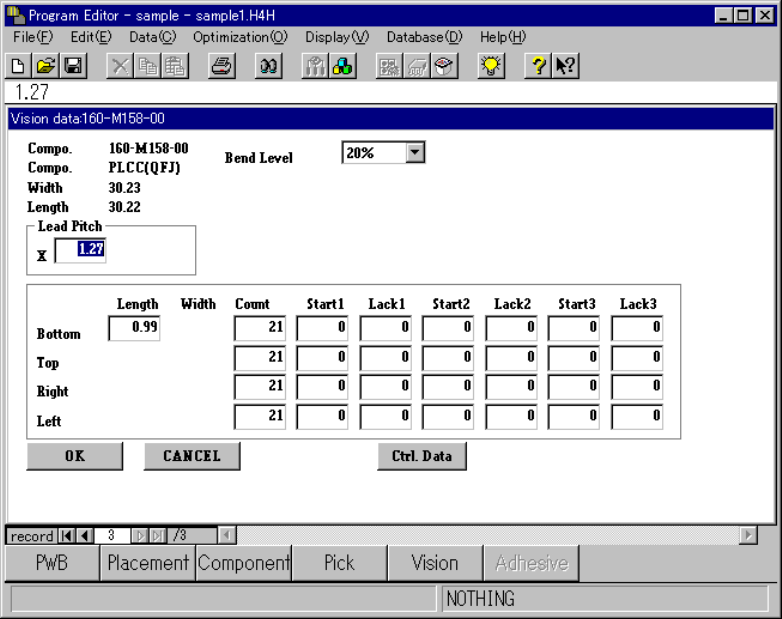
5 − 15 5.2.2.2 Vision Form Sample Vision data and its basic operation are shown below . Figure 5.2.2.2 Vision Form screen ◇ Description of basic operation ① Input focus A line on which the input f ocus is located is r ev…
5 − 14
③ Setting items for which you do not have to enter any data
An asterisk mark (*) appears in a cell which does not require any data entry.
Although you can move the input focus to such a cell, you cannot enter any
data in it.
④ Horizontal scroll
All of the Vision data setting items cannot be displayed on the screen at a time.
Enter data while scrolling the screen horizontally.
Except for a component whose leads are arranged irregularly, when you enter
data for the items from “Type” to “Bot.”, “R”, “Top” and “L”, Vision data on a
component is completed (“Contrast” also for a BGA type of component).
For a component having no lead at some point, scroll the screen in the right
direction to specify the lead arrangement on each side.
- When you reach the last item filed by scrolling the screen in the right
direction, the input focus cannot move any more even though you are to
move it. To move the input focus to the next line, move it to the field below
the current one.
⑤ Vertical scroll
When you press the up arrow key or Up button if the input focus is located on
the top line of the data display area of the window, but this line is not the first
line, the screen is scrolled down by one line.
When you press the down arrow key or Down button if the input focus is
located on the bottom line of the data display area of the window, and a
component type is entered in the “Type” cell of the next line, the screen is
scrolled up by one line.
⑥ Scroll bar
- When you click the scroll bar on the upper side of the vertical scroll box, the
screen is scrolled down by one page.
The Page Up key functions in the same manner.
- When you click the scroll bar on the lower side of the vertical scroll box, the
screen is scrolled up by one page.
The Page Down key functions in the same manner.
- When you click the scroll bar on the left of the vertical scroll box, the screen
is scrolled in the right direction by one page.
- When you click the scroll bar on the right of the vertical scroll box, the
screen is scrolled in the left direction by one page.
⑦ Scroll bar box
When you drag the scroll box, the machine compares the data display area of
all data to the length of the scroll bar, then scrolls the screen with regarding the
scroll box position as the display position.
⑧ Moving to the beginning or end of a line
When you press the Home key, the machine displays the screen up to the left
limit and moves the input field to a “Type” cell.
When you press the End key, the machine displays the screen up to the right
limit and moves the input field to the rightmost cell.
⑨ Making a choice to enter data
To enter or change data, press the F2 key or right button of the trackball.
The pop-up menu appears which allows you to select the desired value.
5 − 15
5.2.2.2 Vision Form
Sample Vision data and its basic operation are shown below.
Figure 5.2.2.2 Vision Form screen
◇ Description of basic operation
① Input focus
A line on which the input focus is located is reverse-displayed, while a cell in
which the input focus is located is not.
◇ An input character is echoed back onto the formula bar as you enter it.
When you validate it, it is entered in a cell.
② Cursor movement range
You can move the cursor to the items displayed on the screen only. To move
the input focus, press the <TAB> key or press the <SHIFT> key and <TAB>
key at the same time.
③ Setting items for which you do not have to enter any data
The items to which you do not have to enter any data show their respective
values on the screen.
5 − 16
5.2.3 Detailed description of operation
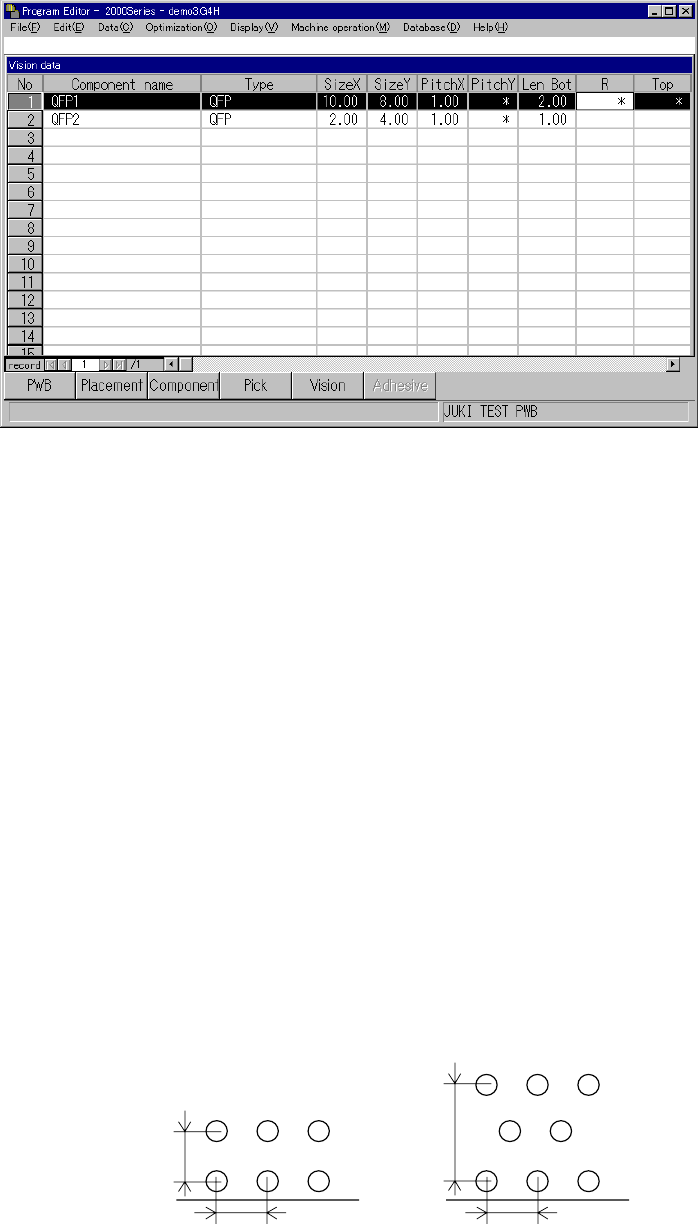
When you invoke Vision data for the first time, data appears in the “Component
name”, “Type”, “SizeX” and “SizeY” cells only.
Figure 5.2.3.1 Vision data initial screen
(1) How to set the items
① Component name
A component name entered on the Placement data screen appears in this cell.
② Type
A component type entered on the Component data screen appears in this cell.
③ Size X
The width of a component, which was entered on the Component data screen,
appears in this cell.
④ Size Y
The length of a component, which was entered on the Component data screen,
appears in this cell.
⑤ 1) PitchX
Enter the horizontal pitch between two consecutive leads (balls) from the
formula bar. The input range varies depending on the component type.
2) PitchY
Enter the vertical pitch between two consecutive leads (balls) from the
formula bar. The input range varies depending on the component type.
Figure 5.2.3.2 Pitches applied to each component type
Ball pitch
(Normal assignment)
Ball pitch
(Stagger assignment)