KE2040 Instruction Manual_ver1.30.pdf - 第403页
5 − 61 5.2.4.4. 2 Ball components ( Element group/El ement format) ■ This section describes the procedure f or cr eating dat a on ball components (complex array components) . 1. Operation on the “ Extended Vision” screen…
5 − 60
Element
group
name
First
element
position
Layout
inspection
(Dimension)
Missing
elements
Element
Element
offset
Element
size
Element
shape
Cutting Lead size
ELG0001 X:-7.25
Y: -5.1
Z: 0
θ: 0
Tol er anc e:
All set to 0.
√ 25% √ ID
Count of
Column: 30
Pitch of
Column:
0.5
Tolerance:
0
Start: 5
Count: 3
Type: Outer
Lead
Reference
pos.:
Center of the
bottom
Polarity:
Bright
Offset: all
set to 0.
Tolerance:
all set to 0.
Size
X: 0.2
Y: 1.0
Tolerance:
all set to 0.
Profile:
Gullwing
Cut shape:
Flat
Coating:
Bare
Cut width:
0
Cut length:
0
Size
X: 0.2
Y: 0.4
Tolerance:
all set to 0.
ELG0002 X: 13.31
Y: 5.1
Z: 0
θ: 180
Tol er anc e:
All set to 0.
√ 25% √ ID
Count of
Column: 4
Pitch of
Column:
1.27
Tolerance:
0
Type: Outer
Lead
Reference
pos.:
Center of the
bottom
Polarity:
Bright
Offset: all
set to 0.
Tolerance:
all set to 0.
Size
X: 0.4
Y: 1.2
Tolerance:
all set to 0.
Profile:
Gullwing
Cut shape:
Flat
Coating:
Bare
Cut width:
0
Cut length:
0
Size
X: 0.4
Y: 0.6
Tolerance:
all set to 0.
ELG0003 X: 7.5
Y: 4.9
Z: 0
θ: 180
Tol er anc e:
All set to 0.
√ 25% √ ID
Count of
Column: 31
Pitch of
Column:
0.5
Tolerance:
0
Type: Outer
Lead
Reference
pos.:
Center of the
bottom
Polarity:
Bright
Offset: all
set to 0.
Tolerance:
all set to 0.
Size
X: 0.2
Y: 1.0
Tolerance:
all set to 0.
Profile:
Gullwing
Cut shape:
Flat
Coating:
Bare
Cut width:
0
Cut length:
0
Size
X: 0.2
Y: 0.4
Tolerance:
all set to 0.
ELG0004 X: -9.5
Y: 5.1
Z: 0
θ: 180
Tol er anc e:
All set to 0.
√ 25% √ ID
Count of
Column: 4
Pitch of
Column:
1.27
Tolerance:
0
Type: Outer
Lead
Reference
pos.:
Center of the
bottom
Polarity:
Bright
Offset: all
set to 0.
Tolerance:
all set to 0.
Size
X: 0.4
Y: 1.2
Tolerance:
all set to 0.
Profile:
Gullwing
Cut shape:
Flat
Coating:
Bare
Cut width:
0
Cut length:
0
Size
X: 0.4
Y: 0.6
Tolerance:
all set to 0.
Click the <OK> button at the lower left corner of the screen after you define all element groups to finish the “Extended Vision”
data entry.
5 − 61
5.2.4.4.2 Ball components (Element group/Element format)
■ This section describes the procedure for creating data on ball components
(complex array components).
1. Operation on the “Extended Vision” screen
- Select “Ball Component” from the “Component Type” combo box.
- Check the “Element group/Element format” check box in the “Define data
format” field.
- Click the <Add> button on the “Element Group List”.
2. Operation on the “Element Group” screen
Define an element group.
An element group consists of components whose size and pitch is the same as
each other.
A complex array component refers to an area array component whose size is
different or whose ball/land pitch is different from each other.
When the lead pitch is not the same even though the polarity is the same, set
element groups separately. If the polarity is the same, the size and shape of the
polarity is the same also.
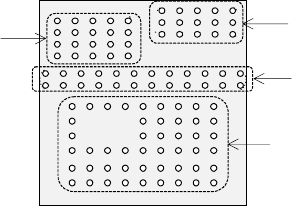
In the example shown in Figure 5.2.4.4.11, a complex array component that
consists of four element groups is shown.
• The procedure for creating data on this component is to be described below.
The element size and pitch of the second and third element groups are the
same as each another. However, columns of elements are not aligned with
each another. Define them as two different element groups.
The posture of a complex array component is viewed from the bottom in the
same manner as an area array component such as a BGA and FBGA.
Figure 5.2.4.4.11
Bottom View
Third element group
Fourth element group
Second element group
First element group
5 − 62
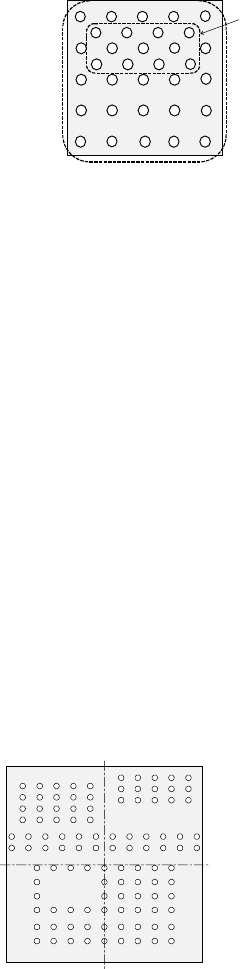
When a component has a staggered pattern of elements partially as shown in
Figure 5.2.4.4.12, divide them into two grid arrangement groups, then define them.
Figure 5.2.4.4.12
① Name
Name an element group to be handled. When you want to change an
element group, specify its name to edit it.
A name is automatically assigned with serial numbers. Users can change this
numbered name to an alphanumeric name (up to 32 characters).
- In the example, the numbered name is used.
② First element position
Specify the position (X, Y) and direction (Theta) of an element group.
As the position, specify the distance (offset) from the center of a component.
Normally, the center of a component is the center of the component outline.
- If the placement coordinates set in Placement data of a production program
is not based on the center of the component outline, you can specify the
coordinates of the reference component center with coordinates different
from the center of the component outline.
Figure 5.2.4.4.13 indicates that the center of the component outline is the
center of a component.
Figure 5.2.4.4.13
Element group 1
Element group 2
Bottom View
Center of a component (Center of
the component outline)