IPC 7711A.pdf - 第307页
OUTLINE This procedure describes the use of flat set eyelets for the repair of a through con- nection that has an inner layer connect, no surface wire is used. The inner layer reconnect is established by soldering the ba…

NOTES
IPC-7721A
Number: 5.2
Revision:
Date: 2/98
Subject: Plated Hole Repair, Double Wall Method
Page4of4
Copyright Association Connecting Electronics Industries
Provided by IHS under license with IPC
Not for Resale
No reproduction or networking permitted without license from IHS
--``,``,-`-`,,`,,`,`,,`---
OUTLINE
This procedure describes the use of flat set eyelets for the repair of a through con-
nection that has an inner layer connect, no surface wire is used. The inner layer
reconnect is established by soldering the barrel of an eyelet to the exposed inner
layer and the connection is encapsulated in high strength epoxy.
CAUTION
This is a complex repair procedure that demands the proper tools and materials. To
expect reliable results, repair technicians must have a high level of expertise. Use this
method only when alternative methods are unacceptable.
CAUTION
This procedure requires very accurate control over the location and depth of a milled
hole. It is recommended that a precision drill system be used in combination with a
high power stereo microscope.
REFERENCES
2.1 Handling Electronic Assemblies
2.2 Cleaning
TOOLS & MATERIALS
Ball Mills, Carbide
Buffer
Caliper
Cleaner
End Mills, Carbide
Eyelets
Eyelet Press System
Eyelet Repair Kit
Eyelet Setting Tools
Hand Held Drill
Liquid Flux
Knife
Microscope
Pin Gauges
Precision Drill Press
Solder
Solder Iron
Wipes
EYELET SELECTION CRITERIA
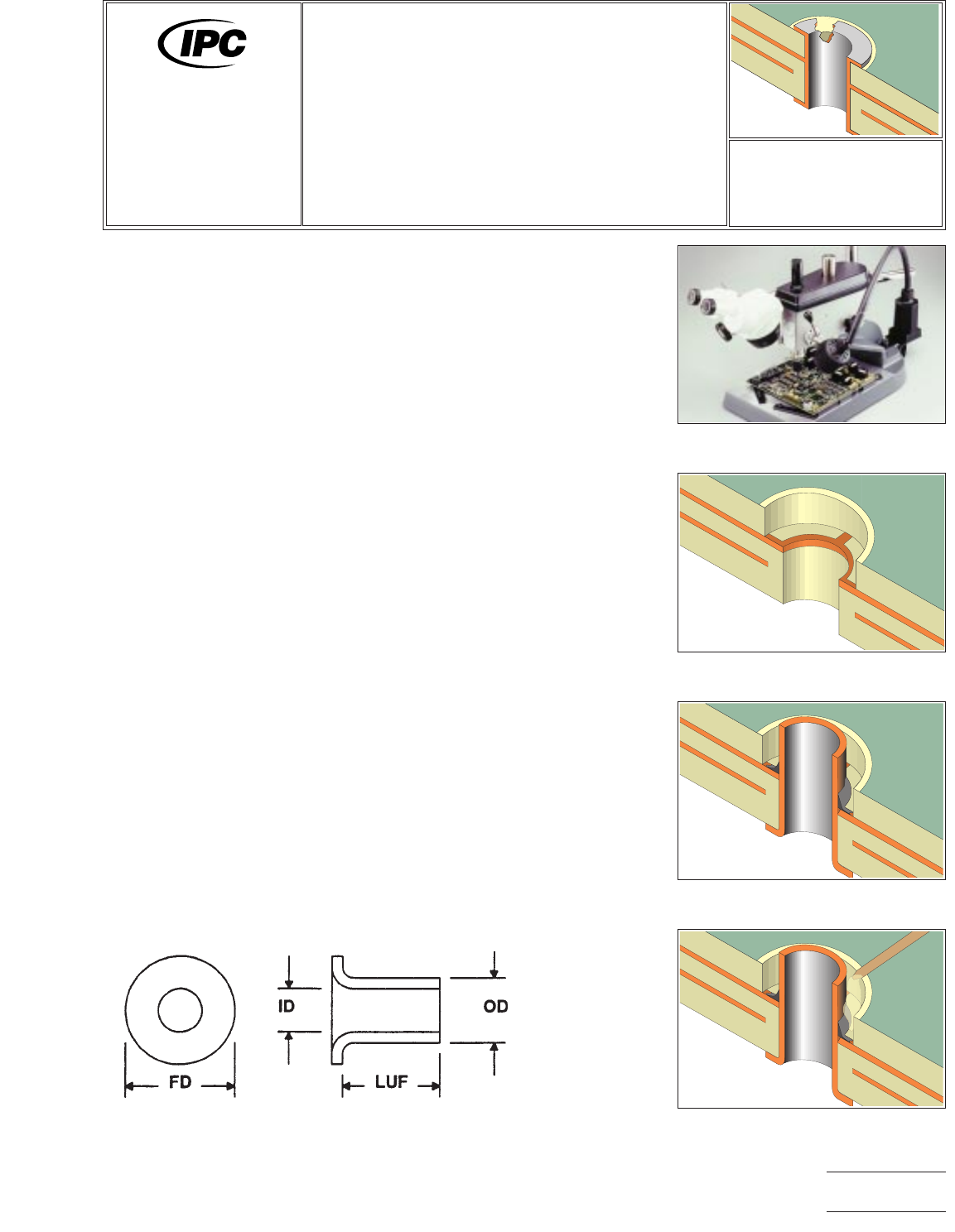
Figure 1 Drill press shown with PC
board pinned in place.
Figure 2 Mill down to and expose
inner layer signal or plane.
Figure 3 Solder the eyelet barrel to
the exposed inner layer.
Figure 4 Fill the milled hole with the
epoxy.
7721A
Repair and
Modification of
Printed Boards and
Electronic Assemblies
Revision:
Date: 2/98
Plated Hole Repair,
Inner Layer Connection
Number: 5.3
Product Class: R
Skill Level: Expert
Level of Conformance: Medium
Material in this manual was voluntarily established by Technical Committees of IPC. This material is advisory only and its use
or adaptation is entirely voluntary. IPC disclaims all liability of any kind as to the use, application, or adaptation of this material.
Users are also wholly responsible for protecting themselves against all claims or liabilities for patent infringement. Equipment
referenced is for the convenience of the user and does not imply endorsement by IPC.
Page1of4
Copyright Association Connecting Electronics Industries
Provided by IHS under license with IPC
Not for Resale
No reproduction or networking permitted without license from IHS
--``,``,-`-`,,`,,`,`,,`---
ID Inside Diameter
The eyelet inside diameter should be a 0.075 - 0.500 mm greater than the compo-
nent lead diameter.
LUF Length Under Flange
The length of the eyelet barrel under the flange should be 0.630 - 0.890 mm greater
than the thickness of the printed wiring board. This added length allows for proper
protrusion when setting the eyelet.
FD Flange Diameter
The eyelet flange diameter should be small enough to prevent interference with adja-
cent pads or conductors.
OD Outside Diameter
The clearance hole drilled through the printed wiring board should allow the eyelet to
be inserted without force but should not exceed 0.125 mm greater than the eyelet
outside diameter.
NOTE
Be sure to select an eyelet meeting the proper criteria. An eyelet with an oversize
flange may interfere with adjacent conductors. An eyelet that is too short will not
protrude through the printed wiring board for proper setting.
PROCEDURE
1. Clean the area.
2. Select an eyelet using the Eyelet Selection Criteria. Use a pin gauge and caliper
to measure the existing plated hole dimensions.
3. Pin the printed wiring board to the base of a precision drill press. (See Figure 1.)
4. Insert the appropriate ball mill, end mill or drill into the chuck of the drill press.
5. Mill or drill out the hole. The drilled hole should be approximately 0.030 mm
larger than the eyelet O.D. Inspect to ensure no metallic particles or burrs
remain.
6. Select the side of the assembly that will have a counterbored hole milled into it.
This side preferably would have no surface connection.
7. Select an end mill approximately 0.050 - 0.075 mm larger than the eyelet diam-
eter. Insert into the precision drill press and mill down to and expose the inner
layer signal or plane. (See Figure 2.)
CAUTION
Great care must be taken to control the depth of the milled hole to prevent
damage to the inner layer signal or plane.
8. Clean the area.
9. Apply a small amount of flux to the exposed signal or plane and tin with solder.
10. Clean the area.
11. Insert the eyelet into the hole from the side opposite the milled hole, then apply
a small amount of flux into the milled hole.
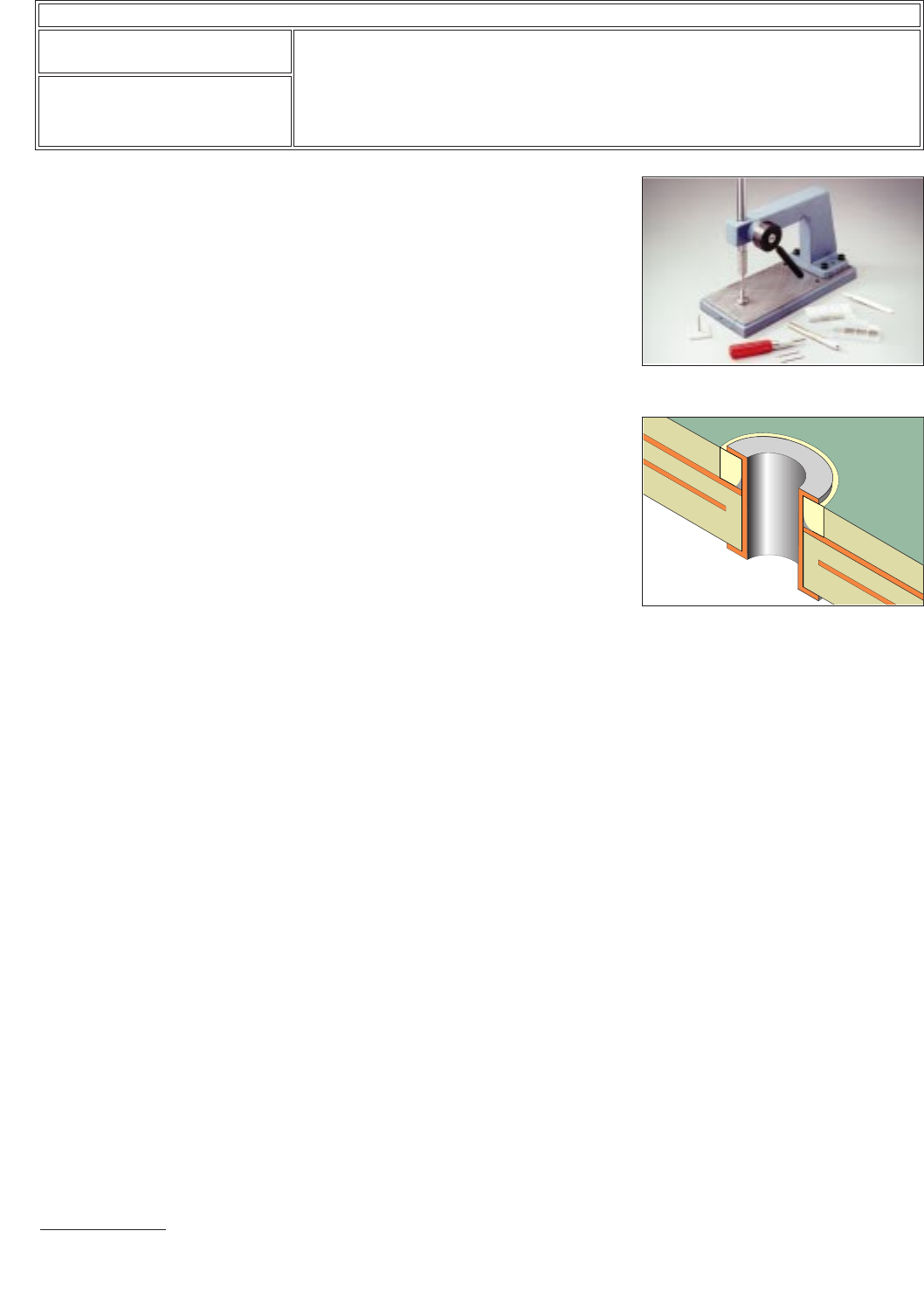
Figure 5 Set the eyelet using an
eyelet press.
Figure 6 Eyelet barrel formed flat to
PC board surface.
IPC-7721A
Number: 5.3
Revision:
Date: 2/98
Subject: Plated Hole Repair, Inner Layer Connection
Page2of4
Copyright Association Connecting Electronics Industries
Provided by IHS under license with IPC
Not for Resale
No reproduction or networking permitted without license from IHS
--``,``,-`-`,,`,,`,`,,`---