s25061872.pdf - 第22页
Sensors 2025 , 25 , 1872 22 of 24 Sensors 2025 , 25 , x FOR PE ER REV I E W 23 of 25 Figure 14. Moti on trajectorie s in a two − dimensional pl a n e . 4. Conclusions This …
Sensors 2025, 25, 1872
21 of 24
Sensors2025,25,xFORPEERREVIEW 22 of 25
(a) (b)
(c) (d)
Figure13.Kinematicimage:(a)DisplacementcurveinCartesianspace;(b)speedcurveinCartes ian
space;(c)accelerationcurveinCartesianspace;(d)jerkcurveinCartesianspace.
Inaddition,thisstudymeticulouslyrecordsthekeyparameters,particularlythejoint
angles,duringtheS‐shapedspeedcurvemovement.Twosetsofjointanglesconsistingof
severalinterpolationpointsaresubstitutedintotheforwardkinematicsformula,asshown
inEquat ion(30).XandYrepr es ent thecoordi natevaluesinthe
Cartesiancoo r dinat e
system,respectively.
112 1 2
112 1 2
cos cos cos
sin sin sin
Xlink link
Y link link
(30)
TheactualmotiontrajectorydepictedintheplanarspaceisshowninFigure14.By
comparingFigures4and14,thehighconsistencyofthetwotrajectoriescanbecl earl y
verified.ThiscomparisonclearlyvalidatestheaccuracyandreliabilityoftheISO. This
planningmethodnotonlyelevatestheaccuracy
oftrajectoryplanning,butalsoensures
thesafetyandreliabilityofthemotion.
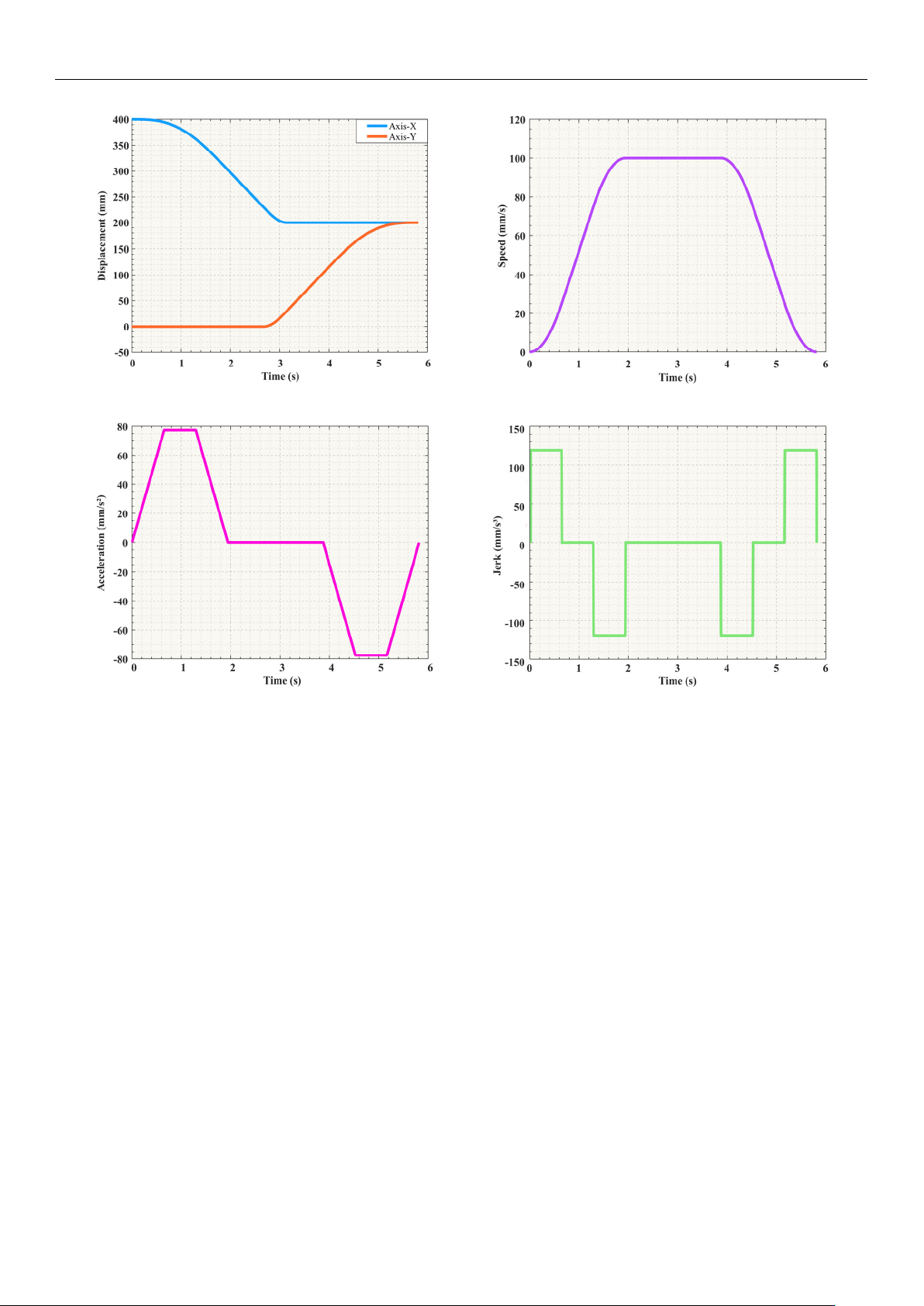
Figure 13. Kinematic image: (a) Displacement curve in Cartesian space; (b) speed curve in Cartesian
space; (c) acceleration curve in Cartesian space; (d) jerk curve in Cartesian space.
In addition, this study meticulously records the key parameters, particularly the joint
angles, during the S-shaped speed curve movement. Two sets of joint angles consisting of
several interpolation points are substituted into the forward kinematics formula, as shown
in Equation (30). X and Y represent the coordinate values in the Cartesian coordinate
system, respectively.
(
X = link
1
×cos θ
1
+ link
2
×
(
cos θ
1
+ cos θ
2
)
Y = link
1
×sin θ
1
+ link
2
×
(
sin θ
1
+ sin θ
2
)
(30)
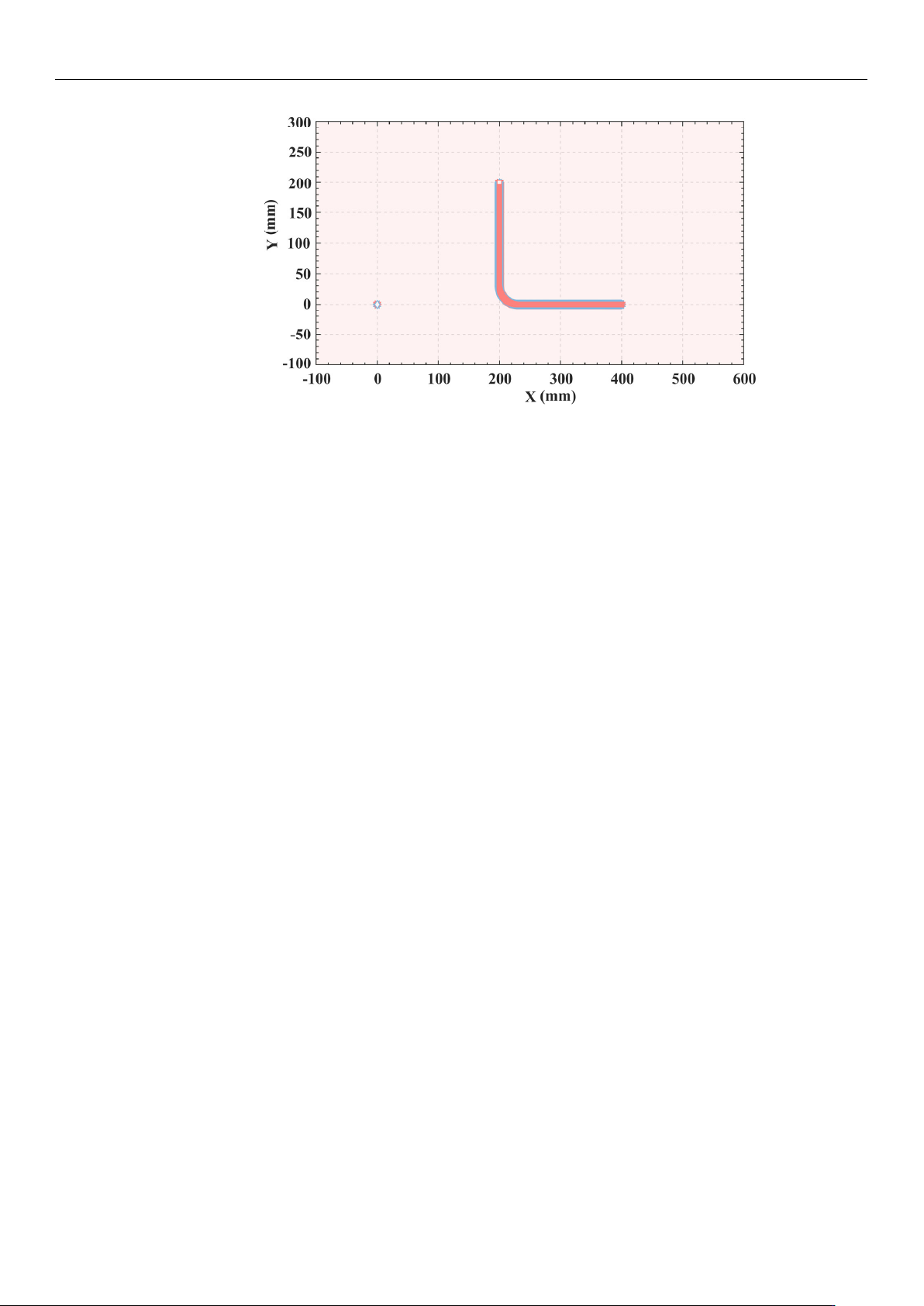
The actual motion trajectory depicted in the planar space is shown in Figure 14. By
comparing Figures 4 and 14, the high consistency of the two trajectories can be clearly
verified. This comparison clearly validates the accuracy and reliability of the ISO. This
planning method not only elevates the accuracy of trajectory planning, but also ensures the
safety and reliability of the motion.
Sensors 2025, 25, 1872
22 of 24
Sensors2025,25,xFORPEERREVIEW 23 of 25
Figure14.Motiontrajectoriesinatwo−dimensionalplane.
4.Conclusions
Thisstudyproposesanimprovedsnakeoptimization(ISO)algorithm.Meanwhile,a
single‐segmentstart–stopS‐shapedspeedcurvewitharctransitionisconstructedbased
onISO,whichisa methodspecificallydesignedfortherapidandstableoperationrequire‐
mentsof thewafer‐handling roboticarm.Thismethod extensively investigates
and
optimizesonthekeyissuesoftimeandimpactwithinthecontextofroboticarmtrajectory
planning.ThroughacomparativeanalysiswiththeoriginalS‐shapedspeedcurvescheme
underthe same para met e r sett ings, the new method improvesthe time efficiencyby
24.1%,therebysignificantlyreducingthetime
requiredfortheroboticarmtocomplete
thetask.Furthermore,theperformanceoftheISOiscomparedwiththatofSO,SA,PSO,
GWO,andWOAonaseriesofbenchmarktestfunctions.Theresultsindicatethat,interms
ofthetwo key performance indicators,averagevalueandvariance,the ISO
algorithm
outperformsthesecondrankedGWOalgorithmbyamarginof38.9%.Theseimproved
simulationsfullydemonstratetheeffectivenessandsuperiorityoftheproposed method
inaddressingthetrajectoryplanning problemforwafer‐handlingroboticarms.
Inthisstudy,theshortcomingsoftheSOalgorithmhavebeenextensivelystudied
andimproved.Whiletheproposedenhancementsimproveglobalsearchcapabilities,the
riskoflocaloptimaconvergencepersists.Additionall y,althoughBayesianopt imization
improvesthesearchefficiency,itconsumesmorecomputerresources.Therefore,future
researchwil l prioritizerefining thesea rchmechanismtoaddresstheseli mitationsofthe
SOalgorithm.Simultaneously,weplanto
explorethecombinationofBayesianoptimi‐
zationandbandit‐basedmethods,aimingtoreducecomputationalcostswhileimprov‐
ingtheoptimizationefficiency.
AuthorContributions:Conceptualization,Y.J.andJ.Y.;methodology,J.Y.;software,J.Y.;validation,
J.Y.;formalanalysis,J.Y.;investigation,Y.J.andJ.Y.Allauthorshavereadandagreedtothepub‐
lishedversionofthemanuscript.
Funding:Thisresearchwasfunded bytheBasicScientificResearchProjectofHigherEducation
InstitutionsofLiaoning
Province(grantnumberJYTQN2023064).
InstitutionalReviewBoardStatement:Notapplicable.
InformedConsentStatement:Notapplicable.
DataAvailabilityStatement:Datasharingnotapplicable.Nonewdatawerecreatedoranalyzed
inthisstudy.Datasharingisnotapplicabletothisarticle.
Figure 14. Motion trajectories in a two−dimensional plane.
4. Conclusions
This study proposes an improved snake optimization (ISO) algorithm. Meanwhile, a
single-segment start–stop S-shaped speed curve with arc transition is constructed based on
ISO, which is a method specifically designed for the rapid and stable operation requirements
of the wafer-handling robotic arm. This method extensively investigates and optimizes on
the key issues of time and impact within the context of robotic arm trajectory planning.
Through a comparative analysis with the original S-shaped speed curve scheme under
the same parameter settings, the new method improves the time efficiency by 24.1%,
thereby significantly reducing the time required for the robotic arm to complete the task.
Furthermore, the performance of the ISO is compared with that of SO, SA, PSO, GWO, and
WOA on a series of benchmark test functions. The results indicate that, in terms of the two
key performance indicators, average value and variance, the ISO algorithm outperforms
the second ranked GWO algorithm by a margin of 38.9%. These improved simulations
fully demonstrate the effectiveness and superiority of the proposed method in addressing
the trajectory planning problem for wafer-handling robotic arms.
In this study, the shortcomings of the SO algorithm have been extensively studied
and improved. While the proposed enhancements improve global search capabilities, the
risk of local optima convergence persists. Additionally, although Bayesian optimization
improves the search efficiency, it consumes more computer resources. Therefore, future
research will prioritize refining the search mechanism to address these limitations of the SO
algorithm. Simultaneously, we plan to explore the combination of Bayesian optimization
and bandit-based methods, aiming to reduce computational costs while improving the
optimization efficiency.
Author Contributions: Conceptualization, Y.J. and J.Y.; methodology, J.Y.; software, J.Y.; validation,
J.Y.; formal analysis, J.Y.; investigation, Y.J. and J.Y. All authors have read and agreed to the published
version of the manuscript.
Funding: This research was funded by the Basic Scientific Research Project of Higher Education
Institutions of Liaoning Province (grant number JYTQN2023064).
Institutional Review Board Statement: Not applicable.
Informed Consent Statement: Not applicable.
Data Availability Statement: Data sharing not applicable. No new data were created or analyzed in
this study. Data sharing is not applicable to this article.

Sensors 2025, 25, 1872
23 of 24
Conflicts of Interest: The authors declare no conflicts of interest.
References
1.
Pu, Q.C.; Xu, X.R.; Li, Q.Q.; Zhang, H. Robotic Arm Time-Jerk Optimal Trajectory Based on Improved Dingo Optimization. J. Braz.
Soc. Mech. Sci. Eng. 2024, 46, 198. [CrossRef]
2.
Zhang, S.B.; Xia, Q.X.; Chen, M.X.; Cheng, S.Z. Multi-Objective Optimal Trajectory Planning for Robotic Arms Using Deep
Reinforcement Learning. Sensors 2023, 23, 5974. [CrossRef] [PubMed]
3.
Ye, J.T.; Hao, L.N.; Cheng, H.T. Multi-Objective Optimal Trajectory Planning for Robot Manipulator Attention to End-Effector
Path Limitation. Robotica 2024, 42, 1761–1780. [CrossRef]
4.
Lu, Z.K.; You, Z.C.; Xia, B.H. Time Optimal Trajectory Planning of Robotic Arm Based on Improved Sand Cat Swarm Optimization
Algorithm. Appl. Intell. 2025, 55, 323. [CrossRef]
5.
Shrivastava, A.; Dalla, V.K. Strategy of Smooth Motion Planning of Multi-Axes Space Manipulator Avoiding Dynamic Singularity
in Cartesian Space. J. Braz. Soc. Mech. Sci. Eng. 2022, 44, 278. [CrossRef]
6.
Tagliavini, A.; Bianco, C.G. A Smooth Orientation Planner for Trajectories in the Cartesian Space. IEEE Rob. Autom. Lett.
2023, 8, 2606–2613. [CrossRef]
7.
Lin, J.J.; Rickert, M.; Knoll, A. Parameterizable and Jerk-Limited Trajectories with Blending for Robot Motion Planning and
Spherical Cartesian Waypoints. In Proceedings of the 2021 IEEE International Conference on Robotics and Automation (ICRA),
Xi’an, China, 30 May–5 June 2021; pp. 13982–13988.
8.
Xiao, P.F.; Ju, H.H.; Li, Q.D. Point-to-point Trajectory Planning for Space Robots Based on Jerk Constraints. Rev. Sci. Instrum.
2021, 92, 09450. [CrossRef]
9.
Zhang, C.; Zhang, Z. Research on Joint Space Trajectory Planning of SCARA Robot Based on SimMechanics. In Proceedings of
the 2019 Electronic and Automation Control Conference (ITNEC), Chongqing, China, 15–17 March 2019; pp. 1446–1450.
10.
Luo, L.; Guo, T.B.; Cui, K.K.; Zhang, Q. Trajectory Planning in Robot Joint Space Based on Improved Quantum Particle Swarm
Optimization Algorithm. Appl. Sci. 2023, 13, 7031. [CrossRef]
11.
Wu, G.L.; Zhang, N. Kinematically Constrained Jerk-Continuous S-Curve Trajectory Planning in Joint Space for Industrial Robots.
Electronics 2023, 12, 1135. [CrossRef]
12.
Hu, Y.H.; Zhang, S.L.; Chen, Y.H. Trajectory Planning Method of 6-DOF Modular Manipulator Based on Polynomial Interpolation.
J. Comput. Methods Sci. 2023, 23, 1589–1600. [CrossRef]
13.
Chen, G.R.; Ma, M.; Guo, S.; Hou, B.W.; Wang, J.Z. An Easy-implemented Optimization Method of Trajectory Planning Based on
Polynomial Interpolation. In Proceedings of the 2021 40th Chinese Control Conference (CCC), Shanghai, China, 26–28 July 2021;
pp. 2802–2807.
14.
Shrivastava, A.; Dalla, V.K. Multi-Segment Trajectory Tracking of the Redundant Space Robot for Smooth Motion Planning Based
on Interpolation of Linear Polynomials with Parabolic Blend. Proc. Inst. Mech. Eng. Part C J. Mech. Eng. Sci. 2022, 236, 9255–9269.
[CrossRef]
15.
Cong, Y.Z.; Jiang, C.R.; Liu, H.; Du, H.B.; Gan, Y.H.; Jiang, C.H. Research on Trajectory Planning Method of Dual-Arm Robot
Based on ROS. In Proceedings of the 2020 Chinese Automation Congress (CAC), Xi’an, China, 6–8 November 2020; pp. 2616–2621.
16.
Ayazbay, A.A.; Gani, B.; Sandugash, O.; Konrad, G.; Algazy, Z. Trajectory Planning, Kinematics, and Experimental Validation of a
3D-Printed Delta Robot Manipulator. Mech. Eng. Robot. Res. 2024, 13, 113–125. [CrossRef]
17.
Wang, G.R.; Xu, F.; Zhou, Z.K.; Pang, Z.H. S-Velocity Profile of Industrial Robot Based on NURBS Curve and Slerp Interpolation.
Processes 2022, 10, 2195. [CrossRef]
18.
Patle, B.K.; Chen, S.L.; Singh, A.; Kashyap, S.K. Optimal Trajectory Planning of the Industrial Robot Using Hybrid S-Curve-PSO
Approach. Rob. Intell. Autom. 2023, 43, 153–174. [CrossRef]
19.
Wu, N.K.; Jia, D.Y.; Li, Z.Q.; He, Z.H. Trajectory Planning of Robotic Arm Based on Particle Swarm Optimization Algorithm. Appl.
Sci. 2024, 14, 8234. [CrossRef]
20.
Du, Y.X.; Chen, Y.H. Time Optimal Trajectory Planning Algorithm for Robotic Manipulator Based on Locally Chaotic Particle
Swarm Optimization. Chin. J. Electron. 2022, 31, 906–914. [CrossRef]
21.
Luo, L.; Guo, T.B.; Zhang, Q. Optimal Trajectory Planning for Robotic Arm Based on Improved Dynamic Multi-Population
Particle Swarm Optimization Algorithm. Int. J. Adv. Comput. Sci. Appl. 2024, 15, 710–718.
22.
Zhong, F.F.; Liu, G.P.; Lu, Z.Y.; Hu, L.Y.; Han, Y.Y.; Xiao, Y.S.; Zhang, X.R. Dynamic Parameter Identification Based on Improved
Particle Swarm Optimization and Comprehensive Excitation Trajectory for 6R Robotic Arm. Ind. Robot 2024, 51, 148–166.
[CrossRef]
23.
Liang, B.Q.; Lin, X.Z.; Liu, G.H.; Lei, J. Trajectory Analysis and Optimization of Sea Buckthorn Fruit Vibration Separation
Manipulator Based on IPSO Algorithm. Sci. Rep. 2023, 13, 20124. [CrossRef]
24.
Lu, Z.G.; Wang, X. Mechanical Arm Trajectory Planning Based on B-Spline and Whale Optimization Algorithm. J. Northeast. Univ.
2024, 45, 683–689.