PR8111、PR8112_user_manual_eng_20191015H.pdf - 第8页
Operati ng Precaut ions 5 Follow these prec autions to ensure safe operatio n and to o btain the f ull benefi ts of the various function s. Be su re to obse rve the oper ating and stor age temper ature and humidity range…
Safety Information
4
Symbols for Various Standards
This symbol indicates that the product conforms to safety regulations set out by the EC Di-
rective.
WEEE marking:
This symbol indicates that the electrical and electronic appliance is put on the EU market af-
ter August 13, 2005, and producers of the Member States are required to display it on the
appliance under Article 11.2 of Directive 2002/96/EC (WEEE).
Other Symbols
Indicates the prohibited action.
(p. ) Indicates the location of reference information.
*
Indicates that descriptive information is provided below.
SET
(boldface)
Text displayed on the instrument is shown in boldface in the manual.
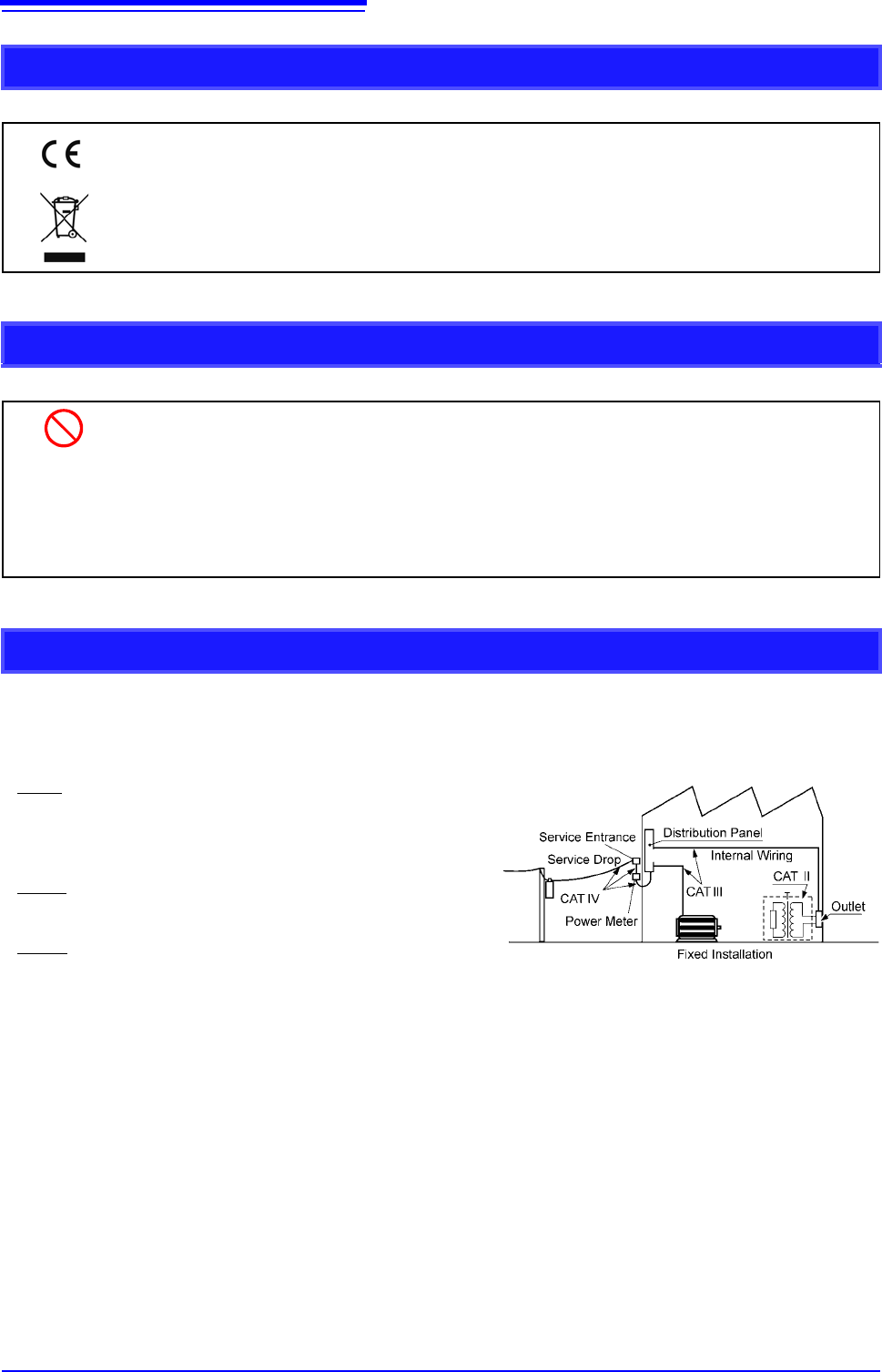
Measurement categories
This instrument complies with CAT II safety requirements.
To ensure safe operation of measurement instruments, IEC 61010 establishes safety standards for various electrical
environments, categorized as CAT II to CAT IV, and called measurement categories.
CAT II: Primary electrical circuits in equipment connected to an
AC electrical outlet by a power cord (portable tools,
household appliances, etc.)
CAT II covers directly measuring electrical outlet recep-
tacles.
CAT III
: Primary electrical circuits of heavy equipment (fixed
installations) connected directly to the distribution panel,
and feeders from the distribution panel to outlets.
CAT IV
: The circuit from the service drop to the service entrance,
and to the power meter and primary overcurrent
protection device (distribution panel).
Using a measurement instrument in an environment designated with a higher-numbered category than that for which
the instrument is rated could result in a severe accident, and must be carefully avoided.
Use of a measurement instrument that is not CAT-rated in CAT II to CAT IV measurement applications could result in
a severe accident, and must be carefully avoided.
Operating Precautions
5
Follow these precautions to ensure safe operation and to obtain the full benefits of the various
functions.
Be sure to observe the operating and storage temperature and humidity ranges specified for
the instrument:
• Operating temperature and humidity: 0°C to 40°C, 40% to 80% RH (non-condensing)
• Storage temperature and humidity: -20°C to 55°C, 10% to 80% RH (non-condensing)
The instrument should be installed on a level surface. Use of the device on an inclined sur-
face may prevent readings from being properly recorded or recording paper from folding prop-
erly.
Operating Precautions
Preliminary Checks
• Before using the instrument for the first time, verify that it operates normally to
ensure that no damage occurred during storage or shipping. If you find any dam-
age, contact your dealer or Hioki representative.
• Before using the instrument make sure that the insulation on the power cord is
undamaged and that no bare conductors are improperly exposed. Using the instru-
ment in such conditions could cause an electric shock, so contact your dealer or
Hioki representative for repair.
• Before using the instrument, make sure that the insulation on cables is undamaged
and that no bare conductors are improperly exposed. Avoid using any cables
showing damage as they may cause electric shock.
Instrument Installation
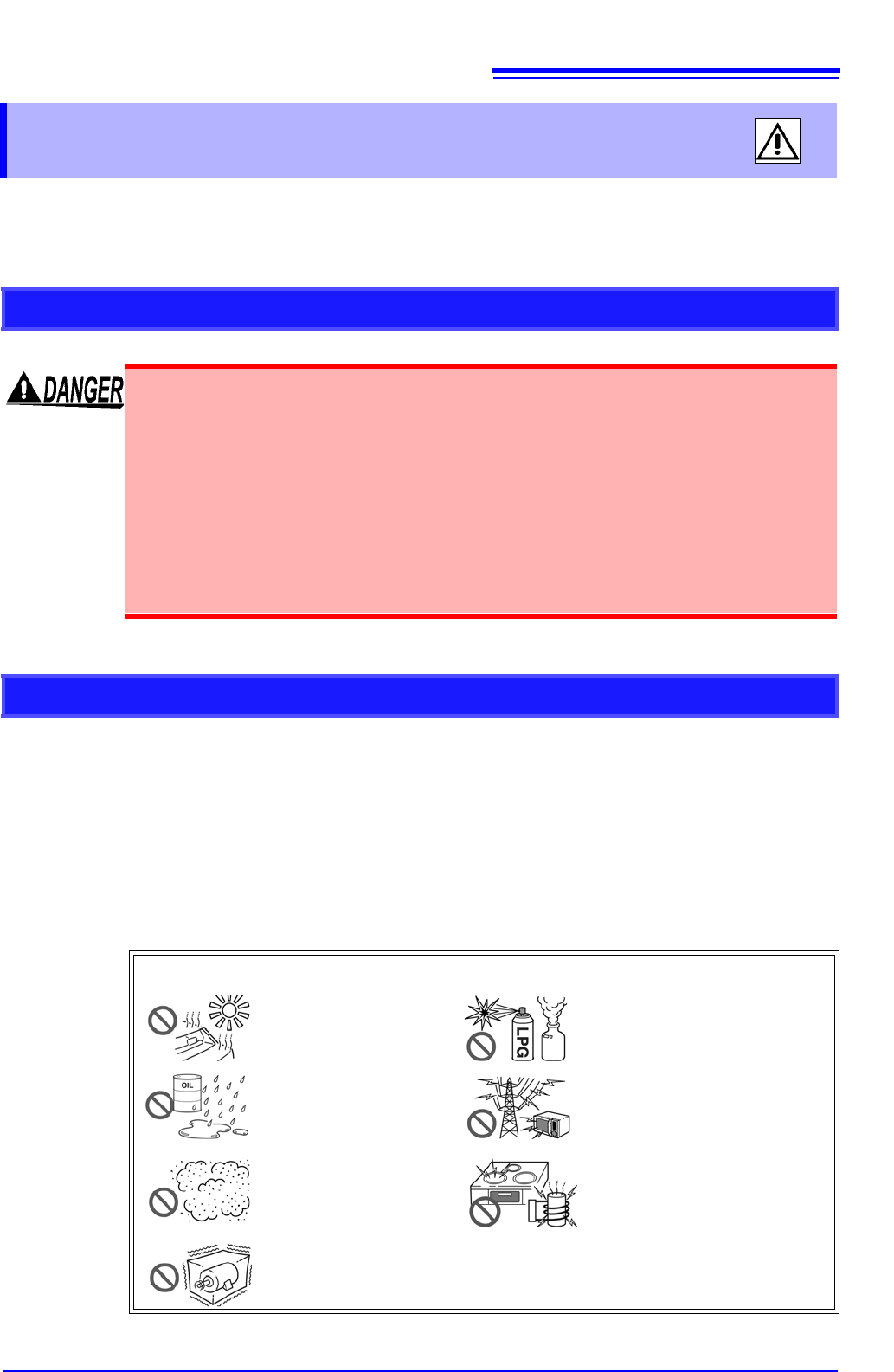
Avoid the following locations that could cause an accident or damage to the instrument.
Exposed to direct sunlight
Exposed to high tempera-
ture
In the presence of corrosive or ex-
plosive gases
Exposed to water, oil, other
chemicals, or solvents
Exposed to high humidity
or condensation
Exposed to strong electromag-
netic fields
Near electromagnetic radiators
Exposed to high levels of
particulate dust
Near induction heating systems
(e.g., high-frequency induction
heating systems and IH cooking
utensils)
Subject to vibration
Operating Precautions
6
Handling the Instrument
• Do not allow the instrument to get wet, and do not take measurements with wet
hands. This may cause an electric shock.
• Do not attempt to modify, disassemble or repair the instrument; as fire, electric
shock and injury could result.
• To avoid damage to the instrument, protect it from physical shock when transporting and
handling. Be especially careful to avoid physical shock from dropping.
• Do not slant the device or place it on top of an uneven surface. Dropping or knocking
down the device can cause injury or damage to the device. Install the instrument on a
level surface.
• Do not install the instrument with any side except the bottom facing down. This may
cause a fire or other malfunction in the instrument.
• Exercise care to keep water droplets from accumulating on or getting into the instrument.
Failure to do so may cause the instrument to malfunction.
Handling pens and recording paper
• Use only genuine Hioki pens and recording paper (p. 33).
• Do not touch pens while recording is in progress.
• Do not use damp recording paper. Doing so may cause the instrument to malfunction.
• Do not reuse recording paper. Doing so may cause the paper to misfeed.
When using fanfold paper
• Ink may run at fold lines. If this running is unacceptable, please use roll paper.
• Paper may not fold properly when used in a very hot, humid environment or when record-
ing waveforms that cover a large percentage of the page. It is recommended to use roll
paper for such applications.
This product may cause interference if used in residential areas. Such use must be avoided
unless the user takes special measures to reduce electromagnetic emissions to prevent
interference to the reception of radio and television broadcasts.
Handling the Cords and Cables
• Avoid stepping on or pinching cables, which could damage the cable insulation.
• To avoid instrument malfunction or damage due to broken connections, do not bend or
pull on the power cord or cables at their base.