PR8111、PR8112_user_manual_eng_20191015H.pdf - 第9页
Operating Precautions 6 Handling the Instrument • Do not allow the ins trument to get wet, and do not ta ke measurement s with wet hands. This may caus e an electr ic shock. • Do not attempt to modify , disassemble or re…
Operating Precautions
5
Follow these precautions to ensure safe operation and to obtain the full benefits of the various
functions.
Be sure to observe the operating and storage temperature and humidity ranges specified for
the instrument:
• Operating temperature and humidity: 0°C to 40°C, 40% to 80% RH (non-condensing)
• Storage temperature and humidity: -20°C to 55°C, 10% to 80% RH (non-condensing)
The instrument should be installed on a level surface. Use of the device on an inclined sur-
face may prevent readings from being properly recorded or recording paper from folding prop-
erly.
Operating Precautions
Preliminary Checks
• Before using the instrument for the first time, verify that it operates normally to
ensure that no damage occurred during storage or shipping. If you find any dam-
age, contact your dealer or Hioki representative.
• Before using the instrument make sure that the insulation on the power cord is
undamaged and that no bare conductors are improperly exposed. Using the instru-
ment in such conditions could cause an electric shock, so contact your dealer or
Hioki representative for repair.
• Before using the instrument, make sure that the insulation on cables is undamaged
and that no bare conductors are improperly exposed. Avoid using any cables
showing damage as they may cause electric shock.
Instrument Installation
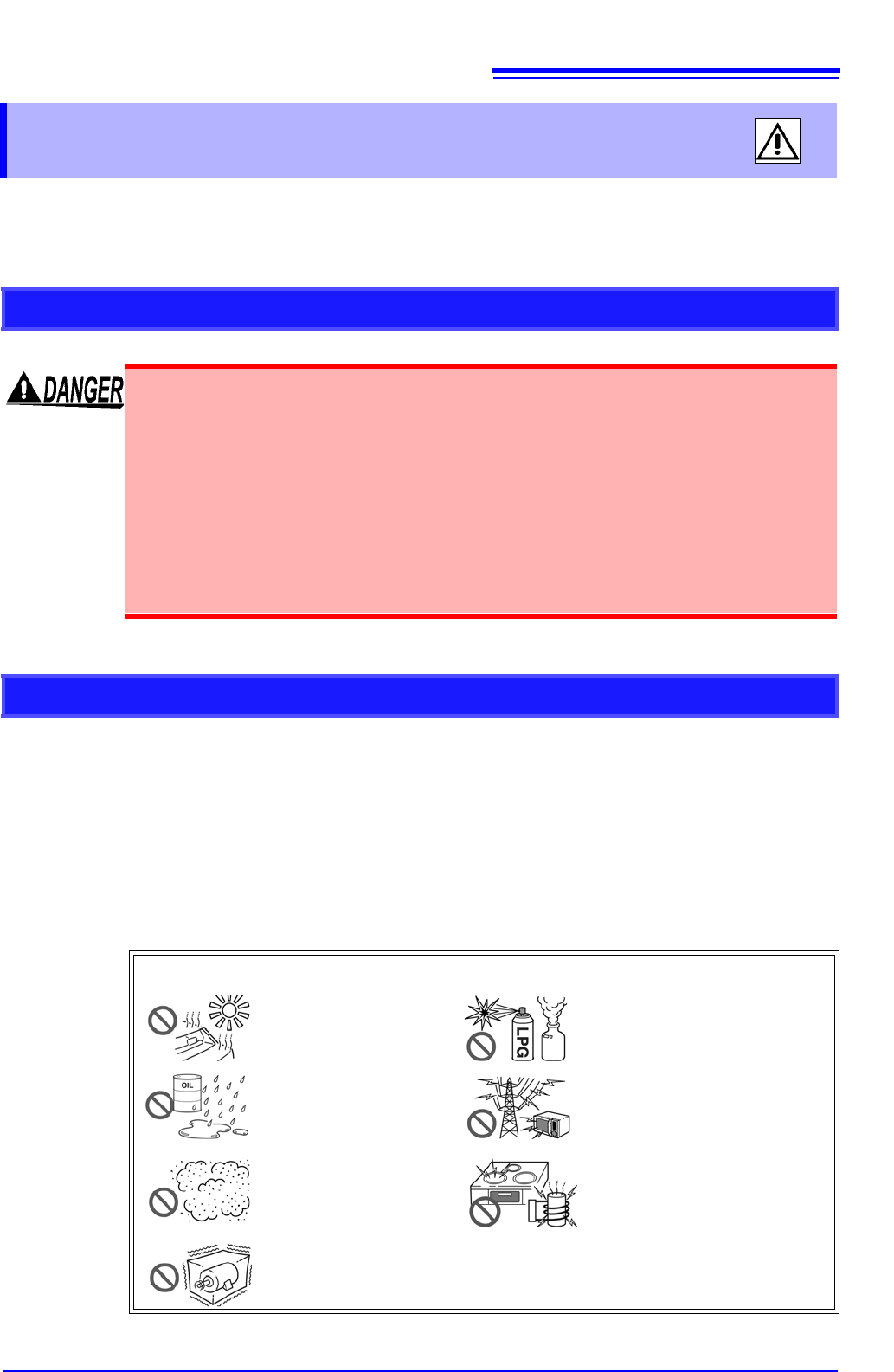
Avoid the following locations that could cause an accident or damage to the instrument.
Exposed to direct sunlight
Exposed to high tempera-
ture
In the presence of corrosive or ex-
plosive gases
Exposed to water, oil, other
chemicals, or solvents
Exposed to high humidity
or condensation
Exposed to strong electromag-
netic fields
Near electromagnetic radiators
Exposed to high levels of
particulate dust
Near induction heating systems
(e.g., high-frequency induction
heating systems and IH cooking
utensils)
Subject to vibration
Operating Precautions
6
Handling the Instrument
• Do not allow the instrument to get wet, and do not take measurements with wet
hands. This may cause an electric shock.
• Do not attempt to modify, disassemble or repair the instrument; as fire, electric
shock and injury could result.
• To avoid damage to the instrument, protect it from physical shock when transporting and
handling. Be especially careful to avoid physical shock from dropping.
• Do not slant the device or place it on top of an uneven surface. Dropping or knocking
down the device can cause injury or damage to the device. Install the instrument on a
level surface.
• Do not install the instrument with any side except the bottom facing down. This may
cause a fire or other malfunction in the instrument.
• Exercise care to keep water droplets from accumulating on or getting into the instrument.
Failure to do so may cause the instrument to malfunction.
Handling pens and recording paper
• Use only genuine Hioki pens and recording paper (p. 33).
• Do not touch pens while recording is in progress.
• Do not use damp recording paper. Doing so may cause the instrument to malfunction.
• Do not reuse recording paper. Doing so may cause the paper to misfeed.
When using fanfold paper
• Ink may run at fold lines. If this running is unacceptable, please use roll paper.
• Paper may not fold properly when used in a very hot, humid environment or when record-
ing waveforms that cover a large percentage of the page. It is recommended to use roll
paper for such applications.
This product may cause interference if used in residential areas. Such use must be avoided
unless the user takes special measures to reduce electromagnetic emissions to prevent
interference to the reception of radio and television broadcasts.
Handling the Cords and Cables
• Avoid stepping on or pinching cables, which could damage the cable insulation.
• To avoid instrument malfunction or damage due to broken connections, do not bend or
pull on the power cord or cables at their base.
Operating Precautions
7
How to install batteries: "Installing Alkaline Batteries" (p. 17)
How to connect the adapter:"Connecting the AC adapter" (p. 18)
If you connect the AC adapter while batteries are installed in the instrument, the AC
adapter takes precedence.
Using the Batteries
• To avoid electric shock, turn off the POWER switch and disconnect the AC adapter
and connection cables before replacing the batteries.
• After replacing the batteries, replace the cover and screws before using the instru-
ment.
• Battery may explode if mistreated. Do not short-circuit, recharge, disassemble or
dispose of in fire.
• Handle and dispose of batteries in accordance with local regulations.
• Keep batteries away from children
• Do not mix old and new batteries, or different types of batteries. Also, be careful to
observe battery polarity during installation. Otherwise, poor performance or damage from
battery leakage could result.
• Use only the specified type of battery (six LR20 alkaline batteries).
• To avoid corrosion and damage to this instrument from battery leakage, remove the bat-
teries from the instrument if it is to be stored for a long time (for a month).
• After use, always turn OFF the power.
• You can check the remaining battery life with the LED on the left side of the instrument. (p.
10)
Using the AC Adapter
• Use only the supplied Model 9418-15 AC Adapter. AC adapter input voltage range is
100 to 240 VAC (with ±10% stability) at 50/60 Hz. To avoid electrical hazards and
damage to the instrument, do not apply voltage outside of this range.
• To avoid electrical accidents and to maintain the safety specifications of this instru-
ment, connect the power cord provided only to a 3-contact (two-conductor +
ground) outlet.
• Turn the instrument off before connecting the AC adapter to the instrument and to
AC power.
• Before turning the instrument on, make sure the supply voltage matches that indi-
cated on the AC adapter. Connection to an improper supply voltage may damage
the instrument or AC adapter and present an electrical hazard.
• For safety reasons, disconnect the power cord when the instrument is not used and
before connecting it to a device to be tested.
• To avoid damaging the power cord, grasp the plug, not the cord, when unplugging it from
the power outlet.