00192975-01.pdf - 第72页
Power supply S-20/S-23HM/F4/F5/F5H M/S-25HM/HS-50 Conversion Instruct ions 2.1 Safety instructions 03/2001 Edition 72 2 Safety check to DIN EN 60 204 The sa fety che ck comp rises: 2 – insul ation test – high -voltage te…
S-20/S-23HM/F4/F5/F5HM/S-25HM/HS-50 Conversion Instructions Power supply
03/2001 Edition 1 Safety instructions
71
1 Safety instructions
RISK OF DEATH 1
The power supply must only be converted by SIEMENS engineers or suitably qualified personnel,
e.g. specialist electricians.
A specialist electrician is anyone who has sufficient technical training, knowledge and experience,
and knowledge of the relevant standards, to be able to assess and recognize the dangers inherent
in the work assigned to them (explanatory notes to DIN VDE 0105 part 1 (07.83), DKE authors’
committee 224). 1
(1) Always follow the accident prevention regulations applicable in your country, e.g. EN 60.204.
(2) End all placement operations on the placement system.
– If an uninterruptible power supply (UPS) is installed on the machine, continue from point (3).
– If the machine does not have an uninterruptible power supply (UPS), shut down the
Windows NT operating system correctly, otherwise you may experience problems or lose
data when the machine is restarted.
(3) Switch the placement system off at the main switch.
(4) Disconnect the main power cable from the main power supply.
(5) Secure the main power cable to prevent reconnection to the main power supply.
(6) Secure the system to prevent reclosing and put up a sign to indicate that servicing work is
being carried out (see section 2 'Operational safety' in the operating instructions).
(7) When the conversion is complete, carry out a safety check (see section 2 'Safety check to
DIN EN 60 204').
PLEASE NOTE: 1
The safety check to DIN EN 60 204 applies to European Union countries. Individual country-
specific regulations should be followed in all countries outside the EU. This also applies to
the warning signs and means of securing that are used during conversion and the safety
check. 1
Power supply S-20/S-23HM/F4/F5/F5HM/S-25HM/HS-50 Conversion Instructions
2.1 Safety instructions 03/2001 Edition
72
2 Safety check to DIN EN 60 204
The safety check comprises: 2
– insulation test
– high-voltage test and
– PE conductor test on the machines and components.
2
To protect the test set-up, you will need 2
– a barrier chain
– a red flashing light to signal the high-voltage tests
– country-specific warning and identification signs to draw attention to the fact that work and
high-voltage tests are being carried out on the electrical system.
2.1 Safety instructions
RISK OF DEATH 2
Å Make sure that no unauthorized persons can come into contact with any parts of the machine.
Å Secure the testing area with a barrier chain and warning signs.
Å Also switch on a red flashing light during the high-voltage test.
Å House the electrical points of contact between the test device and test piece in a distributor box
with protective hood.
Å Make sure that the protective hood remains closed during the test.
Å Monitor opening of the protective hood with a circuit-breaker.
The circuit-breaker must be incorporated into the safety circuit of the high-voltage testing
device so that the high voltage is switched off immediately if the protective hood is opened.
2.2 Testing equipment
2.2.1 Three-phase AC socket with connecting cable for the insulation and high-voltage
test
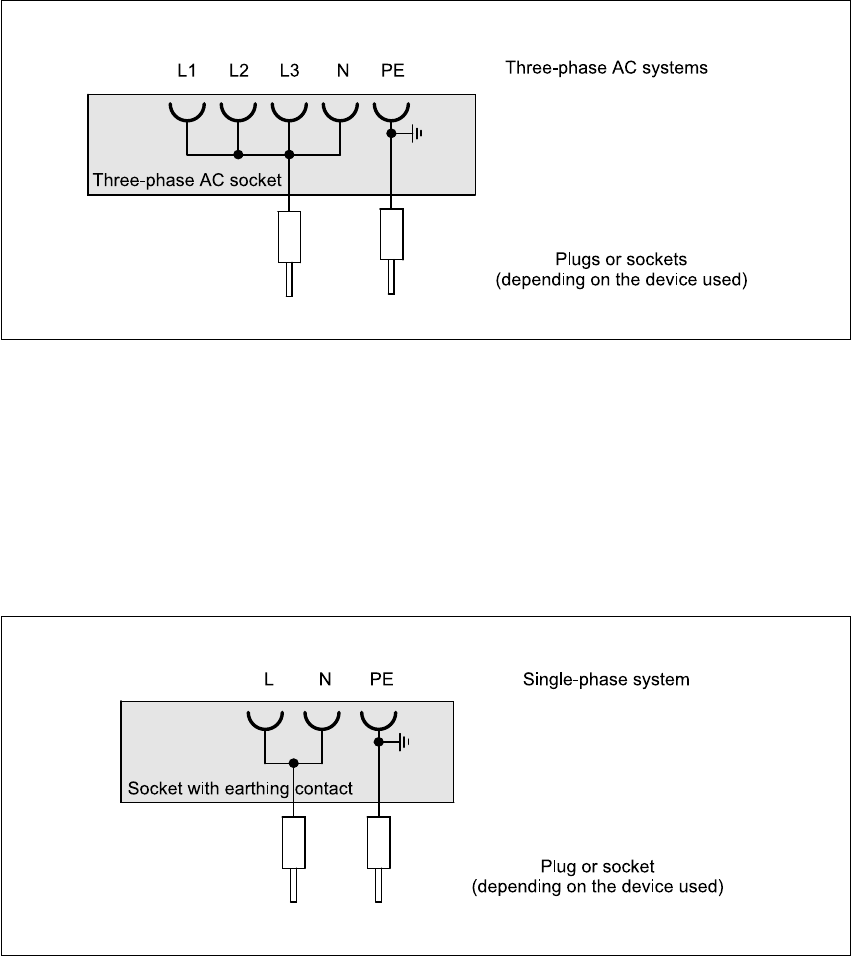
For the insulation and high-voltage tests, you will need a three-phase AC socket with connecting
cable as shown in the following drawing. This is used to electrically connect the test piece to the
S-20/S-23HM/F4/F5/F5HM/S-25HM/HS-50 Conversion Instructions Power supply
03/2001 Edition 2 Safety check to DIN EN 60 204
73
testing device in the distributor box. The ends of the cables may be plugs or sockets, depending
on the type of connection. 2
Fig. 2 - 1 Three-phase AC socket for the insulation and high-voltage test
2.2.2 Socket with earthing contact and connecting cable for the insulation and
high-voltage test
For the insulation and high-voltage tests, you will need a socket with earthing contact and a
connecting cable as shown in the following drawing. This is used to electrically connect the test
piece to the testing device in the distributor box. The ends of the cable may be
plugs or sockets, depending on the type of connection. 2
Fig. 2 - 2 Socket with earthing contact for the insulation and high-voltage test
2.2.3 Distribution box for the insulation and high-voltage test
A distributor box with protective hood is required for the electrical connection between the test
device and test piece. When the protective hood is closed, the circuit-breaker in the distributor box
closes the safety circuit of the testing device. If the protective hood is opened, the protective hood
switch interrupts the safety circuit, immediately disconnecting the high voltage used for the test. 2