00198365-03_UM_JTF-ML2_TX12_V1-V2_EN.pdf - 第20页
2 Operational safety 2.3 Safety features 20 User Manual SIPLACE TX V1/V2 Series JEDEC Tray Feeder (JTF-ML2) 11/2019 2.3 Safety features Fig.13: Door and covers To prevent injuries, there are one door and various safety …
2 Operational safety
2.2 Warning labels
User Manual SIPLACE TX V1/V2 Series JEDEC Tray Feeder (JTF-ML2) 11/2019 19
2.2.2 Warning, Prohibition and Cautionary Labels
WARNING
Damage to warning labels
Incorrect cleaning can damage the warning labels.
ü Using the correct cleaning agents.
► Do not use abrasive cleaners or solvents for cleaning warning labels.
► Replace any damaged or illegible warning labels.
► Verify that the warning labels are positioned correctly.
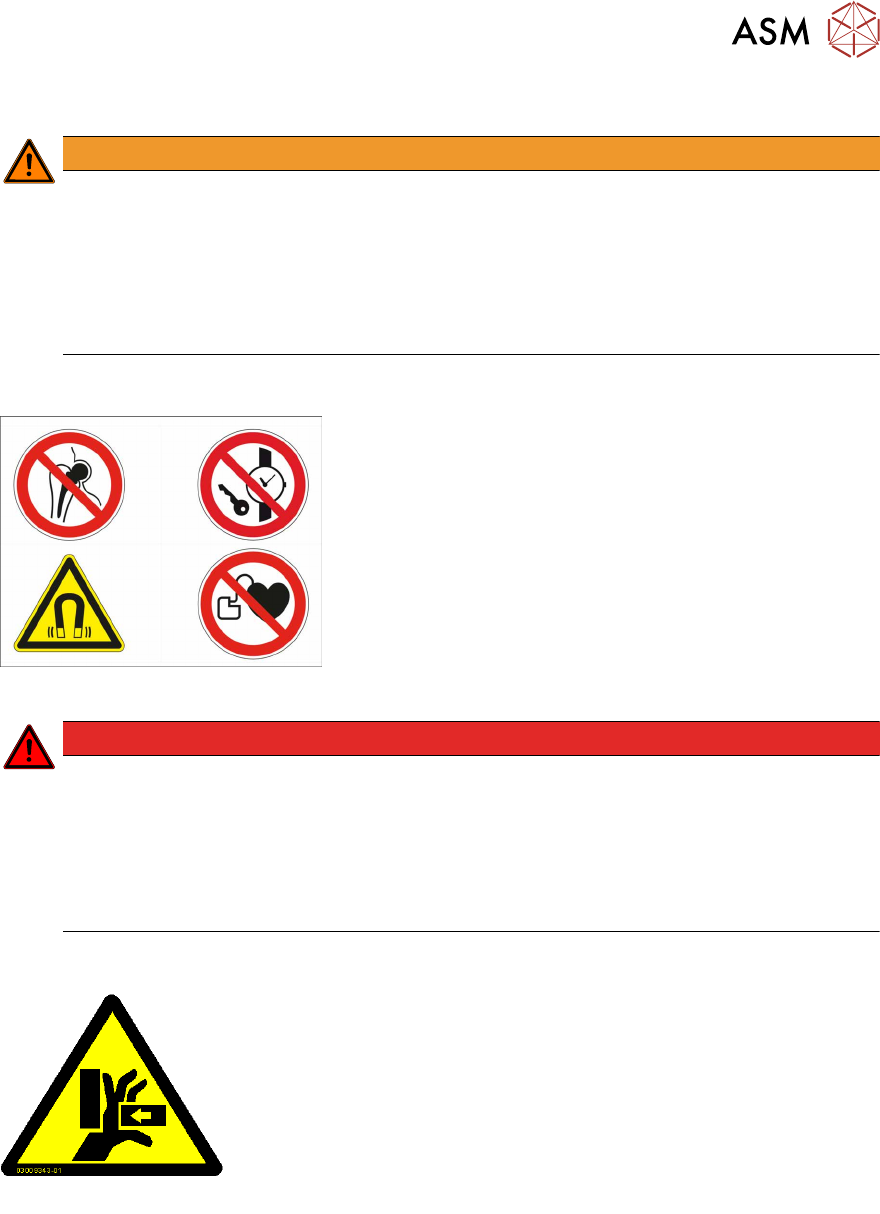
2.2.3 GB 2894 Warning Label 202
Fig.11: GB 2894 warning label 202
Danger to life from powerful magnetic fields inside the
machine!
Forbidden for persons with pacemakers, implants and mag-
netic items on the body
Item no. 03159867‑xx
DANGER
Danger to life from powerful magnetic fields inside the machine!
The life of persons with the following passive or active implants is put at risk:
‒ Pacemakers,
‒ Defibrillators,
‒ Insulin pumps, etc.
► At-risk people must not stand in the immediate vicinity of the machine.
2.2.4 Warning label W204
Fig.12: Warning label W204
DANGER OF CRUSHING!
Reaching in here can lead to injuries to the arms and hands.
Do not reach into the machine while it is running
Item no. 03009343-xx
2 Operational safety
2.3 Safety features
20 User Manual SIPLACE TX V1/V2 Series JEDEC Tray Feeder (JTF-ML2) 11/2019
2.3 Safety features
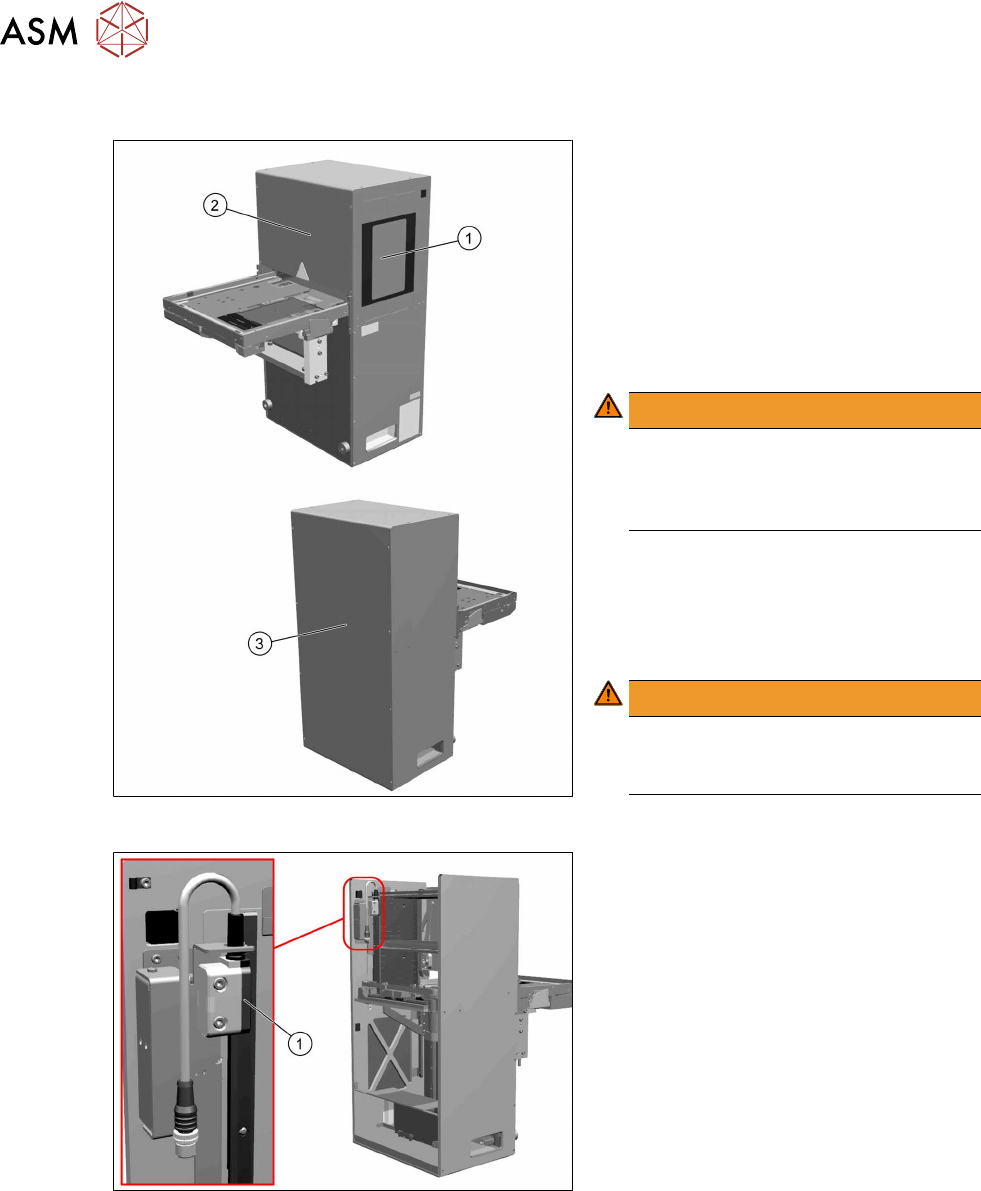
Fig.13: Door and covers
To prevent injuries, there are one door and
various safety covers attached to the
SIPLACE JTF‑ML2.
The door(1) on the SIPLACE JTF‑ML2 is
locked during operation.
When the cassettes need to be changed,
the door can be unlocked using the station
software. The SIPLACE JTF-ML2 is inactive
then and all motors are stopped.
WARNING!
Door
It is not allowed to operate the
SIPLACE JTF‑ML2 without or with
open door.
.
The SIPLACE JTF-ML2 has several covers.
Do not remove these.
(2) Front cover
(3) Back and top cover
WARNING!
Covers
It is not allowed to operate the
SIPLACE JTF-ML2 without covers.
.
Fig.14: Safety protective switch and actuator
Safety protective switch and actuator (1)
This switch is to monitor safety loop signal
from TX machine and detect opening of the
door. If either signal is opened, door switch
contact will be opened and de-energized
safety relay output. Power supply to all mo-
tors will be cut-off.

2 Operational safety
2.4 ESD guidelines
User Manual SIPLACE TX V1/V2 Series JEDEC Tray Feeder (JTF-ML2) 11/2019 21
2.4 ESD guidelines
2.4.1 What does ESD mean?
Fig.15: ESD label
Almost all of the modules in use today are equipped with highly integ-
rated Metal-Oxide-Semiconductor (MOS) blocks and components.
The manufacturing techniques used mean that these electronic com-
ponents are extremely sensitive to overvoltage and thus to electro-
static discharge.
The abbreviation for such modules is "ESD" (Electrostatic Sensitive
Device). "ESD" is used internationally. The following symbol on cab-
inet rating plates, racks or packaging indicates that components
which are sensitive to electrostatic discharge have been used and
thus that the modules concerned are also touch-sensitive.
ESDs can be destroyed by voltages and power levels that are far below the level that can be per-
ceived by humans. Such voltages occur if a person touches a component or module without
earthing themselves. Components that are exposed to such overvoltages do not generally appear
to be defective immediately - incorrect behavior starts after the component or module has been in
operation for some time.
2.4.2 Important measures to protect against static charging
► Most plastics can easily become charged and must therefore be kept away from at-risk com-
ponents.
► Always ensure that people, the workplace and packaging are safely earthed when handling
electrostatic sensitive components.
2.4.3 Handling ESD modules
As a general rule: Only touch electronic modules if you must carry out work on the modules. In that
case, make sure that you do not touch the pins or printed conductors when you pick up flat mod-
ules.
Only touch components if you are earthed by one of the following measures:
●
You are wearing an ESD wristband.
●
You are wearing ESD shoes.
●
You are wearing ESD shoe earthing strips on an ESD floor.
Immediately before you touch an electronic module, discharge your own body by touching a con-
ductive and earthed object (such as unpainted parts of a switch cabinet, a water pipe, etc.).
Do not allow modules with chargeable and highly insulating materials to touch one another, e.g.
plastic films, insulating table surfaces or items of clothing made from synthetic fibers.
Always place the modules on a conductive surface (table with an ESD coating, conductive ESD
foam, ESD bag or container).
Do not move the assemblies near to data view devices, monitors or television units. Keep a min-
imum distance of 10 cm to monitors.
2.4.4 Measurements and modifications to ESD modules
Only perform measurements on modules if one of the following conditions is fulfilled:
●
You are using an earthed measuring device (e.g. via PE conductors)
●
You are using a potential-free measuring device and discharge the measuring head before
the measurement (e.g.by touching an unpainted metal part of the controller casing).
► Always use an earthed soldering iron if you carry out any soldering work.