YG200_YG200L_Mainte_E.pdf - 第40页
Chapter 3 Periodic maintenance items Contents 1 . We e k l y o r b i w e e k l y i n s p e c t i o n 3 - 1 1 . 1 C l e a n i n g " T y p e A " n o z z l e s 3 - 1 1 . 2 C l e a n i n g T y p e F n o z z l e s 3…
2-7
2
Daily maintenance items
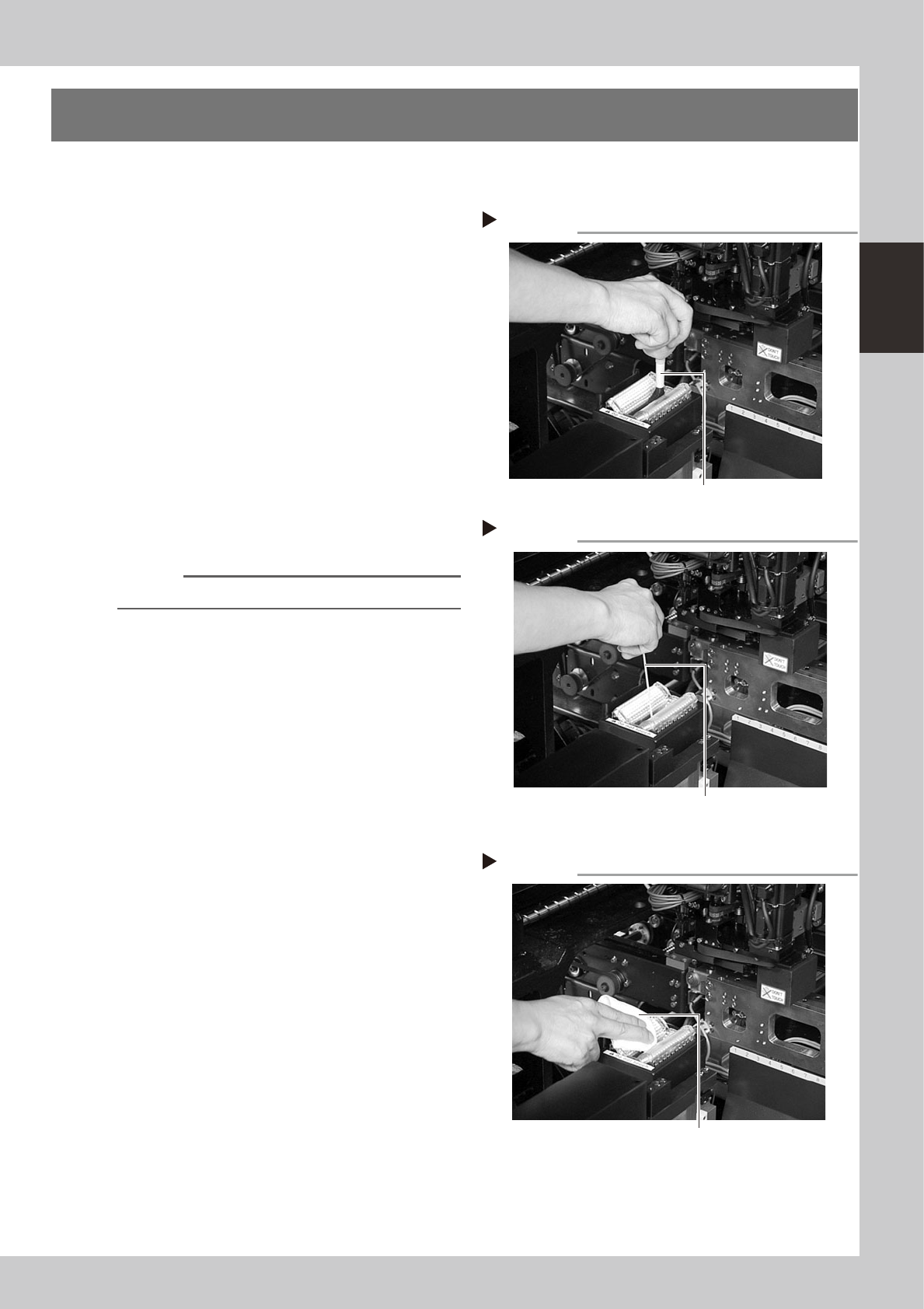
5. Cleaning the camera lighting unit
Dirt or dust particles sticking to the camera lighting unit can cause recognition errors. Periodic inspection
and cleaning are recommended to prevent this problem.
1
Remove dust by using the lens blow
brush.
Use the blow brush to remove dust from the
camera lighting unit and half mirror.
53205-F8-00
2
Wipe off the half mirror using a
cotton swab stick.
Apply several drops of lens cleaner to a
cotton swab and wipe off the half mirror.
53206-F8-00
3
Wipe off the camera lighting unit
with a cleaning paper or cloth.
Apply several drops of lens cleaner to a
cleaning paper or cloth and wipe off the
camera lighting unit.
53207-F8-00
n
NOTE
Use lint-free cleaning cloth or wipes.
Lens blow brush
Step 1
Lens blow brush
Cotton swab stick
Step 2
Cotton swab stick with lens
cleaner applied
Cleaning paper or cloth
Step 3
Use lint-free cleaning cloth or wipes.

Chapter 3 Periodic maintenance items
Contents
1. Weekly or biweekly inspection 3-1
1.1 Cleaning "Type A" nozzles 3-1
1.2 Cleaning Type F nozzles 3-
3
1.2.1 Removing the FNC nozzle assembly 3-3
1.2.2 Cleaning the FNC nozzle assembly 3-
5
1.2.3 Reassembling the FNC nozzle assembly. 3-1
0
1.3 Inspecting ball screws and linear guides of each axis 3-13
2. Monthly or bimonthly inspection 3-14
2.1 Cleaning and lubricating a nozzle holder 3-14
2.2
Cleaning and greasing the X, Y, YT and W axis ball screws
3-16
2.3
Cleaning and greasing the X, Y, YT and W axis linear guides
3-18
2.4 Inspecting and cleaning the air/mist filters 3-2
0
2.5 Cleaning the camera lens 3-2
2
3. Six-month or one-year inspection 3-23
3.1 Cleaning and replacing the ejector filter 3-23
3.2 Cleaning the spline shaft 3-2
4
3.2.1 Removing the standard nozzles 3-24
3.2.2 Cleaning the spline shaft 3-24
3.2.3
Attaching the nozzle, lubricating and checking negative pressure
3-27
3.3 FNC lock pin 3-29
3.3.1 Removing FNC lock pin 3-29
3.3.2 Cleaning and reassembling the FNC lock pin 3-32
3-1
3
Periodic maintenance items
1. Weekly or biweekly inspection
Inspect and clean the nozzles weekly or biweekly as explained below.
1.1 Cleaning "Type A" nozzles
If solder adheres to a nozzle tip, the nozzle may be mistaken for a component or other problems may occur. If
nozzle spring-action is poor, pickup errors tend to occur frequently. To prevent these troubles, check the nozzle
condition and keep the nozzles clean.
e
1
Remove the nozzle from the head.
Always first press the emergency stop button
and then remove the nozzle from the head.
The machine must be in emergency stop to
ensure safety during work.
c
CAUTION
When the machine is equipped with a nozzle station,
make sure that the nozzles are returned to the nozzle
station.
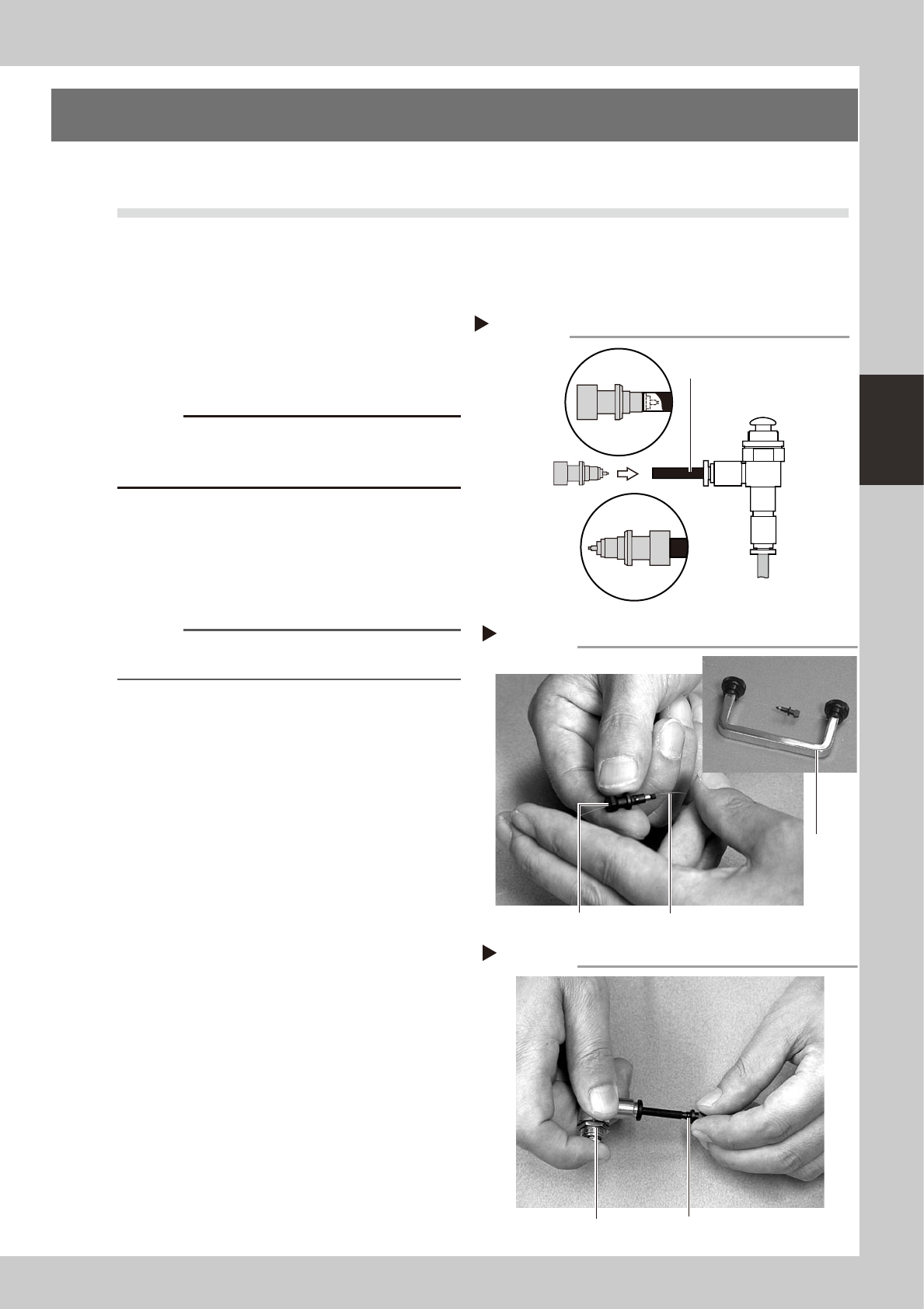
2
Blow air through the nozzle.
Using an air blow gun, blow air through the
nozzle from the nozzle tip and then from the
other end.
53300-F8-00
n
NOTE
If there are dust deposits in the nozzle, perform steps 3
and 4.
3
Clean the nozzle hole.
Pass the nozzle cleaning wire through the
nozzle hole and clean the nozzle hole. While
holding both ends of the wire with fingers as
shown or using a custom handle, gently
move the nozzle back and forth.
53301-F8-00
4
Blow air through the nozzle again.
After removing the cleaning wire, blow air
through the nozzle with the air blow gun, just
as in step 2.
53302-F8-00
5
Clean the slide section.
Apply IPA (isoprophyl alcohol) or ethanol to
the slide section. Push the nozzle tip several
times to repeat the buffing action (spring
action) to clean the slide section. After
cleaning, blow sufficient air to remove IPA or
ethanol.
Cleaning a nozzle
Step 3
Custom
handle
Nozzle
Nozzle cleaning wire
Air blow
Step 4
Nozzle
Air blow gun
Step 2
Air tube (black)
Air blow gun
(option)
Air tube (orange) connected to
air supply port
Air blow
Insert the
nozzle tip into
the air tube and
blow air.
Blow air from the
nozzle attachment
side.