wire-bonder.pdf - 第13页
WEST•BOND MODEL 454647E SER IES INSTRUCTION MANUAL 7 ACCESSORY DESCRIPTIONS -45G.353 Free Furnac e Workholder: 2" x 2" substrates, mechanical clamp, adjustable backsto p, cavity inert atmosphere. With 2" x…
WEST•BOND MODEL 454647E SERIES INSTRUCTION MANUAL
6
ACCESSORY DESCRIPTIONS
The specifications define Features that add additional capabilities or utilities to the basic machine models,
and cross reference those models with which the Features may be combined.
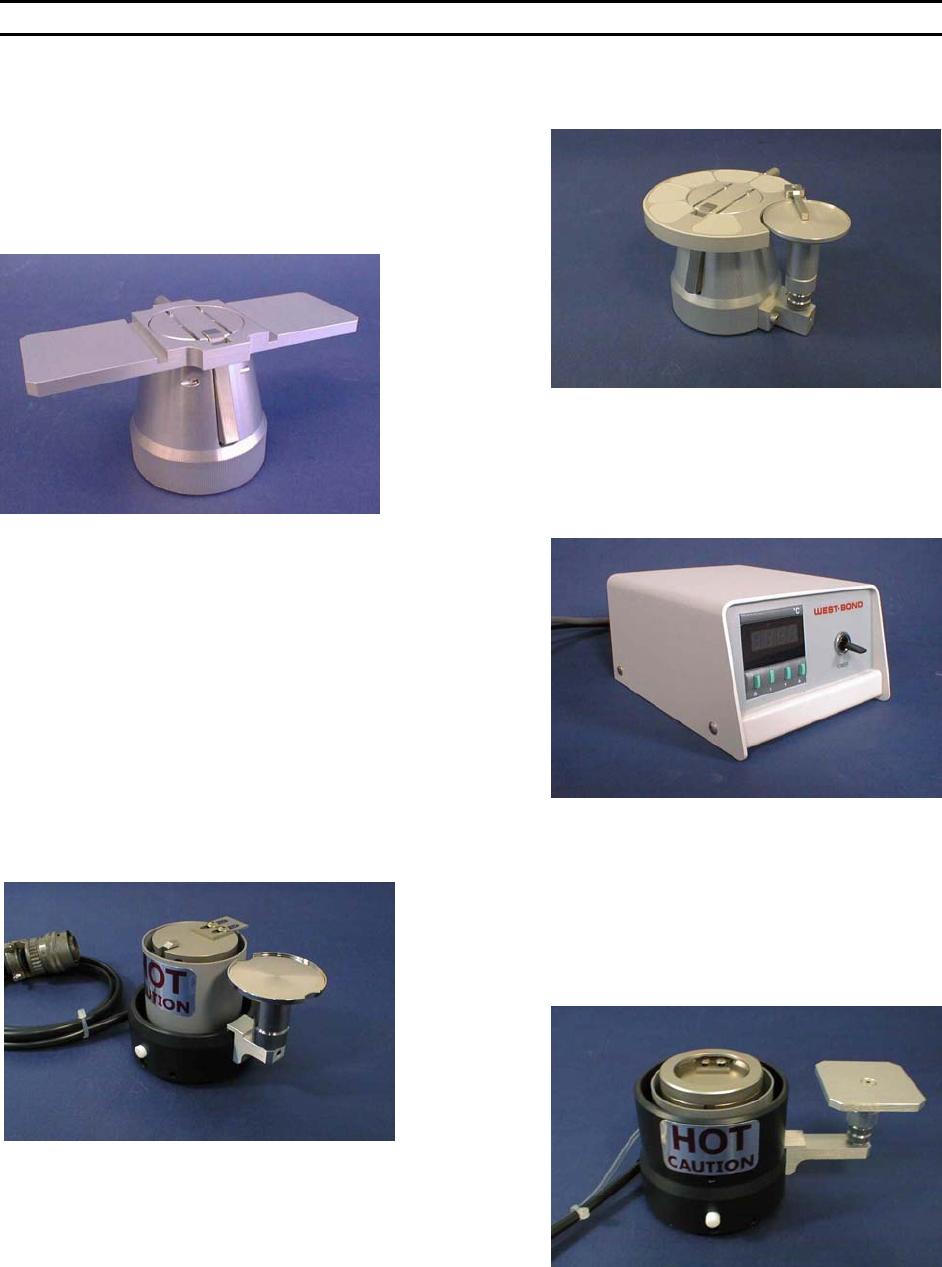
Non Heated Workholder: Non-rotating Epoxy Transfer &
Die Placement workholder for substrates up to 1.000" x
1.000", with mechanical clamp and adjustable back rails:
Assembly No. 3600.018
Non Heated Workholder: Non-rotating workholder for
substrates up to 1.000" x 1.000". Work piece is held by
mechanical clamp, with 2 Position, 2.000" x 2.000"
fluoroware supports. Assembly No. 3600.220
K~1200D, Temperature Controller: A 400 watt
microprocessor-based Temperature Controller provides
precise control with a minimum of set-up. The K~1200D is
a programmable controller linked to the workholder heating
elements through two solid state relays. The controller
offers flexibility, while the solid state relays offer
dependability. K~1201D is a 600 watts version for larger
applications.
Free Furnace Workholders:
This furnace is free in the sense that it is not connected to
the machine but may be readily inter-changed with the Free
Anvil normally used for ultrasonic bonding, giving
workpiece heat capability to any machines of the 4K, 5K or
7K Series.
-45C: Free Furnace Workholder: for substrates up to
1.000" x 1.000", mechanical clamp, adjustable backstop
with rotating die mirror presentation.
Assembly No. 3800.009
-45C.358 Free Furnace Workholder: for substrates up to
1.000" x 1.000", mechanical clamp, adjustable backstop,
with cavity inert atmosphere. Adjustable height, rotating
2.00" x 2.00" fluoroware support.
Assembly No. 3800.358
WEST•BOND MODEL 454647E SERIES INSTRUCTION MANUAL
7
ACCESSORY DESCRIPTIONS
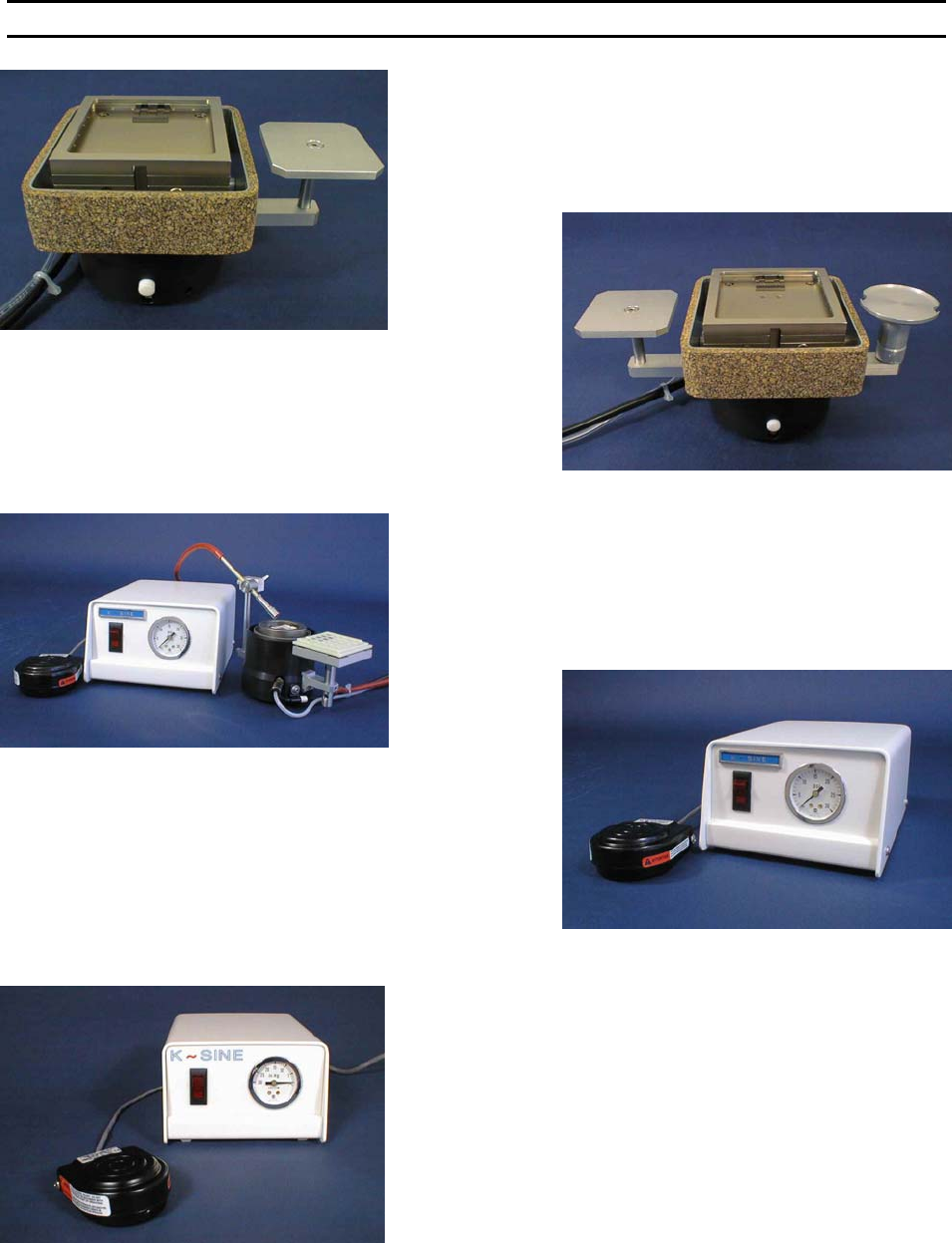
-45G.353 Free Furnace Workholder: 2" x 2" substrates,
mechanical clamp, adjustable backstop, cavity inert
atmosphere. With 2" x 2" fluoroware die presentation.
Assembly No. 3800.353
-45G.402 Free Furnace Workholder: 2" x 2" substrates,
mechanical clamp, adjustable backstop, cavity inert
atmosphere. With 2" x 2" fluoroware support and rotating die
mirror presentation.
Assembly No. 3800.402
K~1300 Gas Flow Assembly: Comprised of K~1310 Gas
Flow Control and K~1320 Laminar Flow Nozzle. Used to
compliment W
EST•BOND Cavity Inert Atmosphere Work
holders for Eutectic die attachment.
K~1310 Gas Flow Control: The operator, by means of an
on/off footswitch, releases the gas to the work area.
Immediately after the scrub cycle stops, the footswitch is
activated and the die is showered with cool forming gas. A
manual adjustment is provided to meter the amount of gas
to be released.
K~1311 Vacuum Flow Control: The operator, by means of
an Off/On footswitch, can disengage the vacuum to the
work area releasing the part to replace with another. A
vacuum gauge on the front of the control box displays the
pressure in inches of Mercury.

WEST•BOND MODEL 454647E SERIES INSTRUCTION MANUAL
8
CAUTIONS
Contained in this section are cautions to be observed during 454647E Installation and Operation.
Wiring
All machine wiring has common ground connected to machine chassis and continuous through the power
supply, cord and cord plug. Make sure the receptacle for this plug has a good ground connection.
Safety and Comfort
Some ergonomic studies suggest that long periods of repetitive motion may be traced to certain types of
physical discomfort leading to possible injury. We have compiled specific instructions herewith to
minimize your chances of experiencing carpal tunnel syndrome (CTS), tendonitis, and tenosynovitis.
It is recommended that your work environment be comfortable for your work situation. A carefully
planned work environment can actually increase productivity. W
EST•BOND recommends that you adopt
the following steps for a healthy physical and mental approach to your work.
Exercises
Many motor oil-manufacturing companies often claim that your car engine is most subject to wear and
tear when you first start it up in the morning. This is due to the lack of oil on the metal bearing surfaces
offering protection when the car is first started. To a great extent, the same can be said for the tendons,
bones, and joints that form your body. In the early morning hours, your body tends to retain fluid from its
over night rest, and the first time these tendons and joints are put to use, there is often a feeling of
stiffness and tightness, and when utilized in an abrupt fashion, can often lead to inflammation and at
times injury.
Therefore, it is considered appropriate if not mandatory for most people engaged in physical activities
such as sports or heavy labor, such as construction, to perform a variety of warm-up exercises before
beginning their job. We have found the same philosophies and many of these same exercises just as
beneficial for those individuals who are placed in a seated position for long periods of time where they
utilize primarily their upper extremities, and most importantly, their hands and wrists.
We are therefore, suggesting the following gentle warm-up program to be done by you before leaving for
work. Begin by gently tilting your head both to the right and left side, to the point of comfortable tension.
Next, tilt your head forward and backward, and lastly, turn your head both to the left and to the right.
Each of these positions is taken to the end of their natural range of motion and held for a brief period of
time. Do not take any of these movements beyond the point of comfort.
Next, for the shoulders, perform a series of simple, slow, shoulder circles in both a forward and backward
direction. Five to ten repetitions in each direction should be enough to warm up the shoulder
musculature.
Next, while standing, lift your arms laterally out to the side, away from your body and over your head.
Repeat this motion five times. For added benefit, make large, wrist circles with your hands while your
arms are overhead.
Lastly, and possibly most importantly, it is important that you carefully flex and extend your wrist prior to
beginning your workday. Using the opposite hand to bend the wrist downward does this. This is best
done with the arm in a forward position with the elbow straight. To assist in wrist extension, lift your wrist
up, using the palm of the opposite hand, pressing against the fingers to assist in lifting the wrist. These
stretches are done only to the point of comfortable tension and are repeated with both hands.
These basic exercises will get you off to a good start in the morning and allow your drive to work to be
more comfortable and less likely to increase the tension and tightness in your upper back, shoulders and
hands.