252301 Issue 2.0.pdf - 第147页
GEM Manual for DEK Printers Additional Capabilities I ssue 2.0 June 9th, 2011 page 147 of 156 Transition Table: # Current State Trigger New State Action Initial Model Instantiated Disabled None 1 Disabled Verification En…
GEM Manual for DEK Printers Additional Capabilities
Issue 2.0 June 9th, 2011 page 146 of 156
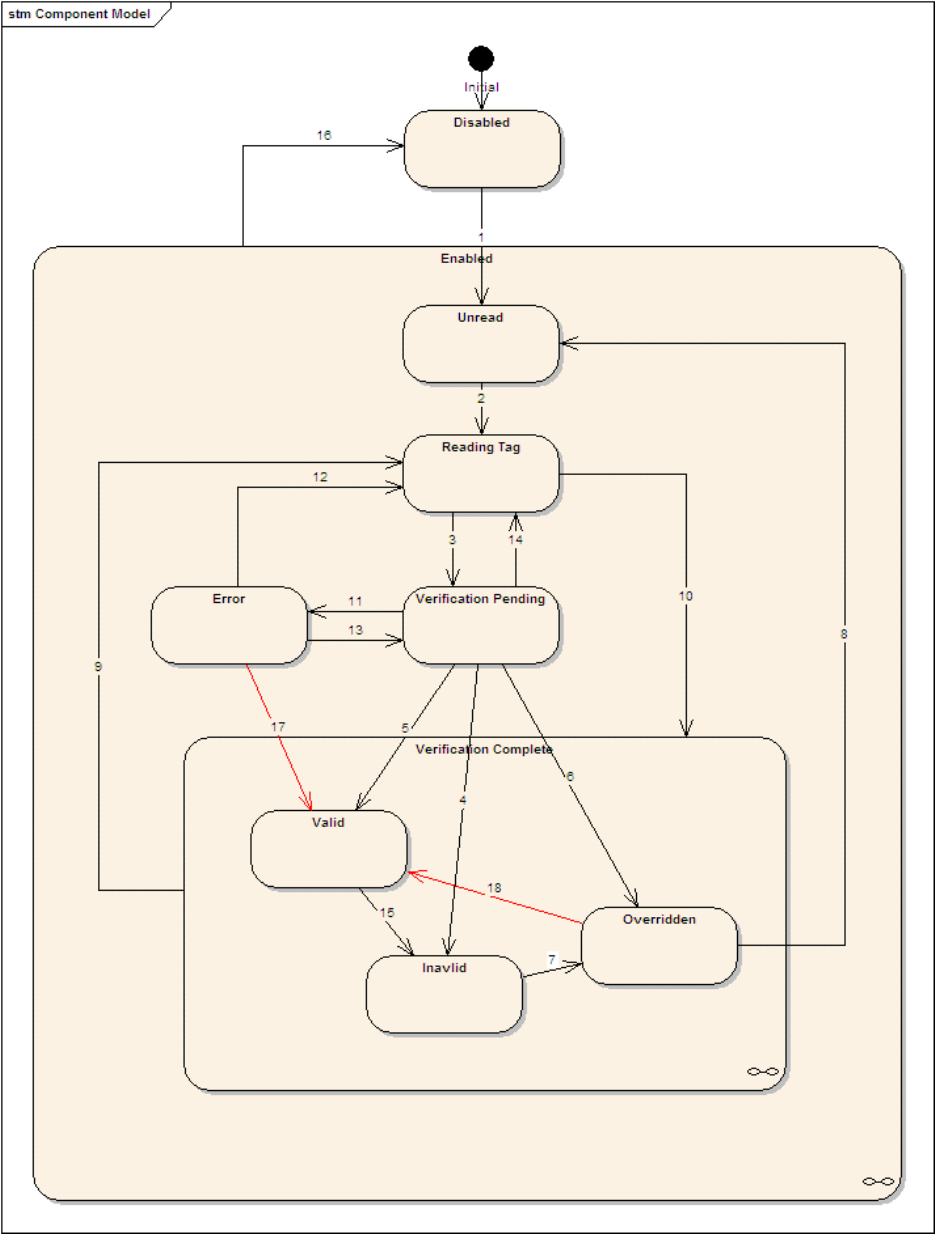
10.4.2 Verification State Model
Each verifiable item maintains a state machine in order to track its status. The model is used to
synchronise the actions of the host and printer. The following diagram illustrates the form of the state
machine.

GEM Manual for DEK Printers Additional Capabilities
Issue 2.0 June 9th, 2011 page 147 of 156
Transition Table:
# Current State Trigger New State Action
Initial Model Instantiated Disabled None
1 Disabled Verification Enabled Unread None
2 Unread Cover Closed, System Up Reading Tag Read Tag,
listen for response
3 Reading Tag Read Complete / UID value
changed or verification status
not received for current UID
Verification Pending Notify host, listen for
response
4 Verification
Pending
Set verification invalid status /
UID in sync with host
Invalid None
5 Verification
Pending
Set verification valid status /
UID in sync with host
Valid None
6 Verification
Pending
Set verification overridden
status / UID in sync with host
Overridden None
7 Invalid Host sets verification
overridden status
Overridden None
8 Overridden Host clears verification
overridden status
Unread None
9 Verification
Complete
Cover Closed, System Up Reading Tag Read Tag,
listen for response
10
Reading Tag Read Complete / UID value
unchanged and verification
status previously received for
current UID
Return to previous
Verification
Complete substate
None
11
Verification
Pending
Verification Timeout Error None
12
Error Cover Closed, System Up Read Tag, listen for response
13
Error Operator requests revalidation
Verification Pending None
14
Verification
Pending
Cover Closed, System Up Reading Tag Read Tag,
listen for response
15
Valid Host sets verification invalid
status
Invalid None
16
Enabled Verification Disabled Disabled None
17
Error Host sets verification valid
after the timeout period
Valid None
18
Overridden Host sets verification valid
after a previous override
Valid None
The host has access to an item state machine via an Equipment Constant. In accordance with the state
machine detailed above the host is able to set the EC value to one of:
• Unread, ECV = 1.
• Invalid, ECV = 4.
• Valid, ECV = 5.
• Invalid, ECV = 6.
In order for the printer to accept the values Invalid, Valid and Overridden as well as the state machine
being in the appropriate state, the value of the corresponding SCValidatedUID EC must reflect the item
identification last read from the RFID antenna.

GEM Manual for DEK Printers Additional Capabilities
Issue 2.0 June 9th, 2011 page 148 of 156
The following table illustrates the message exchange in response to a new paste cartridge being
inserted into the carrier and the tag being read successfully:
Comments Host Equipment Comments
Host acknowledges event
Host checks whether current
material ID is suitable for the
current product.
Host requests the equipment sets the
SCValidatedMaterial EC, ECID 44,
to the value just verified
If the item ID is appropriate for the
current product the host requests the
equipment sets the value of the
MaterialVerifState EC, ECID 43, to
Valid otherwise the value is set to
Invalid
S6F12 -->
S2F15 -->
S2F15 -->
<-- S6F11
<-- S2F16
<-- S2F16
System power up after covers opened.
The equipment successfully reads a new
value for the Material ID and sends to host
using CEID 40201 configured with a report
containing SVID 1047.
Equipment sets ECID 44 to the specified
value and sends the ack message.
Note if the host fails to set the EC value or
another cartridge is loaded prior to the
verification response being received the
attempt to set the verification state will fail
with an EAC value of 65 indicating the
current UID is not synchronised.
Equipment updates the material verification
state model and sets the MaterialVerifState
EC to the required value.
Note the host must set the verification state
within the time period specified by the SC
Verif Timeout configuration parameter
otherwise the state machine will transition to
the error state and refuse any subsequent
updates from the host