SIPLACE Vision Customer_en.pdf - 第44页
Component Shapes Component Shape Description Rules Overview of Componen t Shapes Which Require Separate Group Descriptions S tudent Guide SIPLACE V ision (Customer) Component Shapes Edition 12/2008 EN 44 CO Height The ov…
Component Shapes
Overview of Component Shapes Which Require Separate Group Descriptions Component Shape Description Rules
Student Guide SIPLACE Vision (Customer)
Edition 12/2008 EN Component Shapes
43
5.2 Component Shape Description Rules
For process reliability reasons, SIPLACE Vision checks the CO geometry more exactly than SIPLACE
ICOS. Dimension tolerances up to approx. 30% are considered acceptable; tolerances between 30-40%
could influence the measurement procedure; values above 50% will not be accepted.
General component shape description rules
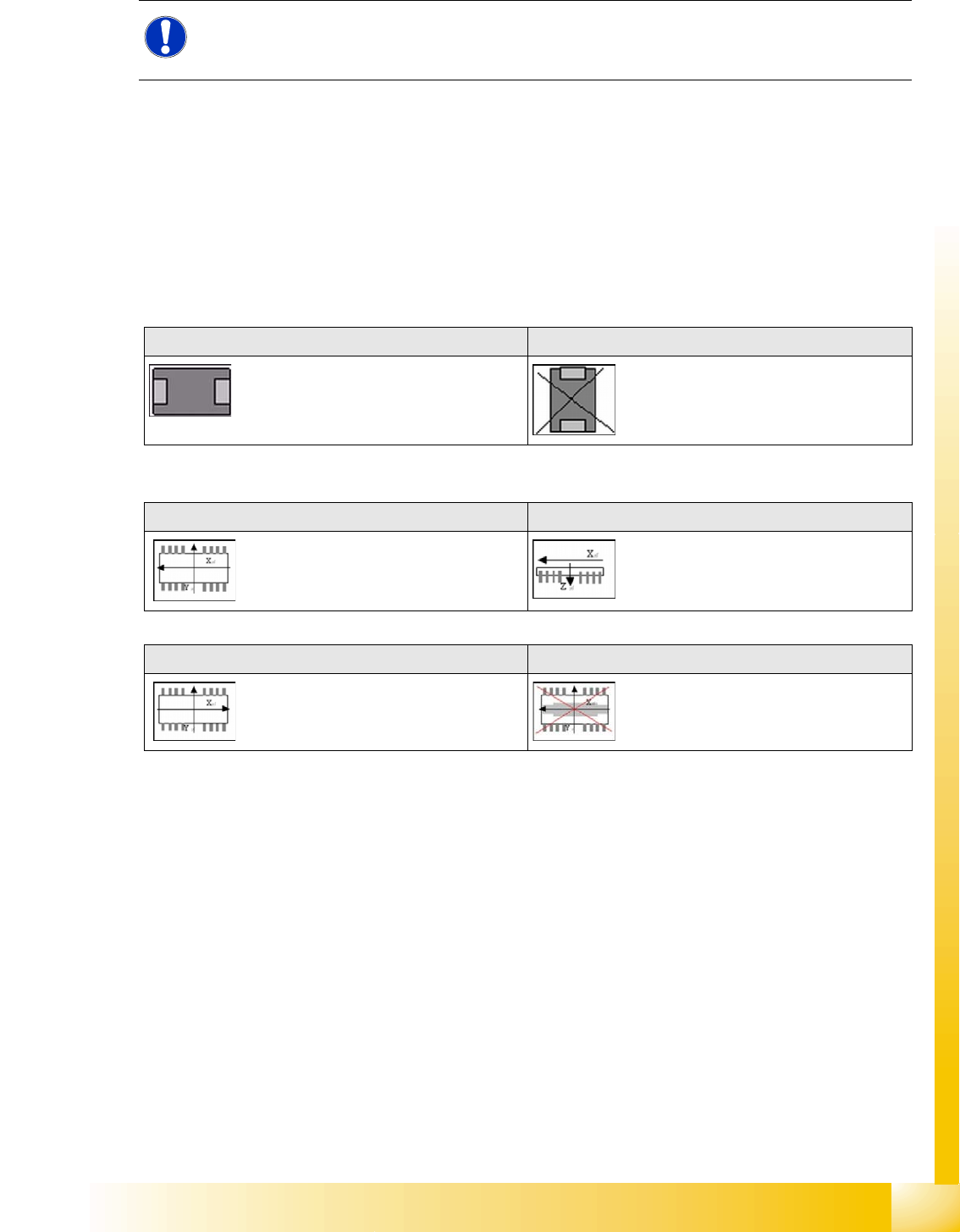
In most cases, the component shapes are not symmetrical to a particular point. To guarantee uniform
programming, please observe the following rules:
We recommend that you describe components in a horizontal position in SIPLACE Pro, not in a
vertical position:
The coordinate system for CS descriptions in SIPLACE Vision is defined as follows:
NOTE: Observe the tolerances!
The tolerance values for lead dimensions must NOT exceed 50%, otherwise error messages
will be issued!
Horizontal: Not vertical:
View from above in SIPLACE Vision: View from side in SIPLACE Vision:
View from above in SIPLACE Pro: Do not use the view from below:
Component Shapes
Component Shape Description Rules Overview of Component Shapes Which Require Separate Group Descriptions
Student Guide SIPLACE Vision (Customer)
Component Shapes Edition 12/2008 EN
44
CO Height
The overall height Z (with lead 1) is used to calculate the Z-axis speed profile during (pickup and)
placement; to calculate the camera focal levels; the focus height position for the Coplanarity option and
the Z-position for the gantry positioning during placement with the TWIN head.
To define the heights of through-hole contacts, centering and locking pins, each case must be
considered individually and requires exact knowledge of the dimensions!
CO thickness
The Z body size (CO thickness 2) must be correctly programmed for the CO sensor installed in the C&P
20 head or for the CO sensor option on the DLM 1/2 C&P 12 head. In addition, take care that the height
is described correctly, so that the combination of CO and nozzles can be brought into the correct focal
range of the CO camera. The ICOS descriptions could include body dimensions with intermediate
values, by which the tolerance levels were set relatively high (common CS for R and C). In reality, these
values are the same as the overall Z value, since the additional lead heights are within the set height
tolerance.
Z body dimensions (component center height )
The Z body dimension (component center height ) must be described correctly, to guarantee various
functions, particularly the following:
Height measurement:
By the CO sensor on the C&P20 head or for the CO sensor option on the C&P12 head (DLM1 & 2).
Component measurement:
So that a combination of components and nozzles can be brought into the correct focal range of the
component camera.
Reliable pickup and optimum placement speed:
Overall height (with leads) is needed for calculating the Z-axis speed profile.
NOTE: In ICOS descriptions, the Z dimensions are not specified correctly. The tolerances were then set
appropriately larger.
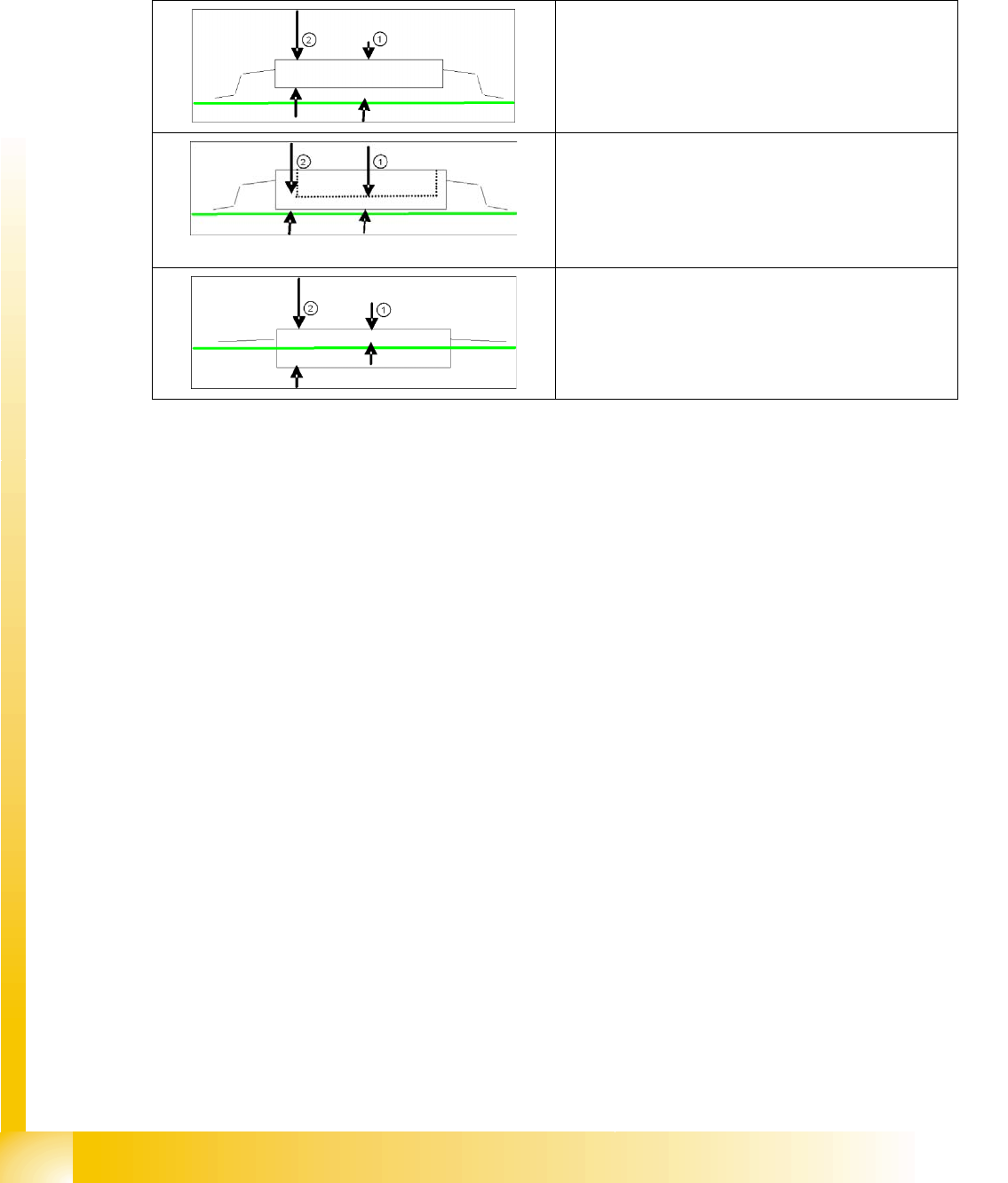
Standard SMD CO
1. CO Height
2. CO thickness (for CO sensors)
Socket SMD CO
1. CO height (if the component height is programmed as
high as the socket edge, this is to be programmed as
a positive (!) Z pickup position correction (inner depth
of socket). (This may be necessary for the
precedence finder from SIPLACE PRO 6.0)
2. (2) CO thickness (for CO sensors)
Special CO in PCB cuts-outs
1. CO Height
2. CO thickness (for CO sensors)
Component Shapes
Overview of Component Shapes Which Require Separate Group Descriptions Component Shape Description Rules
Student Guide SIPLACE Vision (Customer)
Edition 12/2008 EN Component Shapes
45
The X/Y body dimensions
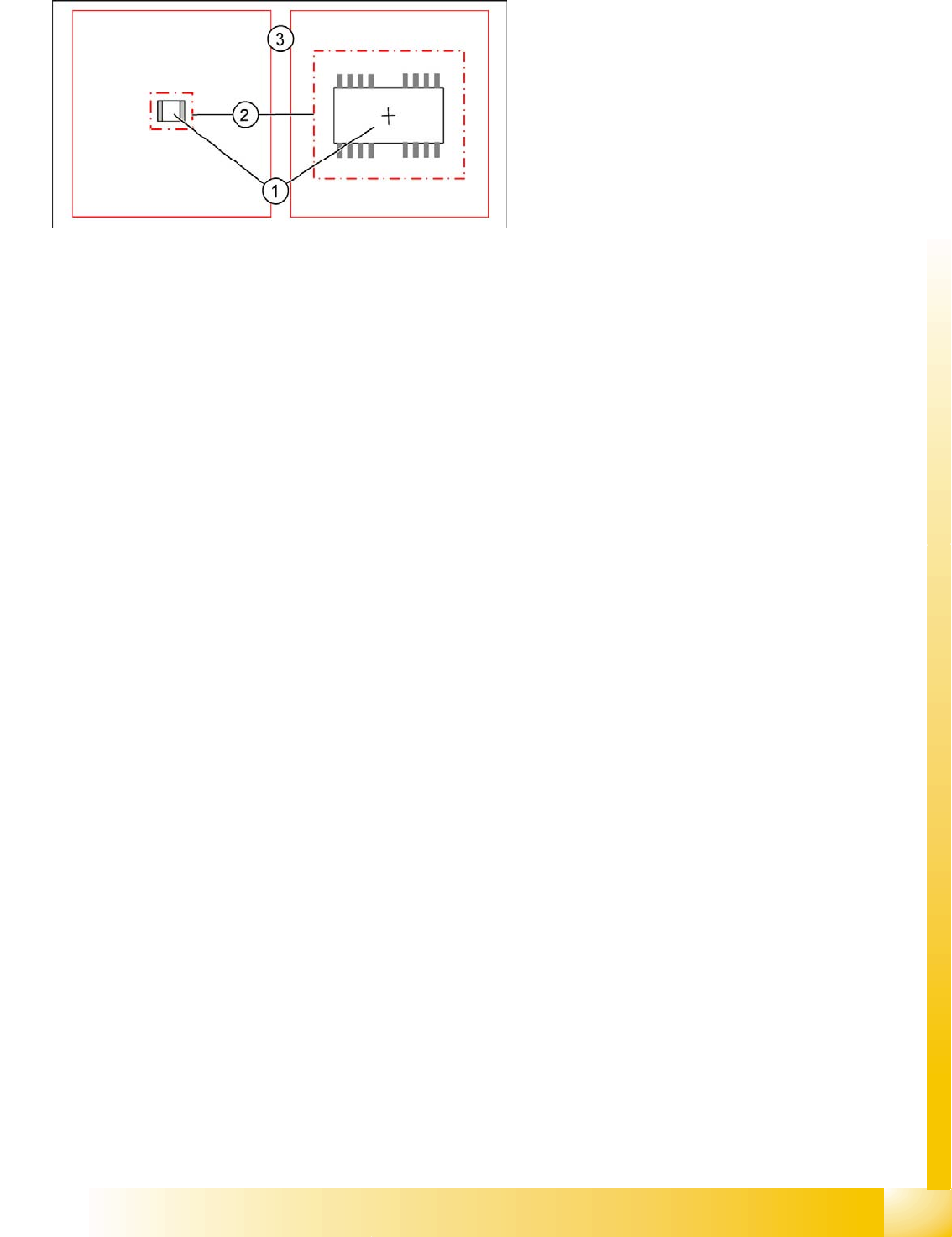
The X/Y body dimensions are now understood to be dimensions for the plastic body (1).
Based on the calculated overall body dimensions, the camera field of vision (2) or so-called Region
of Interest (ROI) is set.
The component tolerance and packaging tolerance are taken into account in this calculation.
The component body is not measured optically. The dimensions are only needed to produce a
diagram for better assessment.
Angle of component
CS testing is normally performed at a definition angle of 0°.
However, the presentation angle can be adjusted in 90° steps for CS testing at any heads.
The optical centering of components is always performed in the pickup position when using DLM
C&P6/12 heads.
Optical centering for Twin heads is performed in the placement angle (next possible 90° angle).
When using the C&P20 head, optical centering is performed in the placement angle (next possible
90° angle).
Polarity detection - inspection mode
SC Bearbeitung des Kamerabildes 02 0305 SIPLACE Vision supports Pin 1 detection, provided
optically recognizable asymmetries have been programmed.
The selection of inspection mode in SIPLACE Pro applies only to SIPLACE Vision (not for older
Vision systems).
The programmed polarity parameters are shown in the board or setup CO displays, in graphics
mode. However, this does not affect the measurements in the Vision system.
Lead lengths
Provided the leads are aligned towards the outside, the lead lengths are added together with the body
dimensions to give the overall dimensions of the component shape. The overall dimensions can be
viewed in the component shape geometry menu. These values can not be edited.
Once the body dimensions for unleaded CSs have been successfully measured, you can generally
assume that the component has been correctly recorded and that it is not in an upright position or
tipped to one side on the nozzle.
Legend
1. X/Y dimensions of component body (without
leads)
2. Restricted camera search field, so-called.
Region of Interest (ROI)
3. Camera field of vision