JAKA Zu se使用手册 - 英文版.pdf - 第24页
24 JAK A Zu Se If there is any doubt or failure during use, pleas e do not try to operate witho ut permiss ion and directl y contacting our Company.

JAKA Zu Se 23
1.3 Basic Sensor Parameters
Fx/Fy (N)
200
Fz (N)
200
Mx/My (Nm)
8
Mz (Nm)
8
Overload level
(%)
300
Accuracy (%)
0.5
Precision (%)
0.1
Protective class
IP64
Operating
temperature (°C)
5~80
Power supply
voltage (V)
9~24
Communication
Interface
RS422
Sampling
Resolution (Bit)
24
Precision: Precision is the evaluation index symbolizing the extent of consistency between multiple
measured values, that is, the output curve consistency degree obtained by the sensor when the
input is tested for multiple times in a unified direction. The precision of reproducibility is the
percentage of the standard deviation of the output error to the rated output (%FS).
Accuracy: Accuracy is the evaluation index of the deviation degree between the measured value and the
true value. The accuracy is the percentage of the standard deviation of the deviation between
the output and the theoretical truth value and the rated output (%FS)
1.4 Precautions for Use
a. Do not use in an environment with temperature and humidity outside the allowed range of
specifications.
b. The wiring must be completely correct. When the power is turned on, please check whether the
color of the connection cable is correct in accordance with the manual. If an error occurs at the connection
terminal, the internal circuit of the sensor may be short cut and possibly be damaged. Please be sure to
check.
c. The sensor has an embedded system and other precision parts. our company has carried out
relevant vibration and impact tests, but please pay attention to the product drop, excessive vibration will
lead to malfunction.
d. Do not knock when installing the sensor. Especially when it is matched with the adaptor plate, if the
clearance fit is tight due to the adaptor plate processing and other factors, do not knock the sensor,
otherwise it will cause damage to the sensor performance.
After the sensor is installed and powered on, it is recommended to preheat it for an hour before
operation.
In the actual use of the sensor, the quality of the mounted equipment shall be taken into consideration
to avoid overloading.

24 JAKA Zu Se
If there is any doubt or failure during use, please do not try to operate without permission and directly
contacting our Company.
JAKA Zu Se 25
6.2 Description of Sensor III
1.1 Overview
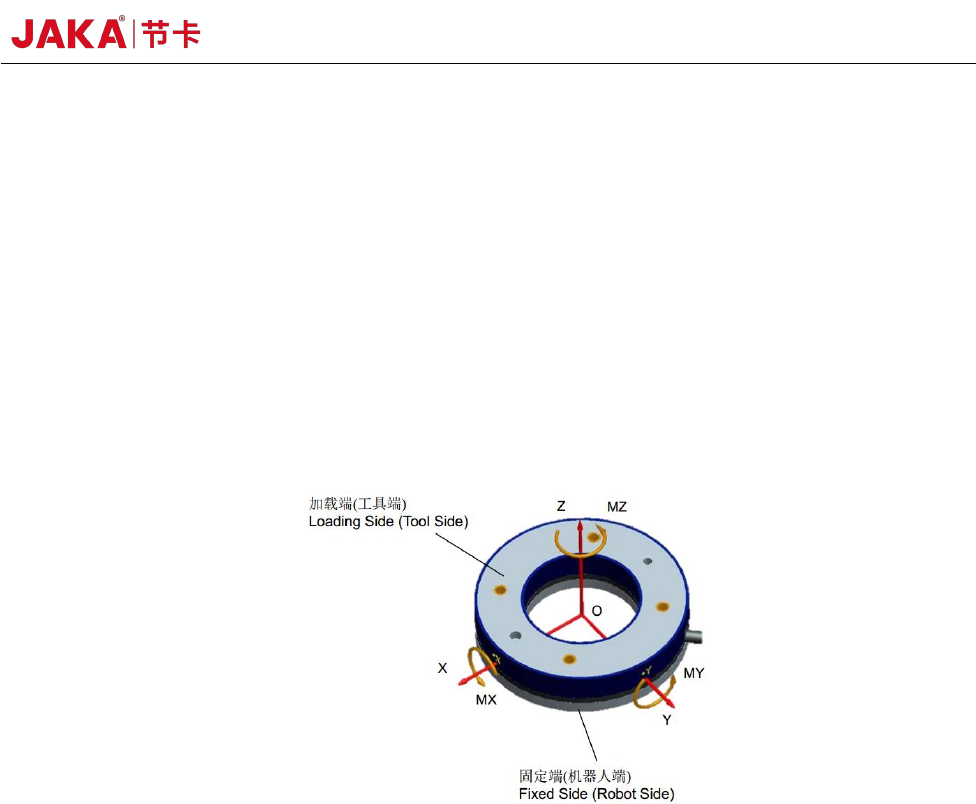
This strain type six-axis force/torque sensor can detect three forces and three torques
simultaneously. Six-axial load sensors are generally divided into fixed side (robot side) and loading
side (tool side). When the two sides of the sensor are under relative force, elastic deformation occurs
and the resistance of the strain gauge inside the sensor changes, which is then converted into voltage
signal output.
The output force and torque of the six-axis force sensor are relative to the neutral coordinate
system, which is generally located in the geometric center of the sensor.
Definition of the Sensor Coordinate System
1.2 Sensor Installation
The sensor size, location of the fixed side (robot side) and the loading side (tool side) are
installed as shown in the figure below. The wire or joint is fixed at the fixed side to prevent the swing
or pull of the wire from affecting the measurement of the force sensor. The fixed side must be fixed
and external force is loaded from the loading side.