00197469-02_SM_Twin_Kunde_EN.pdf - 第5页
1 Introduction 1.1 Safety instructions Service Manual SIPLACE TwinStar (Twin, Twin HF, Twin VHF) 07/2020 5 1 Introduction This service guide is a manual or reference work for performing service work on the SIPLACE® place…

4 Service Manual SIPLACE TwinStar (Twin, Twin HF, Twin VHF) 07/2020
Contents:
4.6 Replacing the sleeve with ball fixing/seal.. 43
4.7 Replacing the pneumatic rotary supply.. 47
4.8 Replacing the force measuring unit and the trick and feather unit.. 51
4.8.1 Parts.. 51
4.8.2 Removal.. 52
4.8.3 Assembly.. 58
4.8.4 Setting the force measuring unit.. 62
5 Boards and cables.. 65
5.1 Replacing the head main board.. 65
5.1.1 Head main board C600.. 69
5.2 Transferring the head specific data.. 72
5.2.1 Transmitting the head-specific data (from SW601).. 72
5.2.2 Transferring the head specific data (from SW701).. 73
5.3 Replacing the board with cable (Twin HF only).. 74
5.4 Replacing the flat ribbon holder, Twin VHF (Twin VHF only).. 75
5.5 Replacing the control cable.. 76
5.6 Replacing the connector clamping piece.. 79
5.7 Replacing the strain relief for the Z encoder Twin.. 80
6 Parameter and Calibrations.. 81
6.1 Parameters and calibrations SW7xx.x.. 81
6.2 Parameters and calibrations SW6xx.x.. 81
6.2.1 Overview: Calibration Steps and Parameters.. 81
6.2.2 Parameters for TwinHead.. 82
6.2.3 Calibrating the D axis.. 84
6.2.3.1 Manual calculation of the D axis zero point correction.. 85
6.2.4 Calibrating the head height.. 85
6.2.5 Calibration of vacuum generator on the TwinHead.. 86
6.2.5.1 Zero point calibration of vacuum generator.. 86
6.2.5.2 Checking the zero calibration.. 87
6.2.5.3 Calibrating the closed vacuum.. 87
6.2.5.4 Checking the pressure tightness of the vacuum system.. 88
6.2.5.5 Checking the air blast.. 88
6.2.6 Calibrating the TwinHead.. 89
6.2.6.1 Mechanical adjustment of the Z axis read unit.. 89
1 Introduction
1.1 Safety instructions
Service Manual SIPLACE TwinStar (Twin, Twin HF, Twin VHF) 07/2020 5
1 Introduction
This service guide is a manual or reference work for performing service work on the SIPLACE®
placement head modules of type Twin, Twin HF and Twin VHF.
1.1 Safety instructions
DANGER
Nonobservance of these safety instructions may cause injury to personnel and dam-
age to the machine!
► Please observe the safety instructions in the user manual of the relevant machine
for all work!
1.1.1 Conventions for the use of safety instructions and symbols
Safety instructions
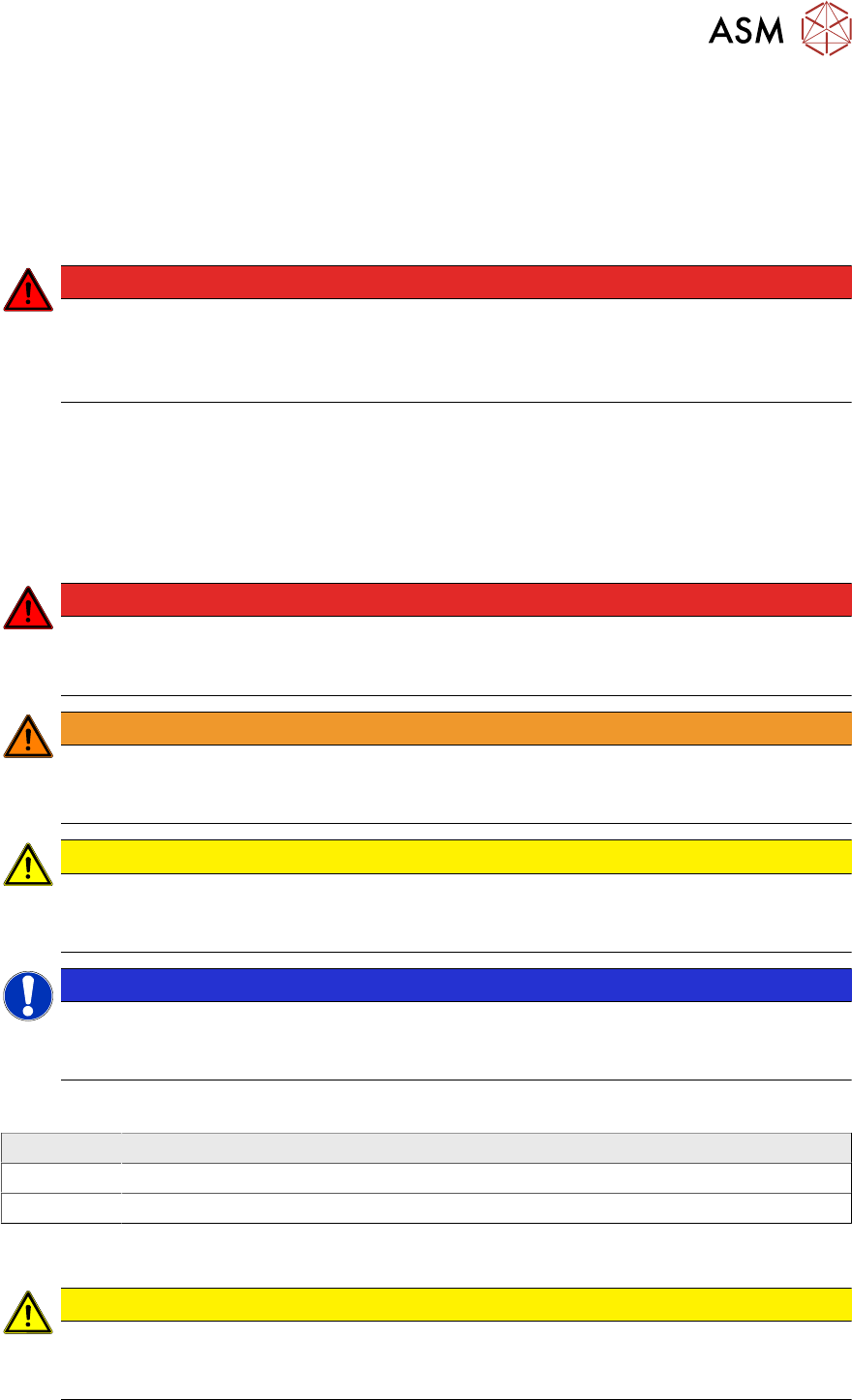
This manual contains notes that must be observed to guarantee your personal safety and to avoid
damage to equipment. These notes are highlighted by warning triangles and are indicated as fol-
lows according to the level of risk:
DANGER
Definition
For the purposes of this manual, this indicates that fatal or severe injuries or considerable
damage to property will occur if this hazard warning is not observed.
WARNING
Definition
For the purposes of this manual, this indicates that fatal or severe injuries or considerable
damage to equipment may occur if these warning instructions are not followed.
CAUTION
Definition
For the purposes of this manual, this indicates that minor injuries or damage to property
may occur if this caution is not observed.
NOTICE
Definition
For the purposes of this manual, this note provides information about the product or indic-
ates a part of the manual that requires particular attention.
Symbols
Example Description
Next This typeface marks controls and interface elements in the software.
► This symbol indicates actions that have to be performed by the operator.
1.1.2 Safety instructions on hazardous materials
CAUTION
Observe the safety data sheets
Observe the applicable safety data sheet, when handling hazardous materials (e. g. Loctite
241, ethanol).
1 Introduction
1.2 Other instructions
6 Service Manual SIPLACE TwinStar (Twin, Twin HF, Twin VHF) 07/2020
1.2 Other instructions
1.2.1 Environmentally-friendly disposal of materials and components
Our products are manufactured using only materials and parts that can be easily separated and
disposed of in an environmentally-friendly way.
NOTICE
Observe the applicable regulations
The company operating the system has sole responsibility for the proper, environmentally-
friendly disposal of machines, working materials, consumable materials and wear parts.
► Please observe your national statutory provisions for waste disposal and environ-
mental protection.
1.2.2 Use of original accessories and spare parts
Only use original spare parts and authorized accessories. The use of other parts will affect safety
and will invalidate the liability for any consequential damage.
1.2.3 Information about this service manual
WARNING
Additional qualifications required
The service work described in this manual may only be performed by specially trained ser-
vice technicians, with appropriate qualifications and expertise.
If you should have any questions during the service work, please contact the SIPLACE customer
hotline directly or send an e-mail to hotline.siplace@asmpt.com.
1.2.4 ESD guidelines
1.2.4.1 What does ESD mean?
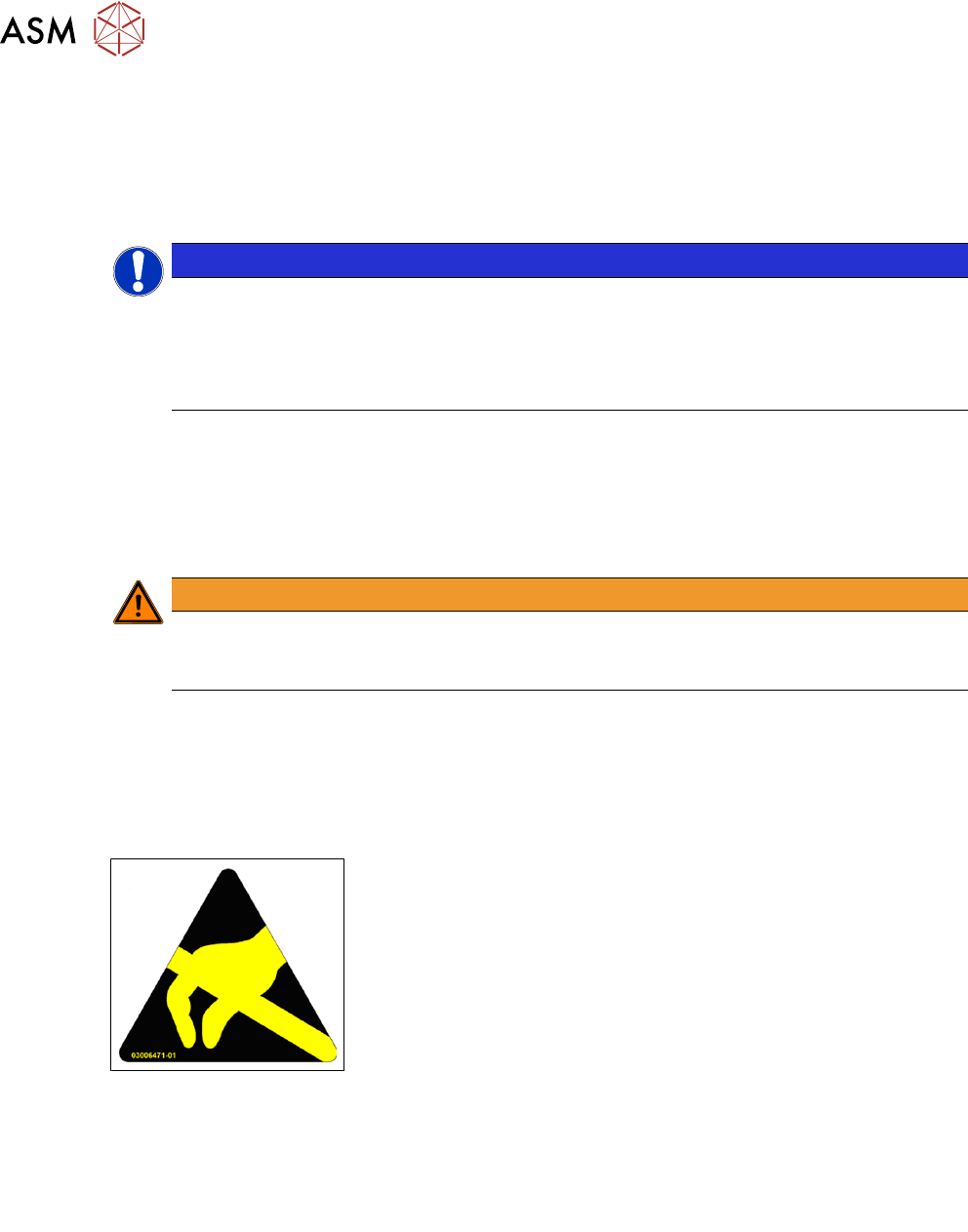
Fig.1: ESD label
Almost all of the modules in use today are equipped with highly integ-
rated Metal-Oxide-Semiconductor (MOS) blocks and components.
The manufacturing techniques used mean that these electronic com-
ponents are extremely sensitive to overvoltage and thus to electro-
static discharge.
The abbreviation for such modules is "ESD" (Electrostatic Sensitive
Device). "ESD" is used internationally. The following symbol on cab-
inet rating plates, racks or packaging indicates that components
which are sensitive to electrostatic discharge have been used and
thus that the modules concerned are also touch-sensitive.
ESDs can be destroyed by voltages and power levels that are far below the level that can be per-
ceived by humans. Such voltages occur if a person touches a component or module without
earthing themselves. Components that are exposed to such overvoltages do not generally appear
to be defective immediately - incorrect behavior starts after the component or module has been in
operation for some time.
1.2.4.2 Important measures to protect against static charging
► Most plastics can easily become charged and must therefore be kept away from at-risk com-
ponents.
► Always ensure that people, the workplace and packaging are safely earthed when handling
electrostatic sensitive components.