ThermoFlex-Manual.pdf - 第49页
Section 3 ThermoFlex 3-11 Thermo Scientific Process Fluid Requirements Do not use automotiv e antifreeze. Commercial antifreeze contains silicates that can damage the pump seals. Use of any uid not listed below will v oi…
Section 3
3-10 ThermoFlex
Thermo Scientific
Water-cooled Chillers
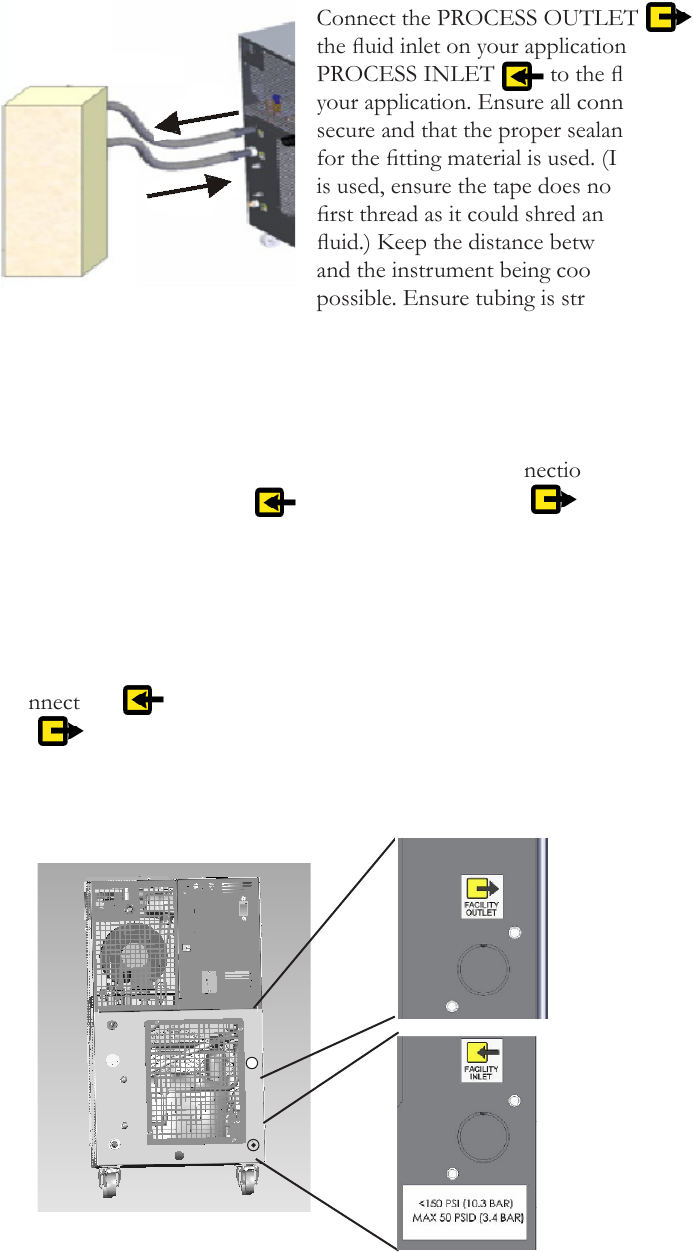
For water-cooled chillers the facility water plumbing connections are also located
on the rear and are labeled
OUTLET. The connections are ½" Female NPT for ThermoFlex900 -
5000, ¾" Female NPT for ThermoFlex7500 - 24000. Both connections
for ThermoFlex900 to 10000 are cast bronze. The supply connections for
ThermoFlex15000 to 24000 are cast bronze, the return connections are stainless
steel.
Connect the
to your facility water supply. Connect
the
to your facility water return or drain. Ensure
®
tape is used, ensure the tape does not overhang the
Connect the
PROCESS OUTLET to
your application. Ensure all connections are
secure and that the proper sealant/lubricant
®
tape
is used, ensure the tape does not overhang the
and the instrument being cooled as short as
possible. Ensure tubing is straight and without
make them at the inlet and outlet of your
application, not at the ThermoFlex.
Figure 3-4 Typical Plumbing
Connections (2 of 2)
Process Fluid Flow
Process Fluid Flow
Application
Figure 3-5 Typical Plumbing Connections, Water-cooled Chillers
See Section 2 for the specific
locations on your chiller.

Section 3
ThermoFlex 3-11
Thermo Scientific
Process Fluid
Requirements
Do not use automotive antifreeze. Commercial antifreeze contains
silicates that can damage the pump seals. Use of any uid not
listed below will void the manufacturer’s warranty.
Approved uids are:
Filtered/Single Distilled water
0 - 75% Ethylene Glycol/Water
0 - 75% Propylene Glycol/Water
Deionized water (1 - 3 MΩ-cm, compensated)
Ethylene glycol (EG) is poisonous and ammable. Before using
any uid or performing maintenance where contact with the uid is
likely refer to the manufacturer’s most current MSDS for handling
precautions.
EG is also hygroscopic, it will absorb water from its environment.
This can affect the freezing point and boiling point of the uid over
time and may result in system failure.
To prevent freezing/glazing of the plate exchanger,
ThermoFlex7500 through 24000 chillers require the use of 50/50
EG/water or 50/50 PG/water below 10°C process temperature.
When using a process uid mixture of ethylene glycol and water or
propylene glycol and water, check the uid concentration and pH
on a regular basis. Changes in concentration and pH can impact
system performance.
When using EG/water or PG/water, top-off with plain water. After
top-off check the uid concentration.
Do not use a Deionization (DI) lter cartridge with Inhibited EG
or Inhibited PG. A DI lter will remove inhibitors from the solution
rendering the uid ineffective against corrosion protection. Also,
inhibitors increase uid conductivity.
WARNING
WARNING
CAUTION
CAUTION
CAUTION
CAUTION
CAUTION

Section 3
3-12 ThermoFlex
Thermo Scientific
Compatibility with
Approved
Fluids
Filtered Tap Water/Single Distilled Water
Filtered drinking water and single distilled water are good choices for
recirculating chillers because the ltering/distilling process used removes
microorganisms that could create biological fouling as well as harmful
particulates and excessive minerals that could cause deposits and scaling.
Chlorine
Short term usage of tap water may not cause any adverse affects on the chiller
or your application, but in the long term problems may arise. To help alleviate
these problems Thermo Fisher Scientic recommends the use of chlorine.
The duration of time that chlorine remains in solution depends on factors
such as water temperature, pH and availability of direct sunlight. We
recommend maintaining chlorine levels at proper levels using chlorine test
strips, generally 1 to 5 ppm is adequate.
For best results, maintain the pH of the uid between 6.5 and 7.5. Do not
add additional chlorine without rst determining the concentration ratio that
already exists in the uid supply. Corrosion and degradation of the circulation
components can result from concentration ratios that are too high. Contact
our customer support for additional information.
Deionized Water
Deionized water is water that has had its mineral ions removed using ion
exchange resins. The purpose of this process is to remove the ions that allow
electrical current to ow more easily through water. This helps to prevent
electrical leaks to ground through the recirculating uid. Deionized water is
classied by the electrical resistance of the water, usually measured in
MΩ/cm, with pure water having a resistance of 18 MΩcm.
Water that has been deionized is in an unbalanced state and will leach the
missing ions from the materials it comes in contact with. The aggressive
nature of this leaching can cause pitting on metal surfaces. It should also
be noted that the deionizing process does not remove microorganisms.
Because of this, it is recommended that only applications that have a specied
requirement for deionized water should use deionized water.
In any case, only deionized water with a resistivity between 1 and 3 MΩcm is
approved for use in Thermo Fisher Scientic recirculating chillers.
Recommended Biocides and Inhibitors
Thermo Fisher Scientic offers a biocide and inhibitor package (NALCO)
premixed with 5 gallons of water or as a kit to be added to water. No other
biocide or inhibitor is recommended for use in our recirculating chillers
.
Biocides are corrosive and can cause irreversible eye damage and skin
burns. They are harmful if inhaled, swallowed or absorbed through the
skin. Refer to the manufacturer's most current MSDS.
WARNING