YSM40 Mainte_E.pdf - 第5页
iii Safety instructions 1.3 Restrictions on machine use 1.3.1 Defining the operator and ser vice personnel c …

ii
Safety instructions
1. Safety
To ensure that the machine you purchased is used safely and correctly, always comply with the instructions
and rules in this manual regarding safety. However this manual cannot cover all items regarding safety in
detail. So it is extremely important that the operator or person handling the machine make correct decisions
regarding safety.
1.1 To ensure safety
Tomaintainthesafetyoftheoperatororpersonworkingwiththismachine,itisessentialthatit(including
externalpartsfeeders)beinstalledcorrectlyincompliancewiththesafetystandardsandconditionsofthat
country.
Complyingwiththesafetyregulationsandlawsofthatcountryistheresponsibilityofthecustomerwho
purchasedthismachine.Thesupervisorofthismachinemusttakeresponsibilitytoensureallmeasureshave
beentakenformachinesafety.
1.1.1 Defining safety
1.Safetyhaspriorityoverallotheroperations.
2.Safetyismoreimportantthananyothertask.
3.Safetyisthefoundationforworkefficiency.
4.Safetybeginswithmaintaining(keepingitneatandorderly)theworkenvironment.
1.1.2 Causes of injuries and accidents
Mostaccidentsarenotsomethingthatoccursbutsomethingthatarecaused.Soitisimportanttomakean
effortNOTtocauseaccidents.
n
Hazardous actions
•Ignoringcausesofaccidents
•Workingoroperatingequipmentincrampedlocations
•Workinginlocationsorpositionswheresafetycannotbeensured
•Unsafemachineoperationandusingequipmentwhosesafetycannotbeensured
•Workingoroperatingequipmentatspeedswheresafetycannotbeensured
•Workingoroperatingmachineswithsafetyequipmentremoved
•Performingworkortasksontopofamachinecurrentlyinoperation
•Playingaroundorgoofingoffduringwork
•Performingmaintenanceorinspectionswithoutwearingsafetygear
1.2 Using safety gear
Alwayswearsafetygearwhenoperatingorservicingequipment.
Helmet :Useduringmaintenancework
Safetyglassesorgoggles:Usearoundlightharmfultoeyesandwhenapplyinglubricant,etc.
Respiratorygear :Usewhenhandlingorganicsolvents
Safetygloves :Usewhenapplyinglubricant,etc.
n
Precautions when applying lubricant (grease)
w
WARNING

iii
Safety instructions
1.3 Restrictions on machine use
1.3.1 Defining the operator and service personnel
c
Operator:
Theoperatorissomeonewhohasbeentrainedbyusinmachineoperation,hasathoroughknowledgeofthemachine
operationmanualanddemonstratesadequateknowledgeofmachineoperationandsafety.
Maintasksoftheoperatorincludepre-operationchecks,operation(componentmounting)andmakingsetups
(changeovers).Themachineisonlyusedinnormaloperatingmode.
Service personnel:
Theservicepersonnelarethosetrainedbyusinmachinemaintenanceaswellassafetyinstructionanddemonstratea
thoroughknowledgeofsafehandlingofthemachineaccordingtothetypeandlocationofmachineoperation.Theymust
alsounderstandhazardoussectionsofthemachineandresidualrisks.
Maintasksoftheservicepersonnelincludemachinemaintenance,repair,adjustmentandmanagementofthesystem.
Theservicepersonnelmaymakechangestothemachinesettingsandoperationinfactoryadjustmentmode.
1.3.2 Restricting machine operation with passwords
Machineoperatinglevelsusablebytheoperatorandservicepersonnel(mentionedabove)mustberestricted
bypassword.Thispreventstheoperatorandservicepersonnelfromusingthemachineatahigherlevelthan
allowed.
1.4 Cautions during machine operation
• Always make pre-operation checks before turning on the main power switch.
• Do not use an air blow tool when cleaning the machine. (Airborne dust will badly affect machine operation.)
• Stop all machine operation before cleaning around the machine.
• Do not turn off the compressed air during operation.
• Always make periodic inspections to prevent unexpected machine breakdowns.
• Allow only properly trained, experienced workers to perform repair and adjustment.
1.5 Cautions during power outages
Ifapoweroutage(blackout)occursduringautomaticmachineoperation,alwaysturnthemainpowerswitch
offtopreventfaultyoperationandequipmentdamageafterpowerhasbeenrestored.Removeitemssuchas
boardsthatremaininsidethemachine.
1.6 Cautions regarding ferromagnetic fields
SomeYGseriesmachinescontainpartsgeneratingstrongmagneticfieldswhichmaycausebodilyinjury,death,
ordevicemalfunction.Alwayscomplywiththefollowinginstructions.
• Persons wearing electronic medical devices such as hearing aids and/or cardiac pacemakers must keep away
from the linear motor.
• Persons wearing ID cards, purses, and/or wristwatches must keep away from the linear motor.
• Do not attempt to disassemble the linear motor (including surrounding covers).
• Do not bring tools close to the linear motor.
• Do not bring tools close to the magnetic scale.
• Do not put magnetic materials or objects close to the linear motor.
• Do not touch a portion close to the linear motor during operation or immediately after the operation has been
finished since such part is hot.
1.7 Handling the internal tape cutter
•Neversupplyelectricalpowerandcompressedairtothemachinewhilethecoversforthetapecutterareremoved.
•TapecuttermaintenancetasksmustbeperformedbyYAMAHAservicepersonnel.
iv
Safety instructions
1.8 Keeping hands away from moving parts
Duringuseofthismachine,thecustomer’sequipmentandoperatingconditionsmightallowtheoperator’s
handstocomeintocontactwithmovingparts.
Usethefollowingsafetymeasureoptionstoavoidpossibledangerwhereopeningsorgapsarefoundonthe
machine.
n
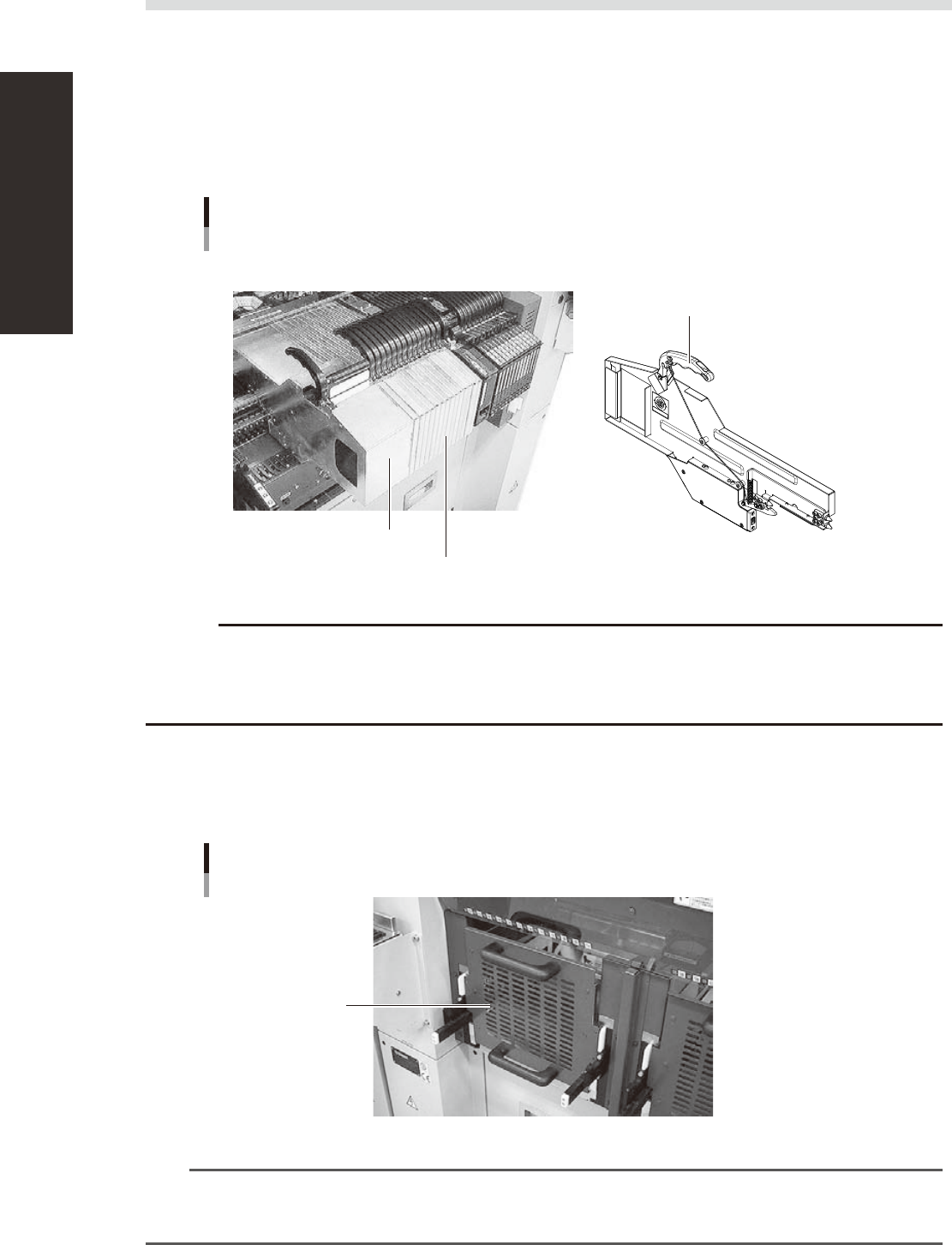
Dummy feeder
Usedummyfeedersassafetymeasurestofillagapbetweentapefeeders.Installdummyfeedersonthefeederplatethe
samewayasnormalfeedersinordertopreventhandsfromentering.
Prevention of hand entry
Dummy feeder
Dummy feeder (8mm-size)
Dummy feeder (Wide-size)
Clamp lever
91203-L0-20
c
machine has a structure that does not allow installing or removing a dummy feeder when the machine is in operation.
to attempt it.
n
One-stop cover (for machines (except for YSM40) with batch change carrier specs.)
Ifnotusingafeederexchangecarriageinthemachinethatistobeusedwithfeederexchangecarriages,installa
one-stopcoverinthepositionwhereafeederexchangecarriageistobeinstalled.
Prevention of hand entry
One-stop cover
One-stop cover
91204-L0-10
n
NOTE
One-stop covers cannot be installed or removed during operation. The machine must be in a stopped state because
the section where a feeder exchange carriage is to be installed will move up and down for the installation or removal
of the feeder exchange carriage.