Nordson_EFD_OptiSure_Operating_Manual.pdf - 第32页
OptiSure Automated Optical Inspection 32 www.nordsonefd.com info@nordsonefd.com +1-401-431-7000 Sales and service of Nordson EFD dispensing systems are available worldwide. T o Use Positional Checking in a Pr ogram # Cli…
OptiSure Automated Optical Inspection
31www.nordsonefd.com info@nordsonefd.com +1-401-431-7000 Sales and service of Nordson EFD dispensing systems are available worldwide.
# Click Step Reference Image
12
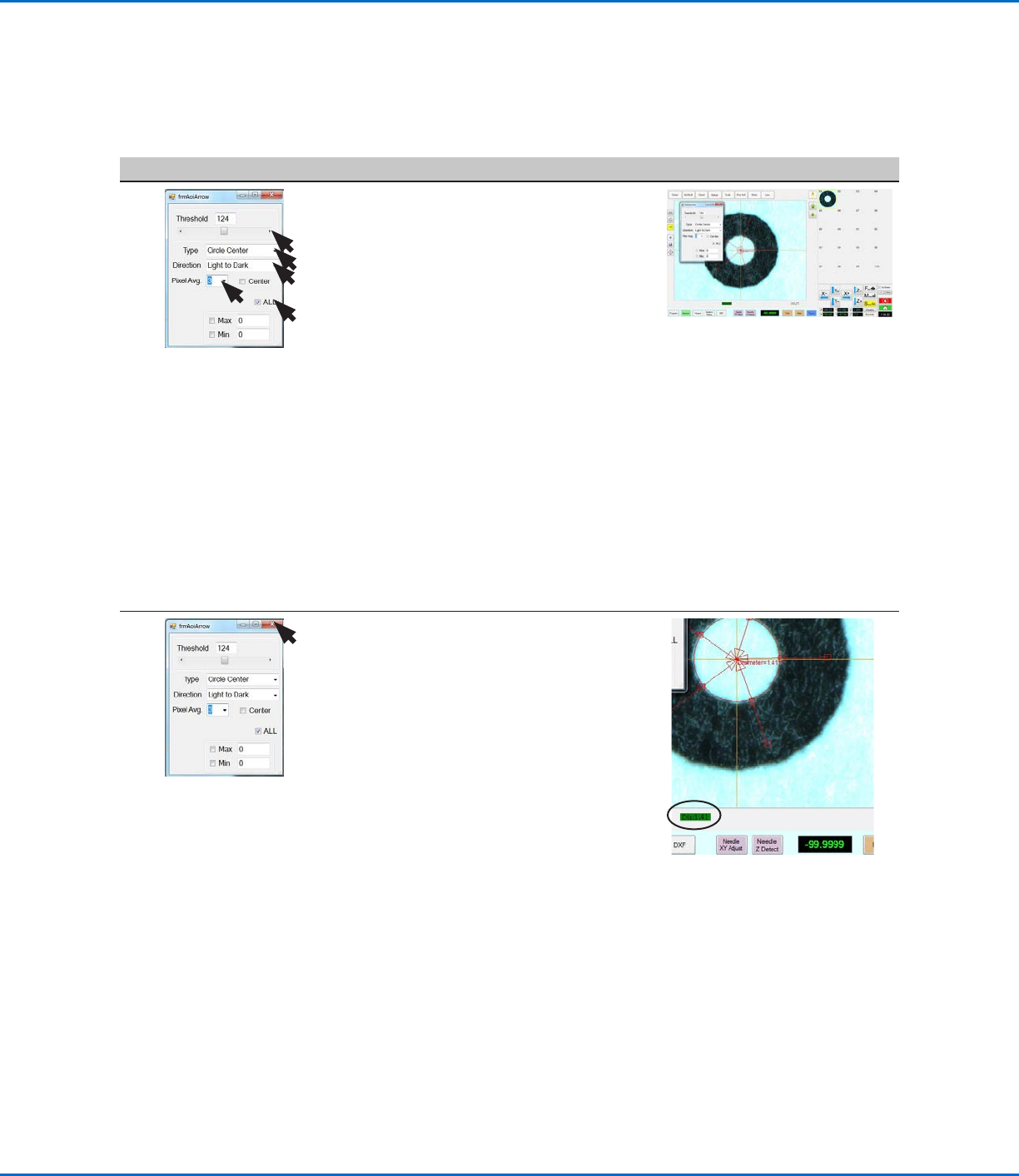
• Select the ALL checkbox (to cause the
system to enter the same settings for
all arrows).
• For Type, select CIRCLE CENTER.
• Select LIGHT TO DARK.
• Set PIXEL AVG to 3.
• Adjust THRESHOLD until the
circumference measurement appears
and is stable.
NOTES:
- Alternatively, you can use the Image
Threshold feature by right-clicking
in the Primary View screen and
selecting Image Threshold. Refer
to “Using Image Threshold” on
page13 for details.
- CENTER is not used in this example.
- MAX and MIN are not used in this
example but can be selected and
added if desired.
13 • Close the dialog box to save the
settings.
The system adds the circle diameter
and its value (item 4) to the mark
image of the circle and displays the
measurement at the bottom of the
Primary View screen (item 5).
The saved mark image now contains
additional data that will allow the
system to accurately find it upon
reaching its corresponding Find Mark
or Arrow Check Point command in a
program.
• Continue to “To Use Positional
Checking in a Program” on page32.
4.
5.
Using the Arrow Types (continued)
Positional Checking Example (continued)
To Create a Circle Center Mark Image (continued)
OptiSure Automated Optical Inspection
32 www.nordsonefd.com info@nordsonefd.com +1-401-431-7000 Sales and service of Nordson EFD dispensing systems are available worldwide.
To Use Positional Checking in a Program
# Click Step Reference Image
1
>
>
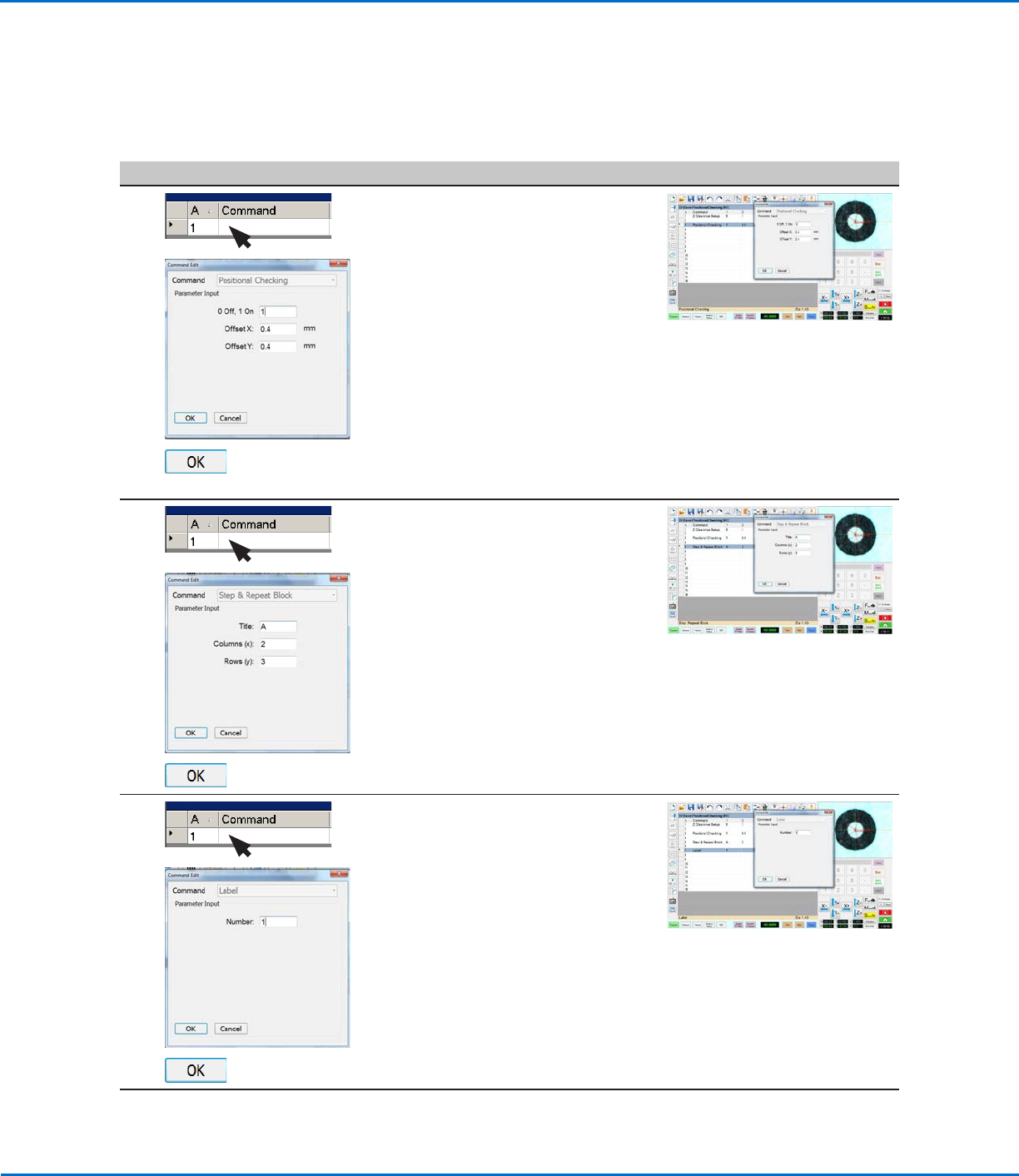
• At the beginning of the program,
insert a Positional Checking
command and enter the following:
- 1 ON
- OFFSET X: 0.4 (mm)
- OFFSET Y: 0.4 (mm)
• Click OK.
NOTES:
• The offset values are the maximum
allowable deviation of the inner dots
from the larger circle.
• This example program includes a
ZClearance Setup command, but it
is not required.
2
>
>
• Insert a Step & Repeat Block
command and enter the following:
- TITLE: A (in this example)
- COLUMNS (x): 2
- ROWS (y): 3
• Click OK.
3
>
>
• Insert a Label command and enter a
number (1, in this example).
• Click OK.
Continued on next page
Using the Arrow Types (continued)
Positional Checking Example (continued)
OptiSure Automated Optical Inspection
33www.nordsonefd.com info@nordsonefd.com +1-401-431-7000 Sales and service of Nordson EFD dispensing systems are available worldwide.
# Click Step Reference Image
4
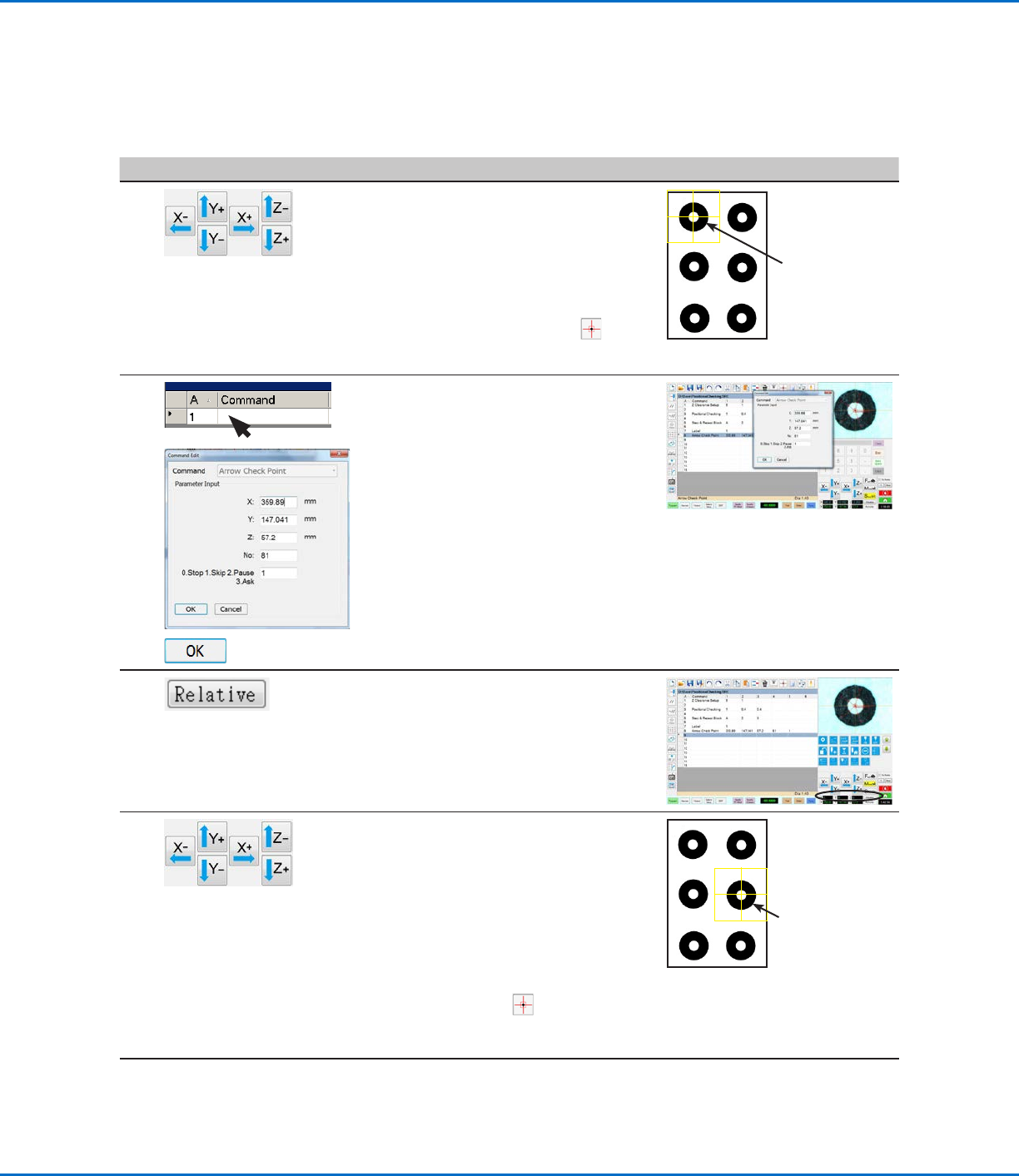
• Jog the camera to center it directly
over the top left dot.
NOTE: Because this dot is the one
used during setup, the camera
should already be at this location.
• Focus the camera.
Tip: Click the Match icon ( ) to
cause the camera to center over the
mark.
Center the
camera over
this dot.
5
>
>
• Insert an Arrow Check Point
command and enter the following:
- NO.: 81
NOTE: This is the number of the
Mark Image that was saved in the
Mark Library during the previous
procedure. Use the correct Mark
Image No. for your program.
- 0.STOP 1.SKIP 2.PAUSE 3.ASK:
1 (for Skip, so the system will
continue through the program
without stopping in order to
demonstrate this feature)
• Click OK.
6 • Click RELATIVE to set the
coordinates to 0, 0, 0.
7 • If you already know the X and Y
offsets of each dot (how far away
each dot is from another dot), then
skip this step.
• To determine the X and Y offsets of
each dot, jog the camera to center
it directly over the dot located in the
2nd row, 2nd column.
Tip: When at the second dot, click
the Match icon ( ) to center the
camera over the mark.
• Make a note of the offsets.
Center the
camera over
this dot.
Continued on next page
Using the Arrow Types (continued)
Positional Checking Example (continued)
To Use Positional Checking in a Program (continued)