YG100R_Mainte_E.pdf - 第41页
3-3 3 Periodic maintenance items 1 . 2 C l e a n i n g T y p e F n o z z l e s ( Y G 1 0 0 R A ) 1 . 2 . 1 R e m o v i n g F N C n o z z l e a s s e m b l y Th i s s e c t i o n e x p l a i n s h o w t o c l e a n T y p …
3-2
3
Periodic maintenance items
6
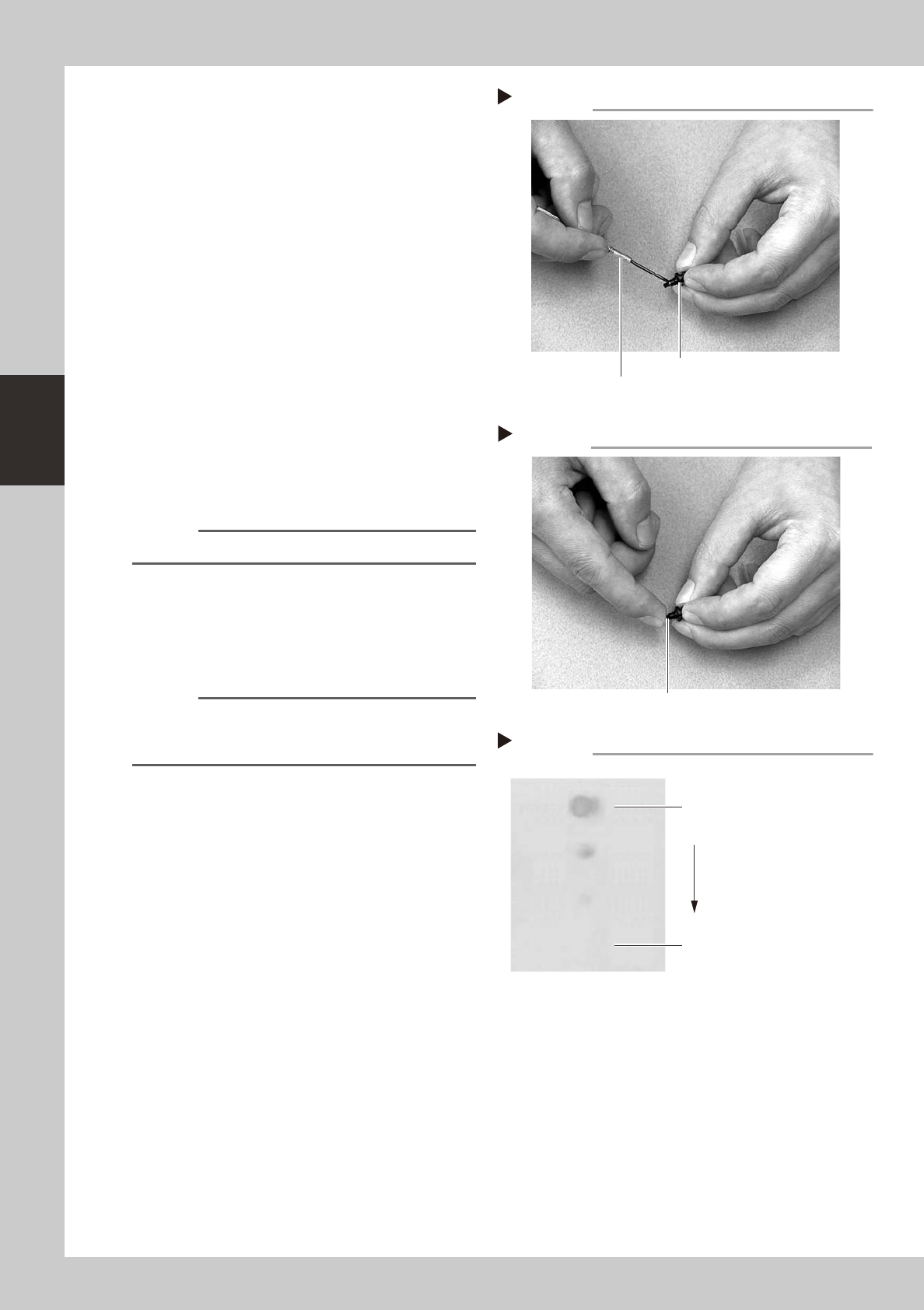
Lubricate the slide section.
Using a precision screwdriver or similar tool
with a pointed tip, apply a small amount of
turbine oil (just enough so that it sinks in) to
the slide section.
53303-F9-10
7
Check the buffing action (spring
action).
Push the nozzle tip several times to repeat
the buffing action and spread turbine oil.
Use a lint-free cleaning cloth to wipe away
excess oil from around the nozzle.
53304-F9-10
8
Remove excess oil remaining in the
nozzle.
Using an air blow gun, blow air for about 5
seconds from the nozzle tip, and for about 5
seconds from the nozzle attachment side.
Repeat this process a few times to remove
excess turbine oil remaining in the nozzle.
n
NOTE
A thin coat of oil is enough to lubricate the slide section.
9
Check that the oil was removed.
Blow air through the nozzle again while
placing commercially-available oil blotting
paper over the opposite end of the nozzle,
and check for residual oil in the nozzle.
n
NOTE
Performing step 8 is usually sufficient to remove oil
remaining in the nozzle. However, if oil still remains then
blow air through the nozzle once again.
53394-F9-00
0
Reinstall the nozzle.
Reinstall the nozzle back onto the head after
checking one more time that there is no oil
remaining there.
Lubricating the slide section
Step 6
Nozzle
Precision screwdriver
(with a small amount of turbine oil applied)
Checking the spring action
Step 7
Spring action at nozzle tip
Step 9
Checking for residual oil
Oil blotting paper
Oil may appear after blowing air
(first time) for about 5 seconds from
the nozzle tip.
Repeat the air blow for about 5
seconds each from the nozzle tip
and from the attachment side.
This task is finished when oil no
longer appears.
3-3
3
Periodic maintenance items
1.2 Cleaning Type F nozzles (YG100RA)
1.2.1 Removing FNC nozzle assembly
This section explains how to clean Type F nozzles used with the YG100RA FNC heads.
1
Perform return-to-origin.
Check safety and press the [Origin] button
on the Setup screen.
2
Select "Type 212F nozzle" for the
FNC heads.
On the [Unit]-[Head] tab screen, press the
[Nozzle Change] button and select "Type-
212F" for the FNC heads (Heads 2, 4, 6 and
8).
e
3
Press the emergency stop button.
The machine must be in emergency stop for
safe maintenance work.
4
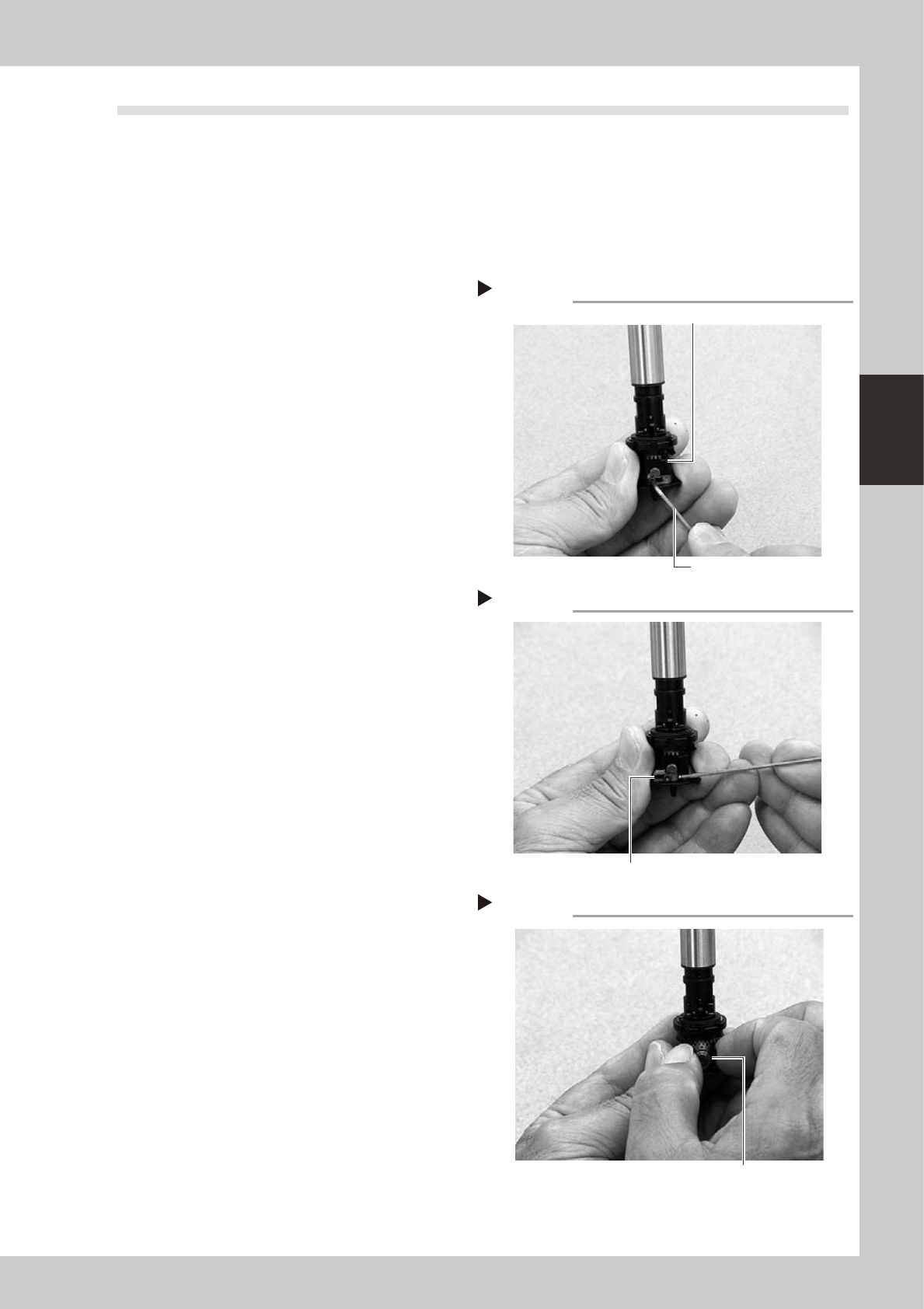
Slide the stopper block outward.
1. Loosen the bolt securing the stopper
block with the M1.5 hex wrench.
2. Slide the stopper block by pushing on
one end of it.
53341-F9-10
53342-F9-10
5
Pull out the FNC nozzle shaft.
While gripping the nozzle assembly, pull out
the FNC nozzle shaft horizontally along with
the bevel gear.
53343-F9-10
Loosening the bolt securing the stopper block
Step 4-1
Hex wrench (1.5)
Stopper block
Pulling out the FNC nozzle shaft
Step 5
Pull the bevel gear and shaft.
Sliding the stopper block outward
Step 4-2
Slide the stopper block outward.
3-4
3
Periodic maintenance items
6
Remove the FNC nozzle assembly.
Pull the FNC nozzle assembly down to
remove it from the head.
53378-F9-10
c
CAUTION
Do not mix up the nozzle assemblies, bevel gears, and
shafts of the different heads. Keep them as the original
set for each FNC head.
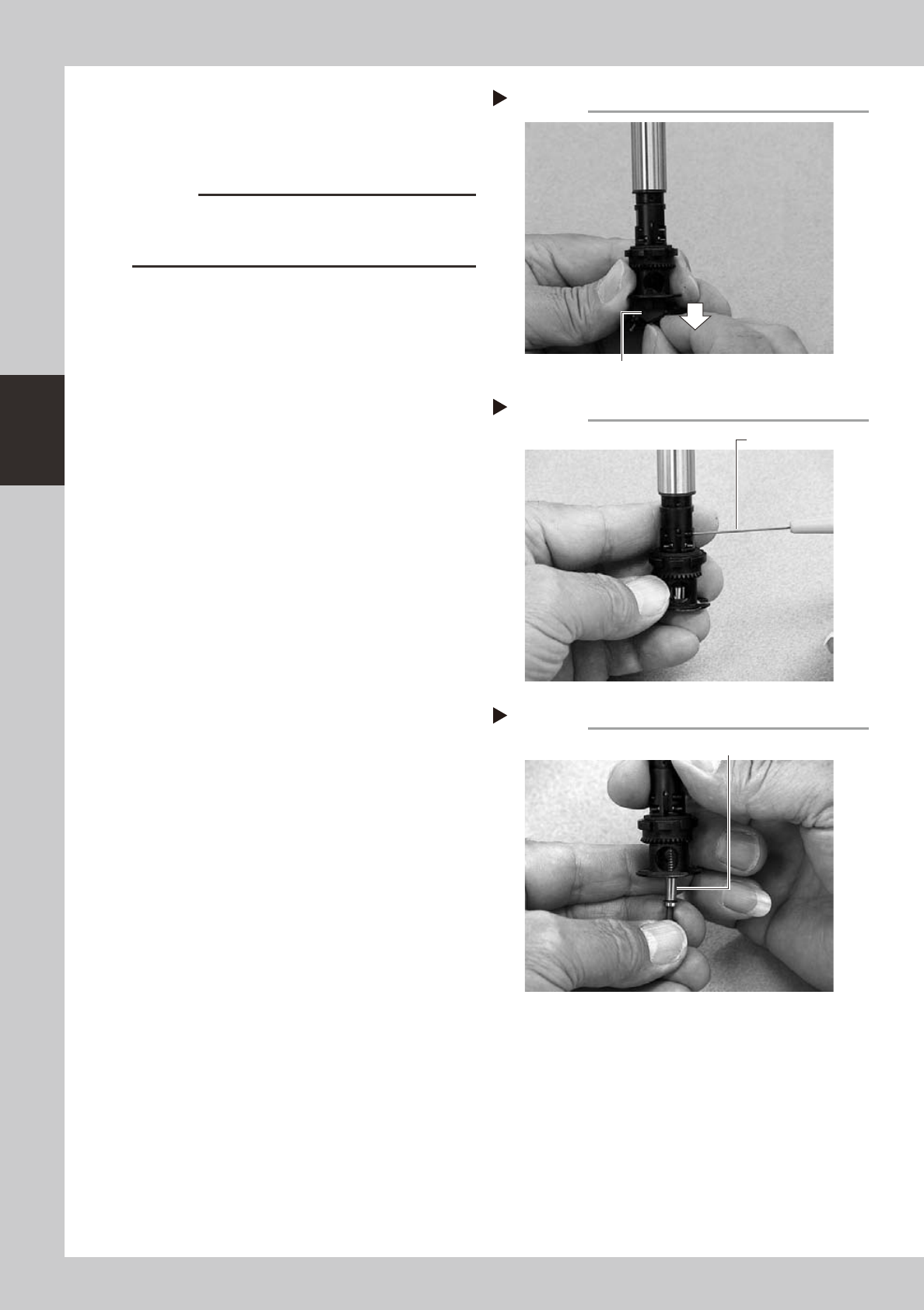
7
Remove the FNC lock pin.
1. Using the M0.7 dedicated hex wrench,
loosen the set screw used to prevent one
of the lock pin cam from being released.
(Stop loosening the set screw at a
position where the cam is retracted in
the shaft.)
2. Retract the lock pin cams fully in the
spline shaft while placing your hand
under the lock pin so that it will not be
pushed out by the internal spring. The
lock pin and spring then come out, so
take them out of the spline shaft.
53398-F9-10
53399-F9-10
Removing the FNC nozzle assembly
Step 6
FNC nozzle assembly
Loosening the set screw
Step 7-1
Dedicated hex wrench
Removing the lock pin and spring
Step 7-2
Remove the lock pin and spring.