265ProFlow.pdf - 第50页
TECHNIC AL RE FERENCE REPLACEM ENT PROCED URES 1.46 ProFlow Manual Chapter Issue 8 Dec 02 NOTE Informat ion on the ProFl ow p arameters are det ailed under Menu Parame- ters in the Machine Progr amming chapter of the Use…

TECHNICAL REFERENCE
REPLACEMENT PROCEDURES
Chapter Issue 8 Dec 02 ProFlow Manual 1.45
c. In Diagnostics the ProFlow menu page can be accessed.
12. Carry out the ProFlow Contact Position Setup in the Calibrations section
later in this chapter.
13. Select Setup on the MMI. Select Load Data and load the product file to be
printed.
NOTE
For an existing product, the product file has already been written. If the
product is new, either edit an existing or default file. (The Machine Program-
ming Chapter of the User Manual refers.)
14. If the loaded file is the correct file for the product this completes Squeegees
to ProFlow Replacement. If the loaded file has to be edited, proceed with
Step 15.
15. Select Edit Data on the MMI and adjust the following ProFlow parameters
as appropriate:
• Transfer Head Size
• Stencil Protection
• System Pressure
• Idle Paste Pressure
• Knead Paste Pressure
• Knead Off-image
• Knead Before Print
• Clean After Knead
• Knead After Replenish
If Advanced ProFlow is set to enabled, adjust the following ProFlow param-
eters as appropriate:
• FWD Start Speed
• FWD End Speed
• RWD Start Speed
• RWD End Speed
• FWD Start Pressure
• FWD End Pressure
• RWD Start Pressure
• RWD End Pressure
If Advanced ProFlow is set to disabled, adjust the following ProFlow param-
eters as appropriate:
• Front Print Speed
• Rear Print Speed
• Print Paste Pressure
TECHNICAL REFERENCE
REPLACEMENT PROCEDURES
1.46 ProFlow Manual Chapter Issue 8 Dec 02
NOTE
Information on the ProFlow parameters are detailed under Menu Parame-
ters in the Machine Programming chapter of the User manual.
Information on the machine set up procedures are detailed in the Machine
Programming chapter of the User manual.
Squeegees to
ProFlow (Infinity)
Instances may occur when the machine is required to print using the ProFlow
module configuration. The following procedure details how to revert the
machine from squeegee use to the ProFlow configuration:
1. In Diagnostics ensure that the squeegees are homed. Position the print
carriage so that removal and fit is carried out within easy reach.
2. Switch the machine OFF and disconnect pneumatics.
3. If squeegees are fitted, remove to a safe stowage.
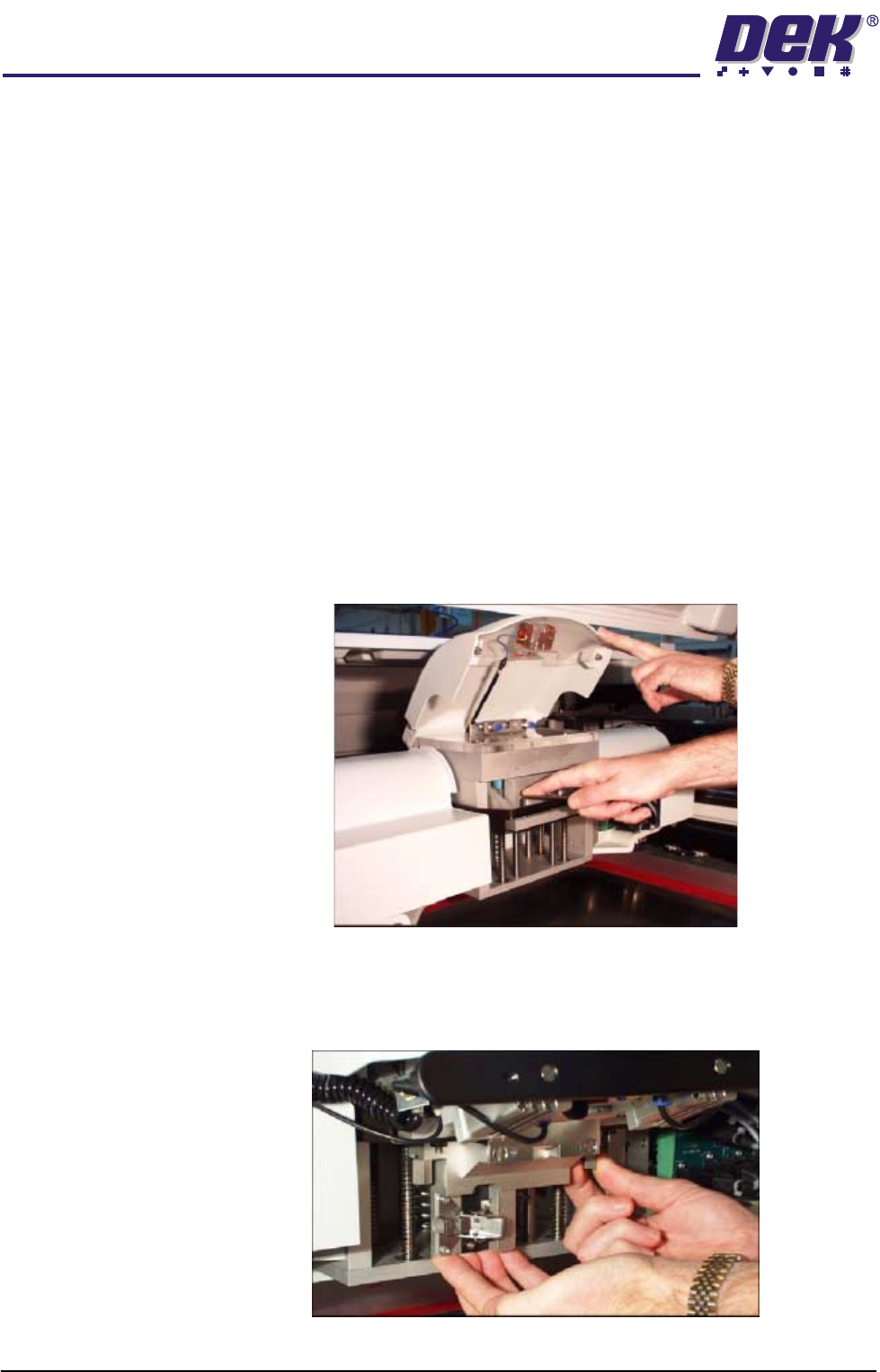
4. Using a 4mm Allen key, remove the front and rear squeegee 'I' bars, (access
to the screws for the front ‘I’ bar is gained by raising the light shroud on it’s
hinge - Figure below refers).
5. Using the existing screws, fit and secure the ProFlow downstop to the front
squeegee 'I' bar mounting position. Ensure that the downstop arms fit
above, to rest upon, the printhead linear webs.
6. Fit the pressure mechanism part of the ProFlow unit to the rear squeegee
mounting plate (where the 'I' bar normally fits) by means of the two securing
bolts. These bolts are easier accessed by fitting the unit in the unlatched
position. Tighten using a 5mm Allen key.
TECHNICAL REFERENCE
REPLACEMENT PROCEDURES
Chapter Issue 8 Dec 02 ProFlow Manual 1.47
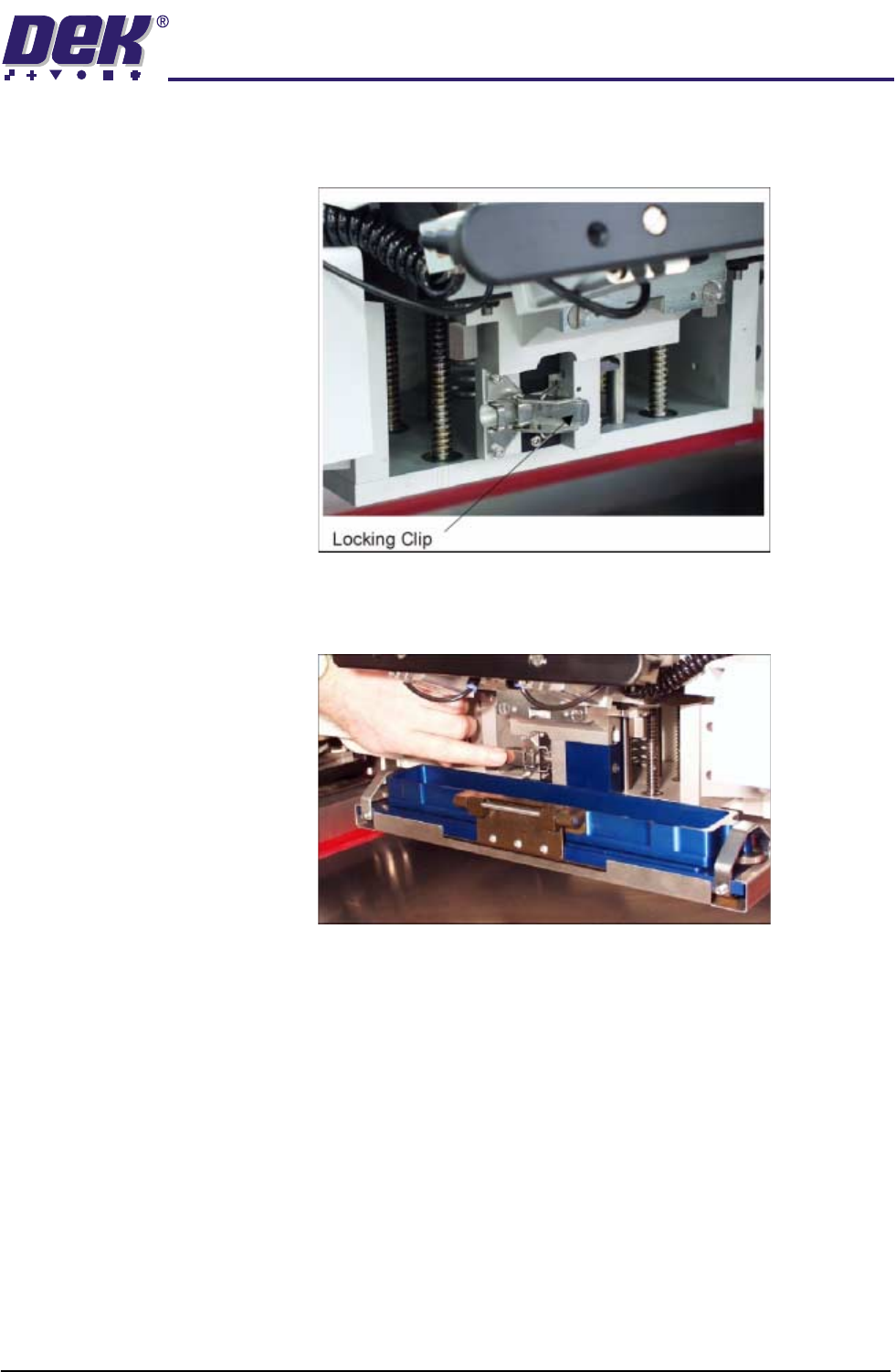
7. Ensure that the locking clip on the pressure mechanism is pressed over to
the right and clicks into place, as shown in the figure below. This ensures
that the locking clip is in the correct position to secure the transfer head.
8. Locate and fit the ProFlow transfer head unit to the pressure mechanism by
means of the two locating dowels. Slide the unit onto the pressure mecha-
nism. Once the unit is slid fully home, it is secured by closing the locking clip.
9. Locate the two pneumatic connectors and one electrical connector sited on
top of the squeegee printhead mechanism by raising the light shroud. Plug
the electrical connection from the ProFlow unit into the electrical socket.
CAUTION
ELECTRICAL CONNECTION.
This electrical connection informs the
machine of ProFlow fitment and must always be connected whilst the
ProFlow unit is fitted otherwise damage may occur if machine is run.
Connect the pneumatic leads from the pressure mechanism to each respec-