CX200-4(Maint).pdf - 第109页
1 . 4 “ERROR” Windows • Window Layout When the machine detects an error , the following “ERROR” window opens. Fig. 4B3 Example of “ERROR” Window • Window Composition *1 Error ID Displayed is a string of alphanumeric char…
Check Code Display Section A Display Section B
801804 Teach Head Bypass Unselected Nozzle Drop.
801805 Teach Head Bypass Dummy Nozzle.
801806 Teach Head Bypass Manual Bypass.
801807 Teach Head Bypass Alarm Error.
(Contents) The nozzle to be taught was bypassed.
(Description) Follow the described instructions to reset the machine to its normal con-
dition.
When the machine cannot be set to its normal condition, consult our
service personnel for the remedy.
801901 Nozzle Adjustment Nozzle UP&Down Action is not Available.
801902 Nozzle Adjustment Communication error.
(Contents) Self-Diagnostics Error Message
(Description) Follow the described instructions to reset the machine to its normal con-
dition.
When the machine cannot be set to its normal condition, consult our
service personnel for the remedy.
801a01 Warning Operation Product started by RUN MODE "PASS"Operation.
(Contents) Self-Diagnostics Error Message
(Description) Confirm the displayed contents.
01 10-003 2-19 AFO01ETRP
1.3 Machine lnformation
1.4 “ERROR” Windows
• Window Layout
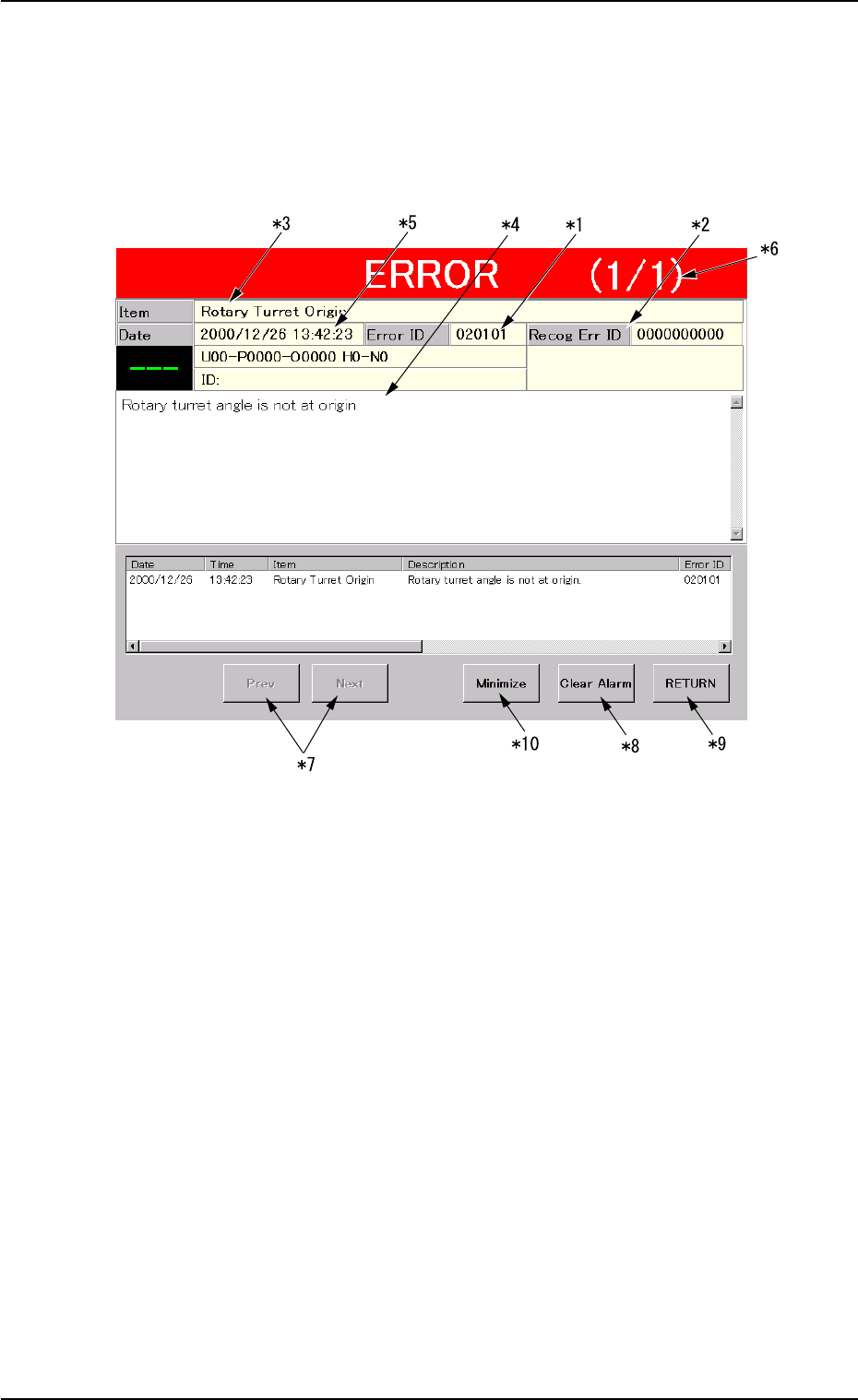
When the machine detects an error, the following “ERROR” window
opens.
Fig. 4B3 Example of “ERROR” Window
• Window Composition
*1 Error ID
Displayed is a string of alphanumeric characters (6 characters)
that identifies an error.
When an error has occurred, use the error ID as an index and refer
to “3. Troubleshooting after Error Window” for details.
*2 Recog Err ID
Displayed is a string of numeric characters (10 characters) that
identifies an error.
When an error has occurred, use the error ID as an index and refer
to “4. Troubleshooting on Recognition System” for details.
*3 Item
Displayed is a name of the classified element that caused an error.
1.4 “ERROR” Windows
01 10-003 2-20 AFO01ETRP

01 10-003 2-21 AFO01ETRP
1.4 “ERROR” Windows
*4 Description
Displayed are the contents of the error.
*5 Date and Time
Displayed are the date and time of error occurrence.
*6 Number of Pages
Displayed are the total number of pages and the number of the
current page.
Example: (3/5)
Total Number of Pages : 5
Number of Current Page : 3
*7 [Prev] and [Next] Buttons
[Prev] Button: When pressed, this button opens the previous page.
[Next] Button: When pressed, this button opens the next page.
*8 [Clear Alarm] Button
When pressed, this button cancels an alarm (sound) only.
*9 [RETURN] Button
When pressed, this button cancels an alarm (sound) and closes
the “ERROR” window. The original window resumes.
• Reset Procedure from “ERROR” Window
(1) Take a note of “Error ID”, “Item (Error Name)”, and “Description” in
the “ERROR” window.
Note: When you have forgotten an error message, refer to the list
of errors in the “Machine Error Recall” window. (Operation
Sequence: [RECALL MSG.] Button (Submenu) Æ “Machine
Error Recall” Window).
(2) Press the [RETURN] button to resume the original window.
(3) Use the error ID as an index and refer to “3. Troubleshooting after
Error Window” and “4. Troubleshooting on Recognition System” for
correct operations to reset the machine to its normal condition.
*10 [Minimize] Button
When this button is pressed, the "ERROR" window is minimized
and moves to the bottom left of the window.
Double-click the minimized window to return it to the size before
it was minimized.