00191017-01.pdf - 第417页
User’s Manual Line Computer UNIX 14 Control / Control Modules Software Version 403.xx Edition 06/97 14.2 Job Control 14 - 17 14.2.3.5 OPTI ONS Menu - Inse rting jobs into the c urrent job li st Newly crea ted jobs c an b…
14 Control / Control Modules User’s Manual Line Computer UNIX
14.2 Job Control Software Version 403.xx Edition 06/97
14 - 16
-
Searching
In the search window different search criteria, e.g. for the name of the line or the subline, are availa-
ble. Making use of a search window, the procedure is the same for all search operations (see also
page 14 - 21).
●
Deactivate all icons in the command area.
●
Click on the
icon.
The dialog window "Search for basic optimization data" opens.
●
Click on the
Subline
search criterion, for example.
●
Enter the
Search word
.
●
Select
Search
or
Search additively
.
The window closes and the matching data are highlighted in the selection area.
●
Click on
Abort
if the search process is to be abandoned.
-
Saving
the edited basic optimization data
●
Click on
FILE
-->
Quit
on the menu bar.
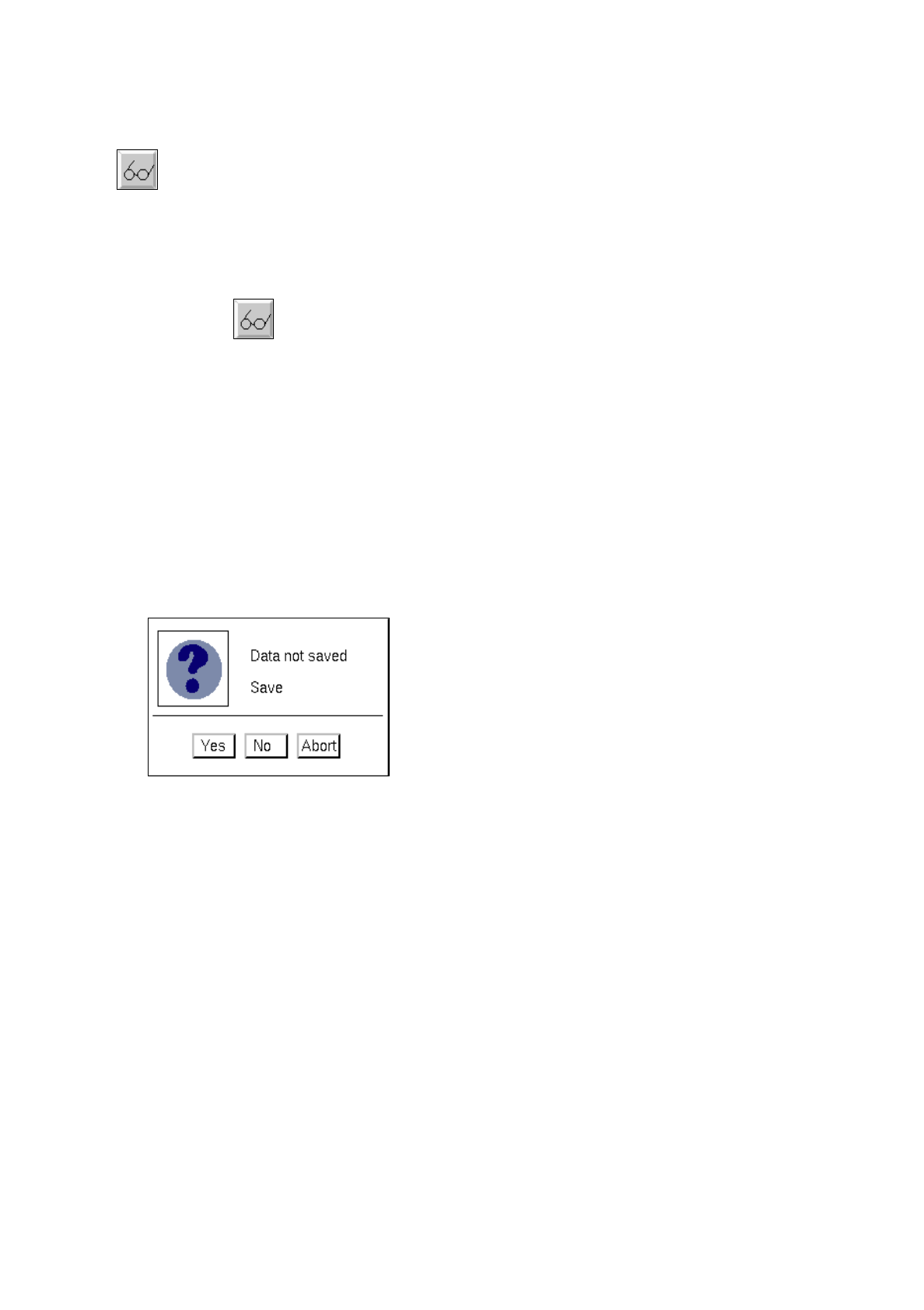
The following dialog box opens.
●
Click on
Yes
in the dialog box.
The dialog box and the "Basic optimization data" window close.
The basic optimization data are saved.

User’s Manual Line Computer UNIX 14 Control / Control Modules
Software Version 403.xx Edition 06/97 14.2 Job Control
14 - 17
14.2.3.5 OPTIONS Menu
-
Inserting jobs into the current job list
Newly created jobs can be inserted at the top of the list (yet behind the jobs already scheduled) or at
the end of the list, or by a mouse-click.
●
Select OPTIONS --> Insert --> File beginning or File end or Mouse click, respectively.
If the mouse-click option for inserting jobs is selected, the new job is inserted below the job which
is clicked-on on the current list, without
prior actuation of "OK" in the command area.
-
Printer selection ...
This option is used to select a connected printer.
●
Click on OPTIONS --> Printer selection ...
The window for printer selection is opened (see chapt. 2).
●
Select the desired printer type.
●
Confirm the selection with OK, or abort procedure with Abort.
-
Auto-schedule ON/OFF
Setting this software switch enables jobs, which are edited within the editing area or which have been
newly created, to be automatically selected for processing provided "Auto-schedule ON" had been
activated earlier under "OPTIONS". This means that the jobs are then automatically subjected to a "pro-
ducibility" check (see section 14.2.3.6) and if they can be processed a standard number of jobs can be
preassigned to each subline. The maximum number is preset and cannot be changed by the operator.
NOTE
"Auto-schedule" preassigns the jobs from top to bottom.
If an error occurs during "Auto-schedule ON" or if the job cannot be processed, the "Auto-schedule"
program stops after the last job which has been produced with the current set-up. An alarm message
occurs. After acknowledging the alarm message, the operator must either delete the job which has
caused the alarm message to occur or to move it further back in the order of sequence, or to place a
new job in front of it.
●
Select OPTIONS --> Auto-schedule ON or Auto-schedule OFF.
-
Deleting files with/without confirmation
If "Delete" has been set in the command area, selected entries can be deleted with or without confir-
mation. If "with confirmation" has been set, a dialog box with the question "Do you want to delete the
specified entries?" (see also "Deleting", page 14 - 20) appears.
●
Select OPTIONS --> Delete with confirm. or Delete without confirm.
-
Saving default values
With this option the currently set values can be saved so that these values will be preset by default
when the Job Control is re-started.
●
Activate OPTIONS --> Save default values.
The set values are saved.

14 Control / Control Modules User’s Manual Line Computer UNIX
14.2 Job Control Software Version 403.xx Edition 06/97
14 - 18
14.2.3.6 Command Area, Section "Actions"
The "Actions" section of the command area (see Fig. 14.2.1) contains the commands for the manipulation of
jobs. In the following, function and execution of the individual commands are explained.
For the execution of the commands, the same procedure is always to be followed
(with the exception of the "Move" command):
●
Activate the icon for the respective command by clicking on it.
●
If several jobs are to be selected, click on them successively using the right mouse button, only
the last
job is to be clicked on with the left mouse button.
To deselect any accidentally selected jobs, the right mouse button is to be used as well.
Or,
●
to select an individual job, click on it directly using the left mouse button.
The action (command) is started.
During or after an action, entries are automatically made in the "Js" column (see Fig. 14.2.1) behind the
selected jobs. Their meaning is as follows:
R = status after a job has been inserted or changed, or after a scheduled job has
been interrupted
tP = job is being checked for "Producibility"
P = job is being checked for "Producibility" with "Schedule" selected
aP = job is automatically being checked for "Producibility" with option "Auto-schedule ON"
selected
S = denotes that a job has been scheduled for processing
pP = job is being checked for "Producibility" and "Prior. schedule" has been activated
for this job
bP = while a job is being checked for producibility through "triggering" of a new barcode
e S= if a job has been scheduled by means of "Prior.schedule"
I = for as long as the production of a scheduled job has been aborted by "Interrupt"
-
(Producibility)
A selected job is checked for "Producibility". I.e. the postprocessor "NU-Compile" is started, NU-Com-
pile starts "RS-Compile"; RS-Compile starts "MA-Compile". All data required for this job are thus chek-
ked or newly generated. If the result of the producibility check for the selected job is negative (i.e. it
cannot be processed) an "E" is entered in front of this job in the column "E" (see Fig. 14.2.1).
-
(Schedule)
A selected job can be scheduled for processing. In the event of "schedule" the job concerned is chek-
ked for "producibility" prior to being passed to the machine controller. In the station controller the pre-
selected job is added to the end of the list of jobs to be processed.