slau358q.pdf - 第20页
Programming MSP Flash Devices Using the MSP Gang Programmer www.ti.com 20 SLAU358Q – September 2011 – Revised October 2019 Submit Documentation Feedback Copyright © 2011–2019, Texas Instruments Incorporated Operation NOT…
www.ti.com
Programming MSP Flash Devices Using the MSP Gang Programmer
19
SLAU358Q–September 2011–Revised October 2019
Submit Documentation Feedback
Copyright © 2011–2019, Texas Instruments Incorporated
Operation
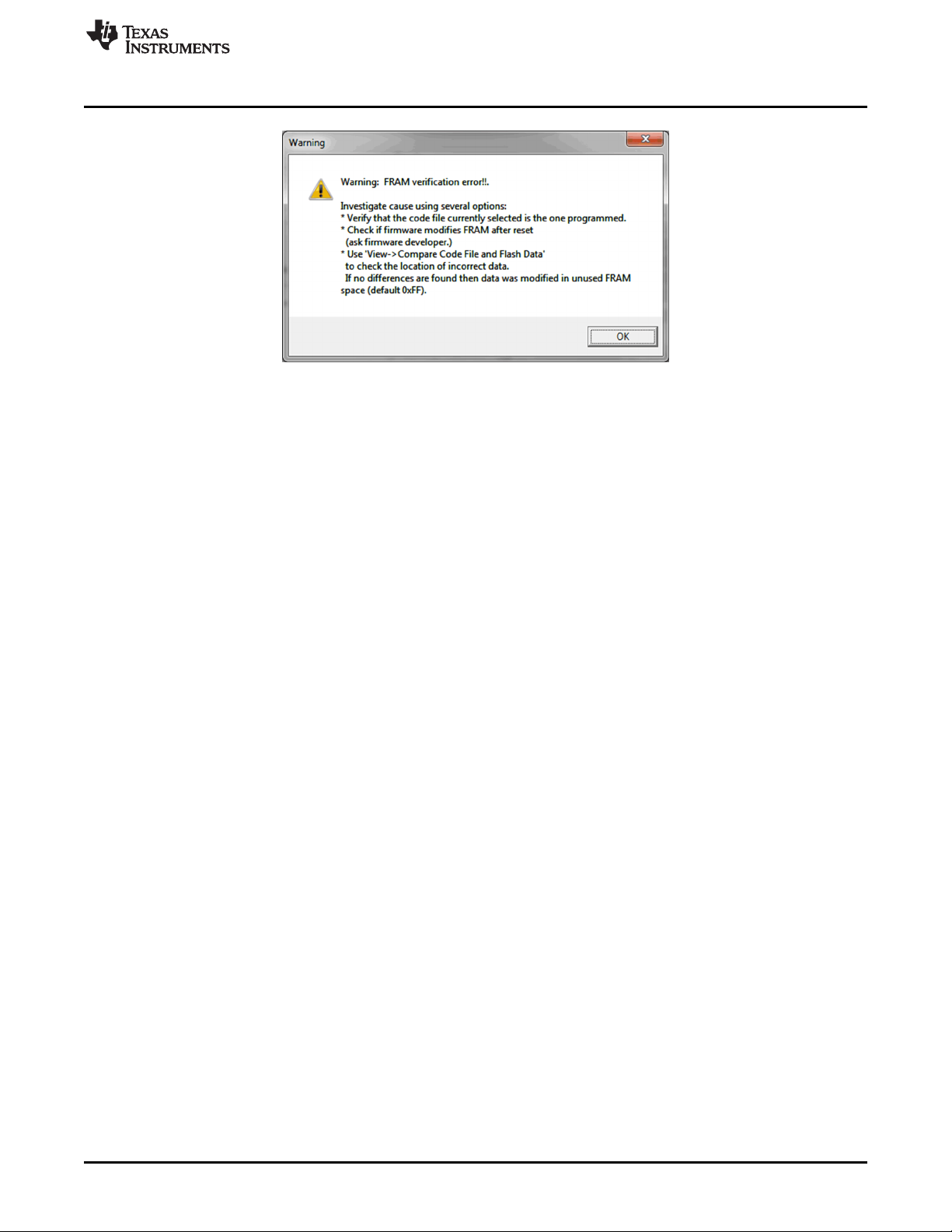
NOTE: Verification failed on MCU with FRAM type memory
Figure 2-4. Verification Error
2.1.1.6 Read
Click the Read button in the Main Dialog GUI to read the contents of the target MCU's flash memory. Use
the Memory Options configuration screen shown in Figure 2-2 to specify which addresses should be read
(Section 2.1.5 describes in detail how to use the memory configuration window).
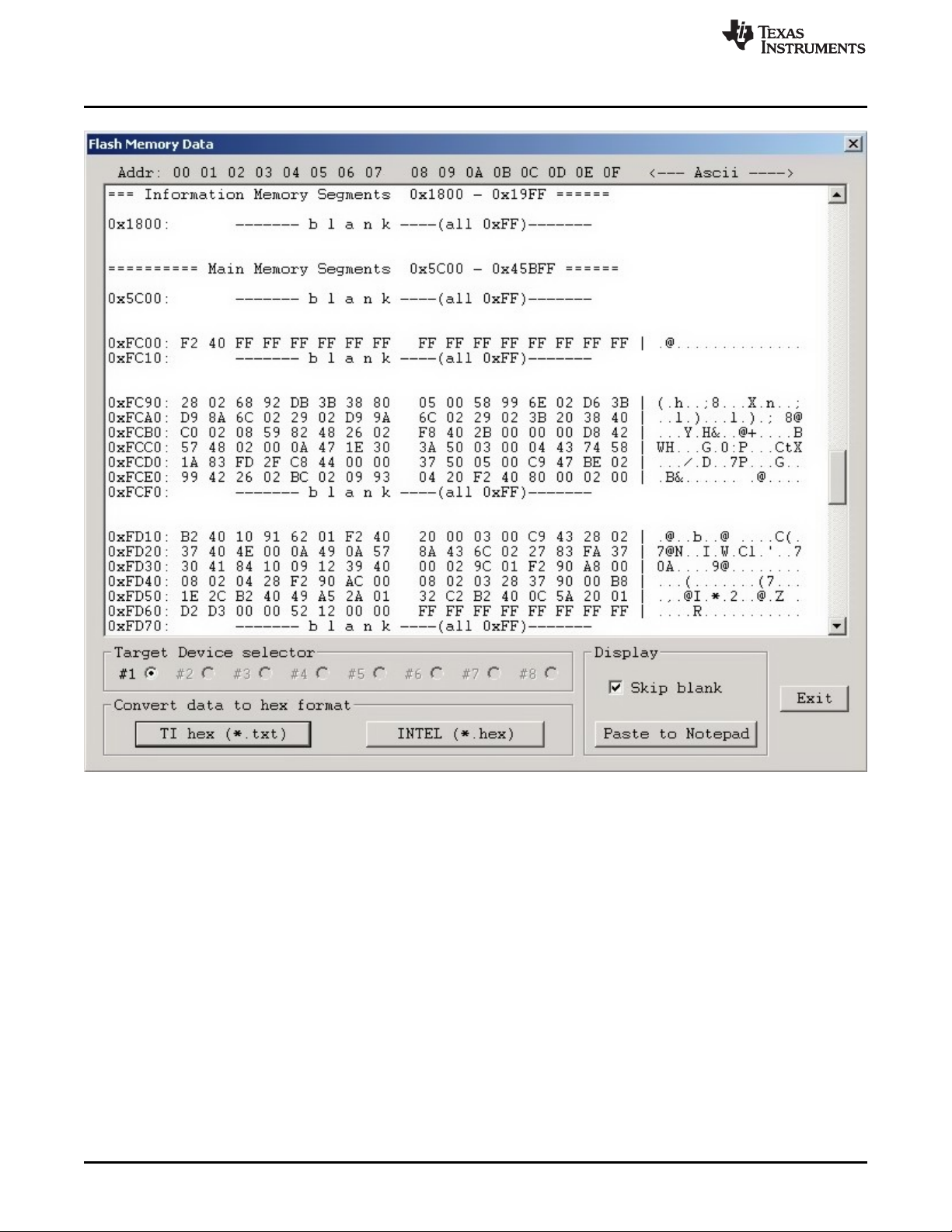
Once used, data is displayed in the Flash Memory Data window as shown in Figure 2-5. This window can
be selected in the View→Flash Memory Data pulldown menu. The Flash Memory Data viewer, shown in
Figure 2-5, displays the code address on the left side, data in hex format in the central column, and the
same data in ASCII format in the right column. The contents of the code viewer can be converted to TI
(*.txt) or Intel (*.hex) file format by clicking on the "TI hex" or "INTEL" button.
Programming MSP Flash Devices Using the MSP Gang Programmer
www.ti.com
20
SLAU358Q–September 2011–Revised October 2019
Submit Documentation Feedback
Copyright © 2011–2019, Texas Instruments Incorporated
Operation
NOTE: This window displays the code addresses on the left side, data in hex format in the center column, and the
same data in ASCII format in the right column.
Figure 2-5. Flash Memory Data
2.1.2 Programming From Image
A programming configuration like the one created in Section 2.1.1 can be stored in the form of an image.
The advantage of an image is that it contains both the configuration options necessary for programming
as well as the code files that are flashed to target devices. Moreover, only images can be saved to internal
MSP Gang Programmer memory and used in Standalone mode, in which the programmer can operate
without being connected to a PC. Using the From Image mode allows the user to test images with full GUI
support before committing them to production.
When an image has been created, it can be used to greatly simplify programming by using the procedure
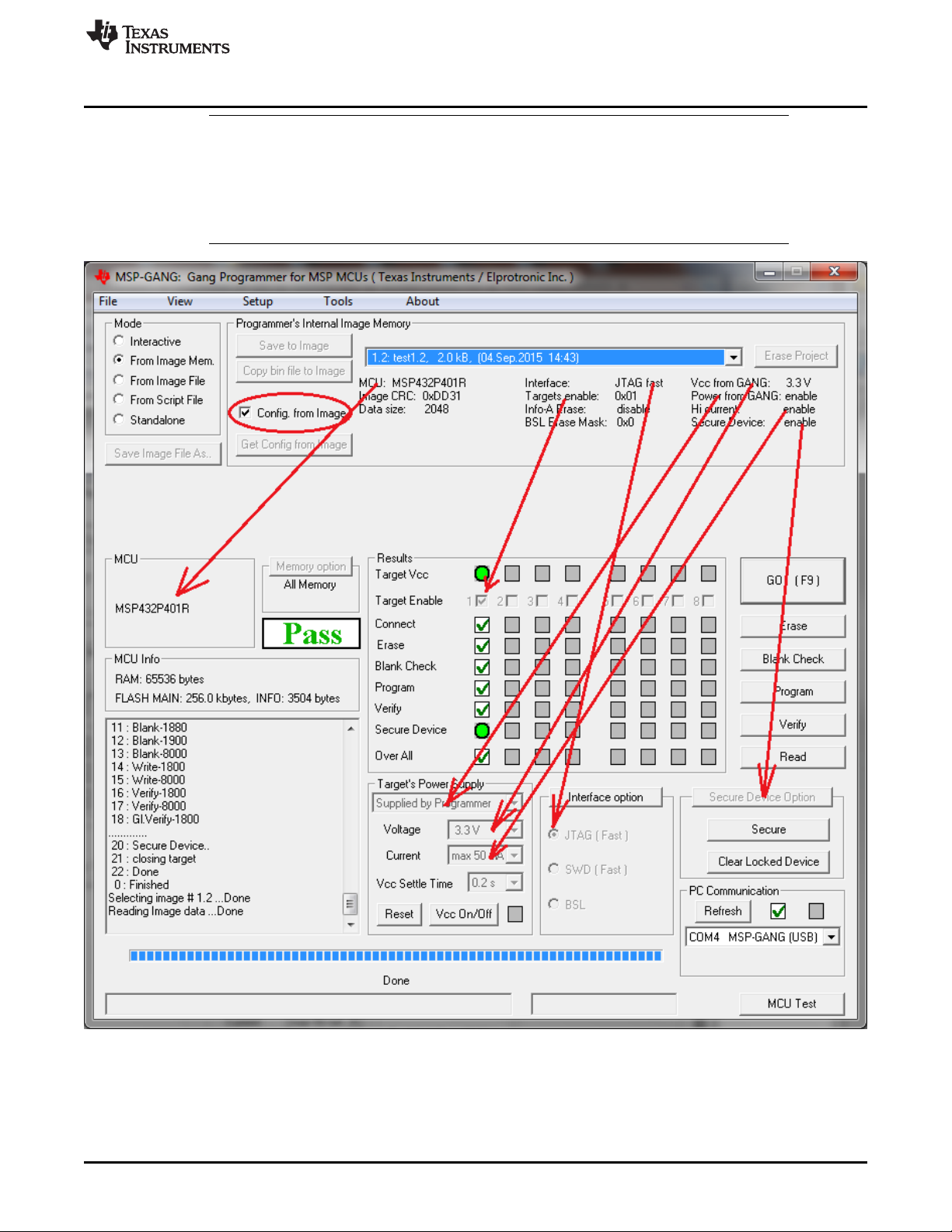
described in Section 2.1.9. Figure 2-6 shows the main dialog GUI where the From Image option is
selected for programming (top left corner). Here the user can load an image from MSP Gang Programmer
internal memory. An image can be created in Interactive Mode and saved to the programmer. One of 96
different images can be selected from internal memory, or one image from each external SD-Card can be
used.
www.ti.com
Programming MSP Flash Devices Using the MSP Gang Programmer
21
SLAU358Q–September 2011–Revised October 2019
Submit Documentation Feedback
Copyright © 2011–2019, Texas Instruments Incorporated
Operation
NOTE: MSP Gang Programmer internal memory and SD-Card are mutually exclusive.
To avoid confusion during programming, connecting an SD-Card to the MSP Gang
Programmer disables its internal memory used for other images. Therefore, when an SD-
Card is connected to the programmer only the image on the SD-Card is usable or
accessible. If the SD-Card is empty, or contains a corrupted image, then it must be
disconnected before MSP Gang Programmer internal memory can be used.
NOTE: This figure shows the From Image Mode (see the Mode section near the top left corner). The user can
load an image from MSP Gang Programmer internal memory. Saved images contain all configuration
necessary for programming and all code files. An image can be created using the Interactive Mode and
saved to the programmer. One of 96 different images can be selected from internal memory, or one image
from each external SD-Card can be used.
Figure 2-6. Main MSP Gang Programmer Dialog GUI, From Image Mode