slau358q.pdf - 第32页
Programming MSP Flash Devices Using the MSP Gang Programmer www.ti.com 32 SLAU358Q – September 2011 – Revised October 2019 Submit Documentation Feedback Copyright © 2011–2019, Texas Instruments Incorporated Operation Fig…
www.ti.com
Programming MSP Flash Devices Using the MSP Gang Programmer
31
SLAU358Q–September 2011–Revised October 2019
Submit Documentation Feedback
Copyright © 2011–2019, Texas Instruments Incorporated
Operation
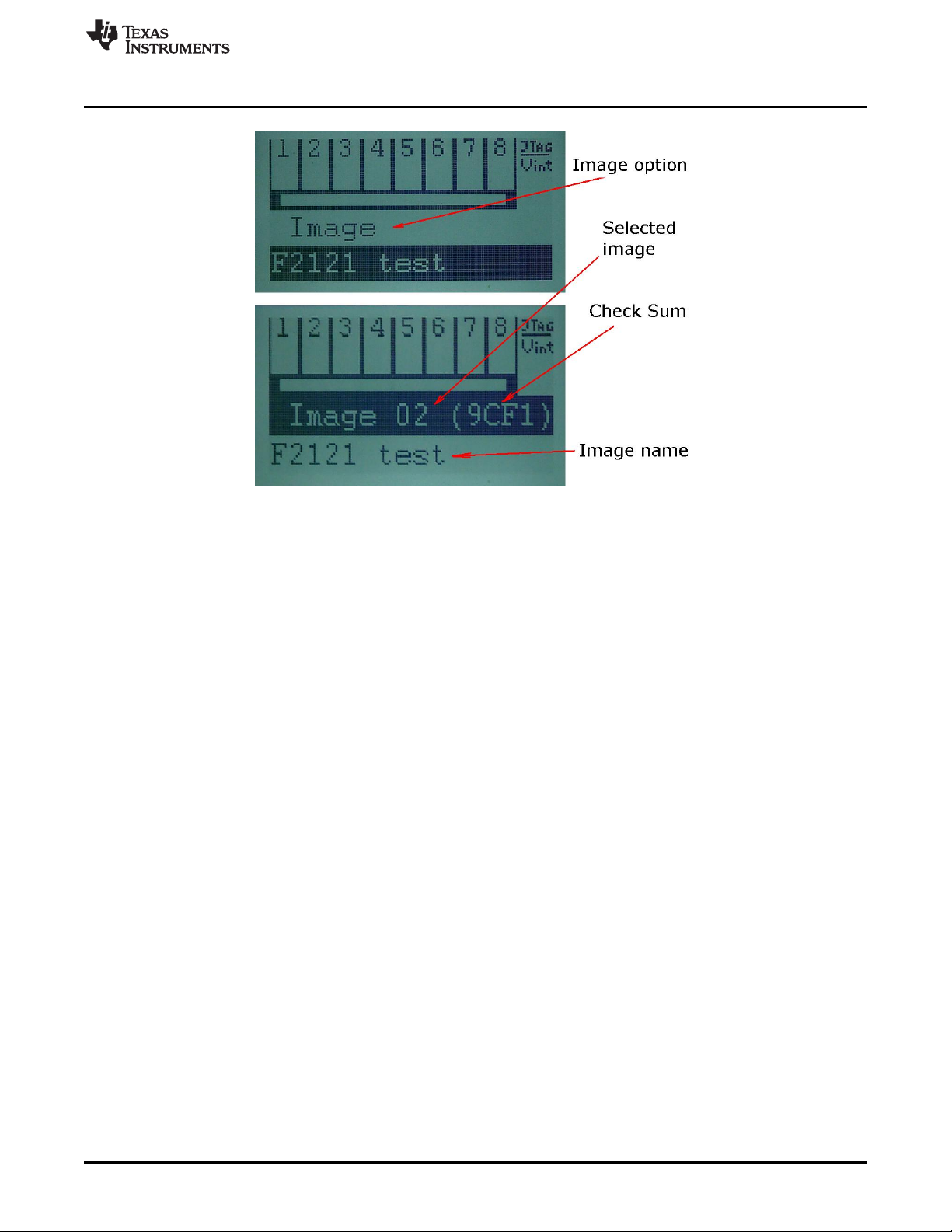
Figure 2-10. Image Option
After the desired image has been selected, press the GO button on the MSP Gang Programmer hardware
to start programming. This button operates the same way as the GO button on the GUI. Progress of the
operation in Standalone mode is indicated by a flashing yellow LED and displayed on the LCD display.
The result status is represented by green and red LEDs on the MSP Gang Programmer and details are
displayed on the LCD display. If a green LED is ON only, then all targets have been programmed
successfully. If only the red LED is displaying, that all results failed. If red and green LEDs are on, then
result details should be checked on top of the LCD display. The LCD display shows target numbers 1 to 8
and marks to indicate failure or success: X for failure and V for success. When an error is reported, the
bottom line repeatedly displays an error number followed by a short description with time intervals of
approximately two seconds.
The selected image contains all necessary configuration options and code files required for programming;
however, the user can change the number of target devices being programmed using onboard buttons.
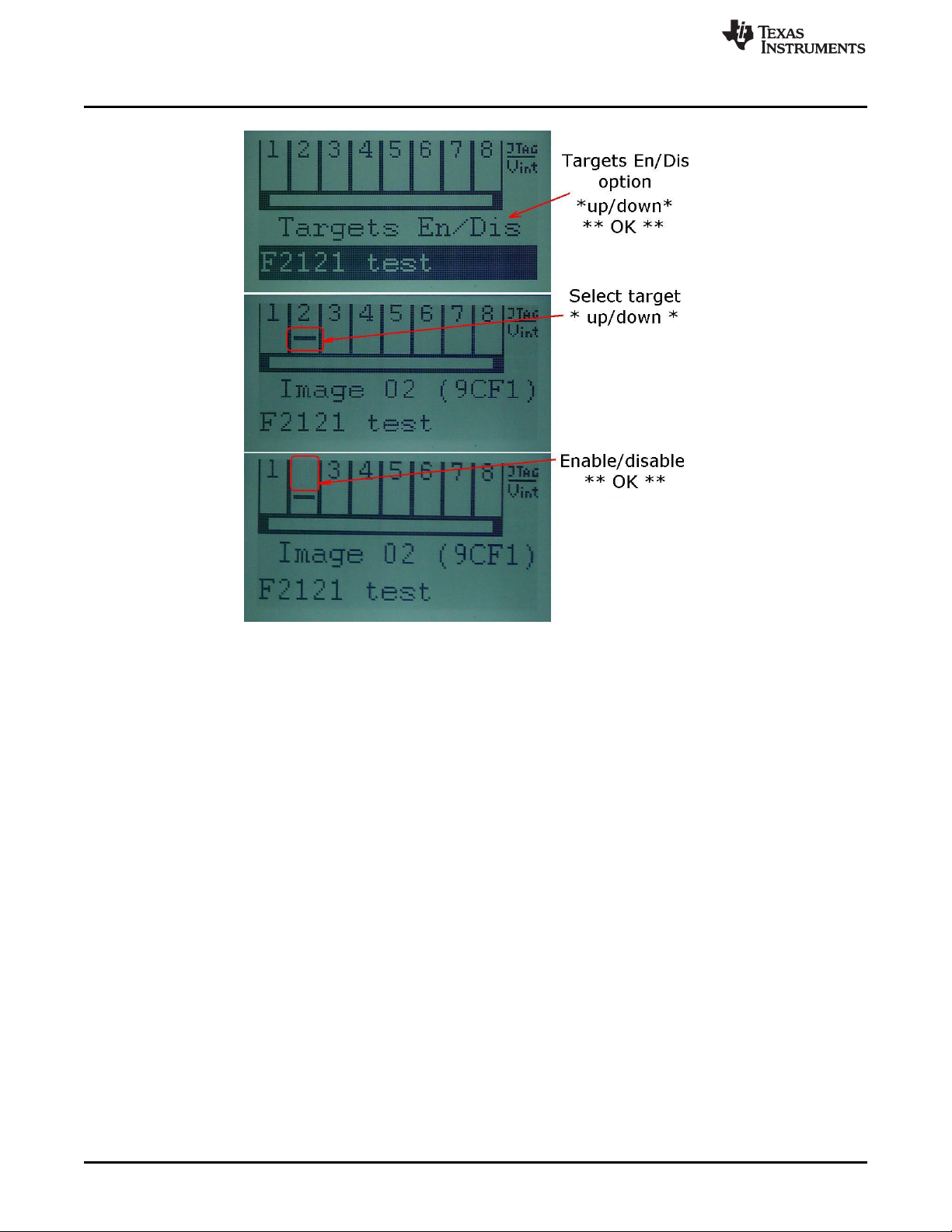
On the main display of the MSP-Gang Programmer (see Figure 2-11), use the up or down arrow buttons
to find the Target En/Dis option. Press the OK button to enter this menu. A sliding cursor appears below
the numbers representing each device at the top of the main display. Use the arrow buttons to underline
the device to enable or disable. Press OK to toggle the devices; press Esc to exit to the main menu. Press
GO to use the selected image to program the selected devices. If another image is selected or the current
image is selected again, the Enable and Disable options reset to what has been configured in the image.
Programming MSP Flash Devices Using the MSP Gang Programmer
www.ti.com
32
SLAU358Q–September 2011–Revised October 2019
Submit Documentation Feedback
Copyright © 2011–2019, Texas Instruments Incorporated
Operation
Figure 2-11. Target Enable or Disable Option
In addition to the these options that control programming, the contrast of the LCD display can be changed.
Select the Contrast option in the main menu, and press OK. Then use the up and down arrow buttons to
adjust the screen contrast. Changes to contrast reset after power down, unless the contrast setting has
been set by the GUI on the host computer.

www.ti.com
Programming MSP Flash Devices Using the MSP Gang Programmer
33
SLAU358Q–September 2011–Revised October 2019
Submit Documentation Feedback
Copyright © 2011–2019, Texas Instruments Incorporated
Operation
2.1.5 Memory Setup for GO, Erase, Program, Verify, and Read
The GO, Erase, Program, Verify, and Read operations shown in Figure 2-1 use addresses specified in the
Memory Options dialog screen shown in Figure 2-2. The memory setup used by these operations has five
main options:
1. Update only – When this option is selected, the GO operation does not erase memory contents.
Instead contents of code data taken from the code file are downloaded to flash memory. This option is
useful when a relatively small amount of data, such as calibration data, needs to be added to flash
memory. Other address ranges should not be included in the code file, meaning that the code file
should contain ONLY the data which is to be programmed to flash memory. For example, if the code
file contains data as shown in TI format:
@1008
25 CA 80 40 39 E3 F8 02
@2200
48 35 59 72 AC B8
q
Then 8 bytes of data are written starting at location 0x1008 and 6 bytes of data starting at location
0x2200. The specified addresses should be blank before writing (contain a value of 0xFF). Before the
writing operation is actually performed, the MSP Gang Programmer automatically verifies if this part of
memory is blank and proceeds to program the device only if verification is successful.
NOTE: Even Number of Bytes
The number of bytes in all data blocks must be even. Words (two bytes) are used for writing
and reading data. In case that the code file contains an odd number of bytes, the data
segment is appended by a single byte containing a blank value of 0xFF. This value does not
overwrite the current memory contents (because Update only is selected), but verification
fails if the target device does not contain a blank value of 0xFF at that location.
2. All Memory – This is the most frequently used option during programming. All memory is erased before
programming, and all contents from the code file are downloaded to the target microcontroller's flash
memory. When the microcontroller contains an INFO-A segment that can be locked (for example the
MSP430F2xx series contains DCO constants at locations 0x10F8 to 0x10FF), then INFO-A can be
erased or left unmodified. The including locked INFO-A segment should be selected or unselected
respectively. When INFO-A is not erased, none of the data is saved into INFO-A, even if this data is
specified in the code file. In addition, the DCO constants in the Retain Data in Flash group should be
selected if the DCO constants should be restored after erasing the INFO-A segment.
3. Main memory only – Flash information memory (segments A and B, C, D) are not modified. Contents
of information memory from the code file are ignored.
4. Used by Code File – This option allows main memory segments and information memory segments to
be modified when specified by the code file. Other flash memory segments are not touched. This
option is useful if only some data, like calibration data, needs to be replaced.
5. User defined – This option is functionally similar to options described before, but memory segments
are explicitly chosen by the user. When this option is selected, then on the right side of the memory
group, in the Memory Options dialog screen, check boxes and address edit lines are enabled. The
check boxes allow the user to select information memory segments to be enabled (erased,
programmed, verified). Edit lines in the Main Memory group allow the user to specify the main memory
address range (start and stop addresses). The start address should specify the first byte in the
segment, and the stop address should specify the last byte in the segment (last byte is programmed).
Because the main memory segment size is 0x200, the start address should be a multiple of 0x200; for
example, 0x2200. The stop address should specify the last byte of the segment to be written.
Therefore, it should be greater than the start address and point to a byte that immediately precedes a
memory segment boundary; for example, 0x23FF or 0x55FF.