PPS Pro version 8.2.pdf - 第141页
4022 591 98 247 User Manual 05.07 P PS-Pro v8.2 137 Guidelines for using PPS-Pro FIGU RE 13 Workflow Pr e-assignmen t Action specification 1 can al so be used with the exten ded setup. ! WARNING: It is likely th at PCB 1…
User Manual 4022 591 98247
136 PPS-Pro v8.2 05.07
Guidelines for using PPS-Pro
3.6 Specify FeederOffset
The ‘FeederOffset’, which can be specified for each individual feeder in the
ALE file, expresses the number of slots away a feeder must be placed from a
specified feeder. This value measures the slots between the feeders’ address
slots (the address slot is the slot among those consumed that is plugged into
the bank). Information on offsets for your feeders is described in your
machines documentation. Refer to that documentation to set up FeederOffsets
in the ALE file. The ‘FeederOffset’ is only used by the ‘Line Scheduler’, ‘Board
Scheduler’ and ‘Runtime Balancer’. The Assembléon optimizers do not use this
value. Instead exact dimensions, which are provided by means of initial data
tables, are used.
NOTE: When FeederOffset statements are used, the ‘Slots’ and ‘AddrSlot’
statements are ignored. The ‘FeederOffset’ can play a significant role when
a line is specified which contains some different machine types.
3.7 Pre-assign Feeders
Every PCB calculation results in a number of .con files (one per machine in the
line). A.con file contains information on the feeder setup of machines for the
calculated PCB (among other information).
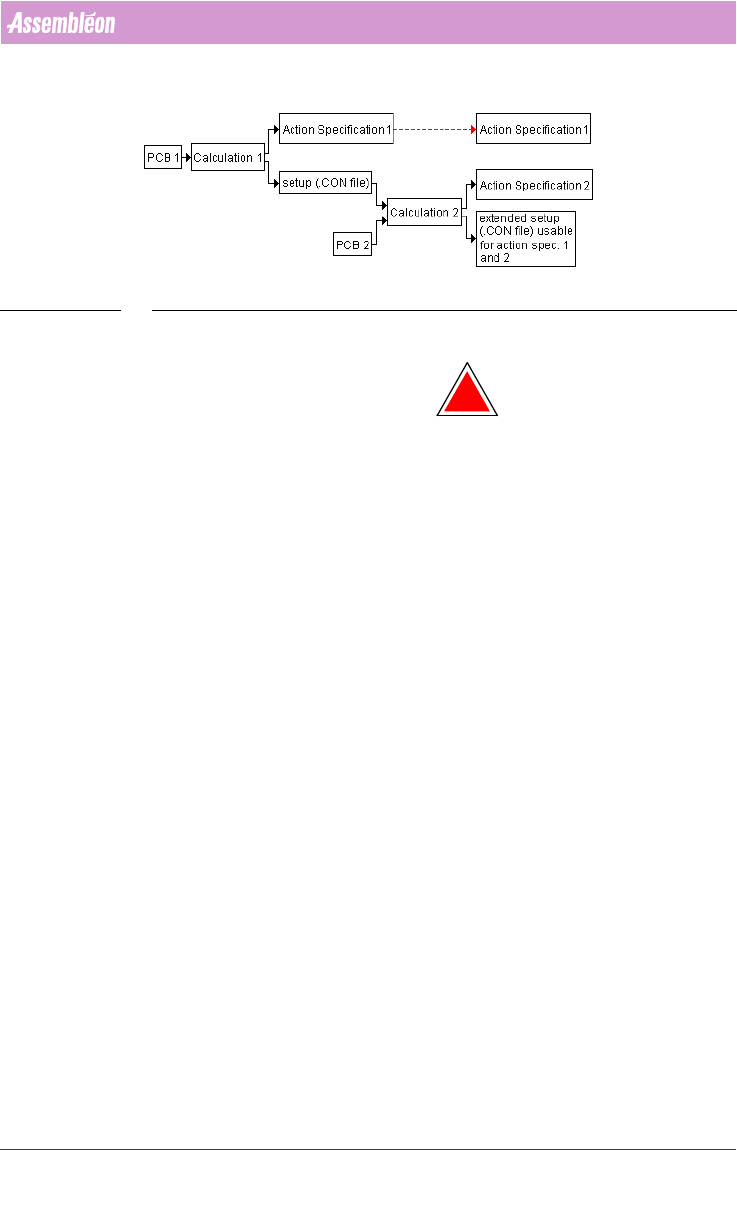
It is possible to use the .con files that belong to current machine configu-
rations as input for a new PCB calculation. This ensures that the same setup
can be used for both PCBs. This leads to a considerable decrease of the change
over time.
An important rule is that the .con file that a user wishes to re-use as input
has to be copied to another directory since a new calculation will overwrite it.
In principle .con files have to match the flowlines (see FIGURE 13 on page
137). It is not advised to use .con files for flowlines with different setups/
layouts unless the user is sure that there will not be any incompliancy.
It is not possible to use .con files when the feederbars have not been fixed
(meaning they have to be specified in the ALE file when a pre-assignment is
applied).
4022 591 98247 User Manual
05.07 PPS-Pro v8.2 137
Guidelines for using PPS-Pro
FIGURE 13 Workflow Pre-assignment
Action specification 1 can also be used with the extended setup.
!
WARNING: It is likely that PCB 1 contains parts that are not in PCB 2. In this case,
ensure that the parts that are in PCB 1 and not in PCB 2 are present in the
PSI file that is used for the calculation. Otherwise the .con file resulting
from calculation 2 will not contain all setup information.
In general, PCB 2 is a newer version of PCB1. This method works most effi-
ciently if changes are small.
The .con files can also be used to pre-assign nozzles to heads on machines.
3.7.1 Modification of older PSI files
In some older PSI files (Version 6.0 and 6.1) this field is named
‘Philips_AlternatPos’ instead of ‘Philips_AlternatePos’ If the PSI file contains
this error, it is necessary to correct it. This can be achieved by following the
instructions below.
1. Start the Part Information Manager (PIM).
2. Select the Types tab.
3. For all types shown (*, C, CR, J, PackageDesc,...) select the field
‘Philips_AlternatPos’ and change it to Philips_AlternatePos’. To change the
name of a selected field click the Rename button. After all modifications
have been done, save the file.
The procedure that needs to be followed in order to obtain alternate feeding
depends on the type of feeder. Below, the procedure is described for tape,
stick and tray.
3.7.2 Alternate feeding with tape feeders (ACM)
Start PIM and select the part or package that requires alternate feeding.
Select the field ‘Philips_AlternatePos’ and set its value to ‘YES’.

User Manual 4022 591 98247
138 PPS-Pro v8.2 05.07
Guidelines for using PPS-Pro
Furthermore set the ‘FeederTypeName’ to <Feeder_id> _ALT. Note that the
<Feeder_id> must be a known feeder, example of a name of such a definition:
ITF2_24_ALT. Currently only the ITF2 feeders are supported. Those ‘*_ALT’
feeders have twice the size of the original feeder, thus ensuring enough room
for the alternate pick position.
3.7.2.1 Adding alternate feeders in the ALE file (ACM)
Note that in the current default ALE files the alternate feeders are not
present. These can be defined as follows:
Add feeder definitions of the alternate feeder(s) to the ALE file, the following
feeders can be defined: ITF2_08_ALT, ITF2_08s_ALT, ITF2_12_ALT,
ITF2_16_ALT, ITF2_24_ALT, ITF2_32_ALT, ITF2_44_ALT and ITF2_56_ALT. Both
name and type must have this name. (Do not use Reel* names) Define twice
the number of slots as the regular feeder has.
Add the feeder(s) to the applicable feederbank definition(s) from the
machines that must get assignments of alternate feeders.
3.7.3 Alternate feeding with stick feeders (ACM)
Start PIM and select the part or package that requires alternate feeding, select
the field
‘Philips_AlternatePos’ and set its value to ‘YES’.
3.7.4 Alternate feeding with trays (ACM and AQ)
Start PIM and select the part or package that requires alternate feeding.
‘Philips_AlternatePos’ and set its value to ‘YES’.
After optimization, the AS generator tries to locate an empty slot in the tray
trolley and it fills this slot with the same part.
3.8 Tracks on Twin Bulk Feeders
‘Tracks’, also known as ‘lanes’, are different feederpositions on e.g. ‘Twin Bulk
feeders’. In the next paragraphs there are examples how to pre-assign a track.
This keyword in the ALE file is used with MPGs that support multi-track
feeders, which contain multiple part numbers. The concept of ‘tracks’ is used
to differentiate the locations in the feeder for part pickup and placement. The
value of this keyword (in below example ‘2’) indicates the number of track
locations that exist in the feeder.
NOTE: For ALE specifications Refer to manual “Description ALE-file 12nc 4022 591
98715”