BA-UI-EN-D33363.pdf - 第46页
46 D33363 | Date 01/2020 Maintenance and service 8. Maintenance and service 8.1 Cleaning Warning! Danger due to electric shock. Before doing any maintenance work, pull out the mains plug. Warning! In case of appliances o…
D33363 | Date 01/2020 45
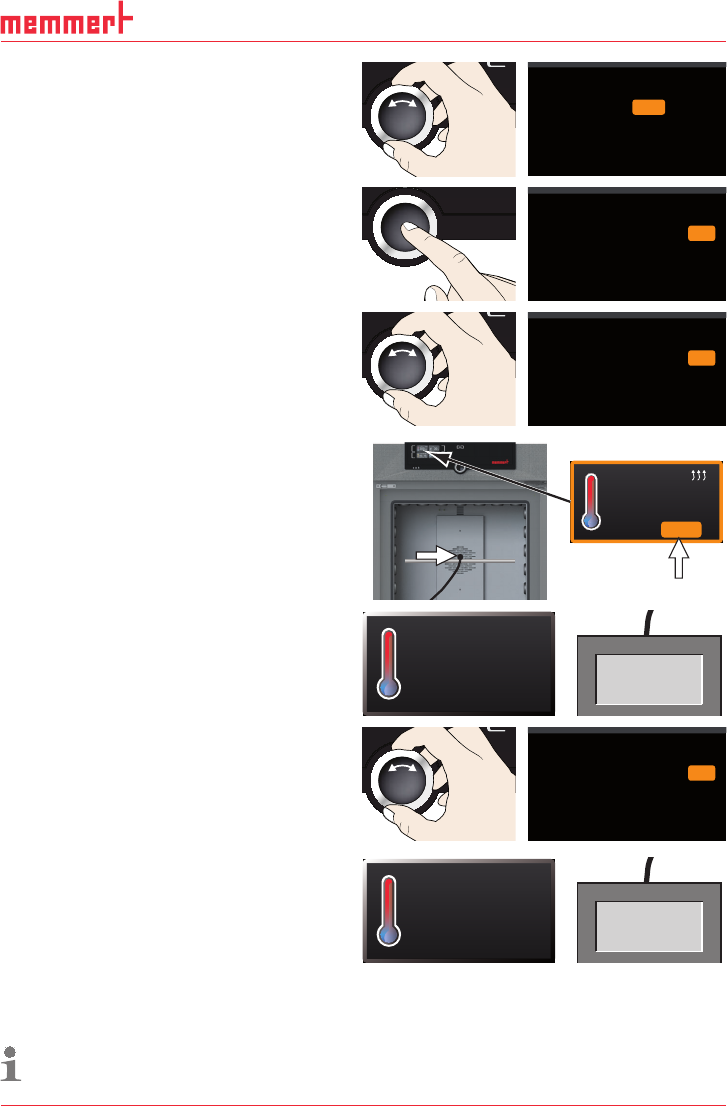
Menu mode
3. With the turn control, set the calibration
temperature Cal2 to 120 °C.
CK0,2-
CK0,1+
CK0,2-
Temperature
Cal1
Cal2
Cal3 180.0
40.0
120.0
4. Save the setting by pressing the confir-
mation key. The corresponding calibra-
tion value is automatically highlighted.
CK0,2-
CK
CK
0,2-
Temperature Cal1
Cal2
Cal3 180.0
40.0
120.0 0,1+
5. Set the calibration value to 0.0 K and ac-
cept the setting by pressing the confirma-
tion key.
CK0,2-
CK
CK
0,2-
Temperature Cal1
Cal2
Cal3 180.0
40.0
120.0 0,0
6. Position the sensor of a calibrated refer-
ence instrument centrally in the appli-
ance's working chamber.
7. Close the door and, in manual mode,
adjust the set temperature to 120 °C.
21.4 °C
TEMP
120.0 °CSet
8. Wait until the appliance reaches the set
temperature and displays 120 °C. The
reference instrument for example displays
122.6 °C.
120.0°C
TEMP
Set 120
.0 °C
122.6 °C
9. In the SETUP, adjust the calibration value
Cal2 to +2.6 K (actual value measured
minus setpoint temperature) and save the
setting by pressing the confirmation key.
CK0,2-
CK
CK
0,2-
Temperature Cal1
Cal2
Cal3 180.0
40.0
120.0 2,6+
10. After the calibration procedure, the
temperature measured by the reference
instrument should now also be 120 °C.
120.0°C
TEMP
Set 120
.0 °C
120.0 °C
With Cal1, a calibration temperature below Cal2 can be programmed accordingly, and with
Cal3, a temperature above. The minimum difference between the Cal values is 20 K for univer-
sal ovens UN
.../UF... and 10 K for incubators IN.../IF...
If all calibration values are set to 0.0 K, the factory calibration settings are restored.
46 D33363 | Date 01/2020
Maintenance and service
8. Maintenance and service
8.1 Cleaning
Warning!
Danger due to electric shock. Before doing any maintenance
work, pull out the mains plug.
Warning!
In case of appliances of a certain size, you can get accidentally
locked in, which is life-threatening. Do not climb into the appliance!
Caution!
Danger of cuts due to sharp edges. Always wear gloves when wor-
king in the chamber interior.
8.1.1 Working chamber and metal surfaces
Regular cleaning of the easy-to-clean working chamber prevents build up of material remains
that could impair the appearance and functionality of the stainless steel working chamber
over time.
The metal surfaces of the appliance can be cleaned with normal stainless steel cleaning
agents. Make sure that no rusty objects come into contact with the working chamber or with
the stainless steel housing. Rust deposits can lead to an infection of the stainless steel. If rust
spots should appear on the surface of the working chamber due to impurities, the affected
area must be immediately cleaned and polished.
8.1.2 Plastic parts
Do not clean the ControlCOCKPIT and other plastic parts of the appliance with caustic or
solvent-based cleaning agents.
8.1.3 Glass surfaces
Glass surfaces can be cleaned with a commercially available glass cleaner.
8.2 Regular maintenance
Once a year, grease the moving parts of the doors (hinges and lock) with thin silicone grease
and check that the hinge screws are not loose.
To guarantee perfect control, we recommend to calibrate the appliance once a year (see page
44).
8.3 Repairs and service
Warning!
After removing covers, live parts may be exposed. You may
receive an electric shock if you touch these parts. Disconnect
the mains plug before removing any covers. Any work inside
the appliance may only be performed by qualifi ed electri-
cians.
Repairs and service work are described in a separate service manual.
D33363 | Date 01/2020 47
Storage and disposal
9. Storage and disposal
9.1 Storage
The appliance may only be stored under the following conditions:
► in a dry and enclosed, dust-free room
► frost-free
► disconnected from the power supply
9.2 Disposal
This product is subject to the Directive 2012/19/EC on Waste
Electrical and Electronic Equipment (WEEE) of the European Parliament
and of the Council. This appliance has been brought to market after
August 13
th
, 2005 in countries which have already integrated this
directive into their national laws. It may not be disposed of in normal
household waste. For disposal, please contact your dealer or the
manufacturer. Any appliances that are infected, infectious or contami-
nated with materials hazardous to health are excluded from return.
Please also observe all other regulations applicable in this context.
Before disposing of the appliance, please render the door locking
mechanism unusable, for example, to prevent playing children from
being locked inside the appliance.
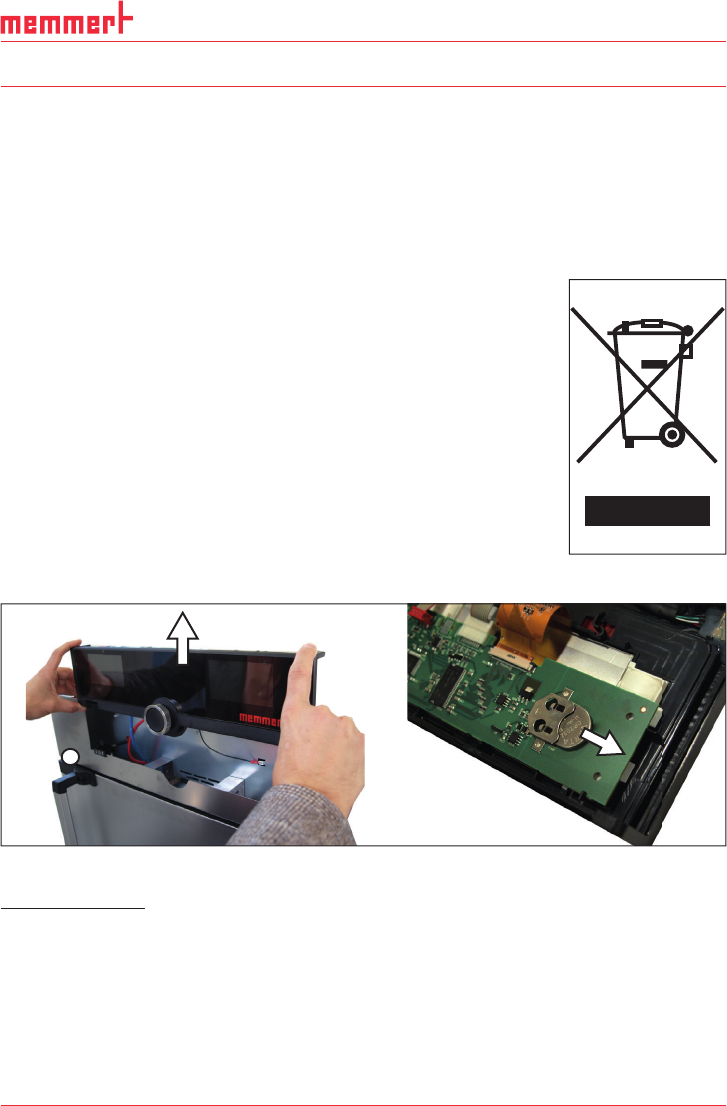
There is a lithium battery in the ControlCOCKPIT of the appliance.
Remove it and dispose of it in accordance with the regulations in your
country (Fig. 25).
Fig. 25 Removing the lithium battery
Note for Germany:
The appliance may not be left at public or communal recycling or collection points.