SOM-1802-002_w.pdf - 第41页
38 AJBES-P (B02_15) Polarity detn (Reserved Data) Specify how to determine the polarity (direction) of the component. (1) Polarity detn Select one of the following options to determine whether or not the polarity detecti…
37 AJBES-P
(B02_13) Electd pos detn/Electd pos tol [mm]
Select one of the following options to determine whether or not the electrode
position should be detected. When "Enable (Auto)" or "Enable (Mnl)" is
selected, the tolerance must be specified.
Disable : Select this when the electrode position determination
should not be made.
Enable (Auto) : Select this to make the electrode position determina-
tion.
The automatically specified default is used as an
electrode position tolerance.
Enable (Mnl) : Select this to make the electrode position determina-
tion.
The arbitrarily specified value is used as an elec-
trode position tolerance.
(a) To set a parameter, select "Manual" in the "Recog data set" text box.
(b) When "Enable (Auto)" is selected in this text box, the value
indicated in the "Electd pos tol [mm]" text box is used.
(B02_14) Electd size detn/Electd size tol [mm]
Select one of the following options to determine whether or not the electrode
size should be detected. When "Enable (Auto)" or "Enable (Mnl)" is selected,
the tolerance must be specified.
Disable : Select this when the electrode size determination
should not be made.
Enable (Auto) : Select this to make the electrode size determination.
The automatically specified default is used as an
electrode size tolerance.
Enable (Mnl) : Select this to make the electrode size determination.
The arbitrarily specified value is used as an elec-
trode size tolerance.
(a) To set a parameter, select "Manual" in the "Recog data set" text box.
(b) When "Enable (Auto)" is selected in this text box, the value
indicated in the "Electd size tol [mm]" text box is used.
0606-002
Note
Note
4.2 Data Explanation (B02_13), (B02_14)
38 AJBES-P
(B02_15) Polarity detn (Reserved Data)
Specify how to determine the polarity (direction) of the component.
(1) Polarity detn
Select one of the following options to determine whether or not the
polarity detection should be made.
Disable : Select this when the polarity detection
should not be made.
Enable (Discard) : When the polarity is checked and
determined as a different one, select this to
regard the recognition as an error.
Enable (Placement) : After the polarity is checked and
determined, select this to re-perform the
recognition according to the determined
polarity.
Fig. 21
(a) When "Enable (Placement)" is selected, the recognition processing
time becomes twice or more as long as the normal one.
(b) When it is required to check whether or not a component has a
polarity (when components are not fed in the specified direction),
"Enable (Discard)" or "Enable (Placement)" must be set in the text
box. The machine performs the recognition operation after checking
the polarity.
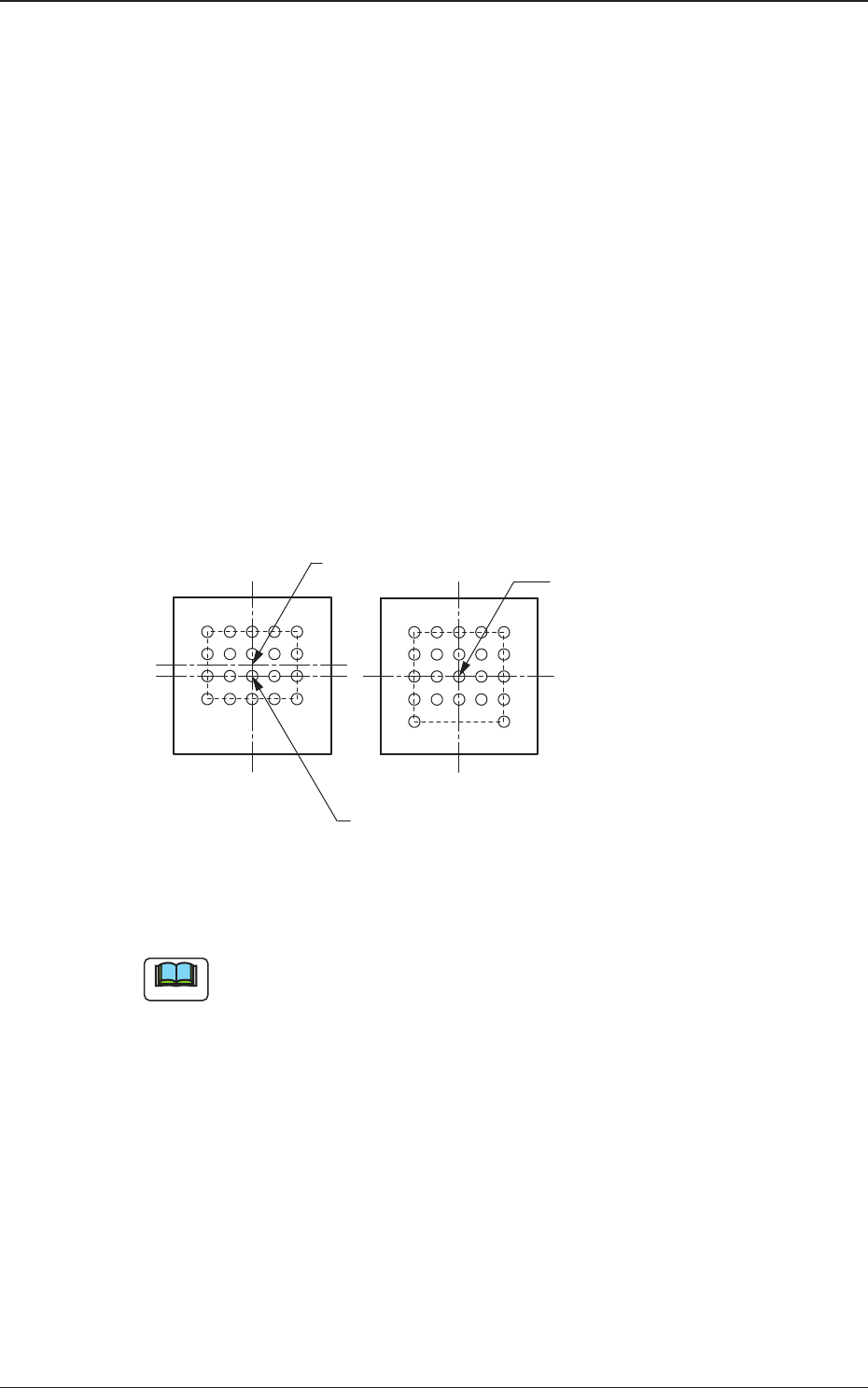
(c) The following requirements must be met when "Enable (Discard)" or
"Enable (Placement)" is selected.
• The center of the ball grids must be aligned perfectly with the
center of the mold.
Note
Top View of Component
Center of Ball Grids
Center of Ball Grids
Center of Mold
Center of Mold
Impossible
Possible
0606-002
4.2 Data Explanation (B02_15)
39 AJBES-P
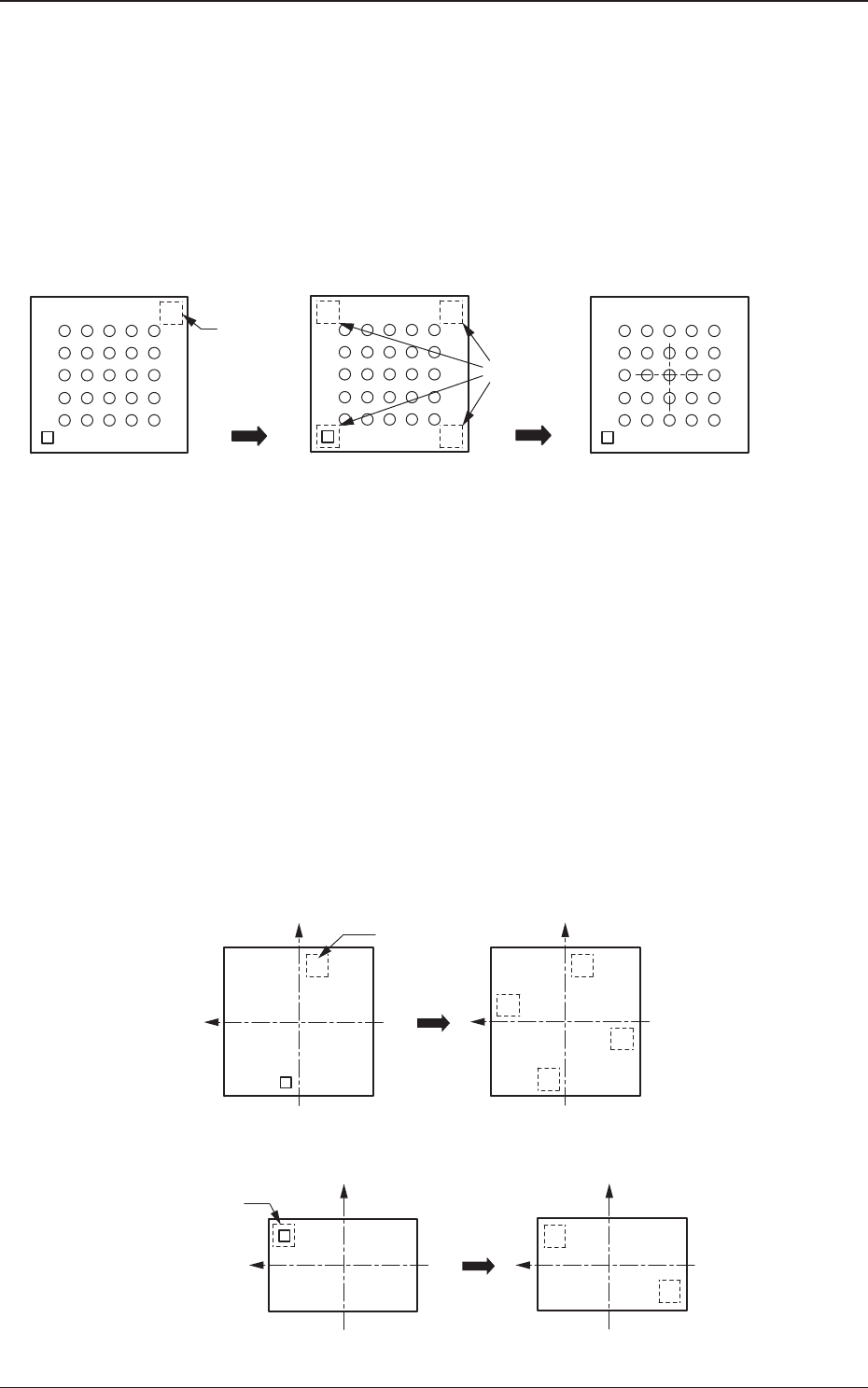
• Sequence of Polarity Determination
Fig. 22
(2) Inspection method
Select one of the following options to specify how many places should
be inspected for polarity determination.
4-Point Insp : Select this to inspect the four places rotated in
increments of 90°, based on the center of the
component.
Select this for a square component.
2-Point Insp : Select this to inspect the two places rotated by 180°,
based on the center of the component.
Select this for a rectangular component.
Fig. 23 4-Point Inspection
Fig. 24 2-Point Inspection
4.2 Data Explanation (B02_15)
Top View of Component (Polarity Different by 180°)
Positioning is performed for
polarity determination.
When "4-Point Insp" is selected,
the machine inspects four places
and determines whether or not
the component has a polarity.
When "2-Point Insp" is selected,
the machine inspects two sym-
metrical places and determines
whether or not the component
has a polarity.
When "Enable (Discard)" is
selected in the "Polarity detn"
text box, the processing is
regarded as a recognition NG
(No Good). When "Enable
(Placement)" is selected, the
recognition processing is
re-executed at the determined
angle.
Specified
Inspection
Range
Inspection
Ranges
Inspection
Range
Inspection
Range
0606-002