VDA_6.3_EN_Yellow_Volume_22-05-16.pdf - 第16页
14 2.3 Differentiation betwe en a potent ial analysis and a process audit As can be seen from figure 2-1, a pote ntial analysis (P1) can be carried out before a contra ct is awarded . The questionnaire , with a re duced …
13
Process element P4 can be used at a later time to analyze and evaluate the
implementation of the planning activities in accordance with process element
P3.
The breakdown of the process elements provides the opportunity to assess
the planning activities as well as the implementation/realization in accordance
with the requirements. From the contracting stage including SOP, the use of
process elements P2 to P4 serves to identify maturity level and process risks
early on.
Process elements P5 to P7 are ideally used at the time of the milestone SOP.
This corresponds to maturity level ML 6 from VDA MLA. As part of series pro-
duction, process elements P5 to P7 can be used to regularly monitor the se-
ries production processes and the processes after discontinuation of the se-
ries, or to support an event-based reactive process analysis.
In principle, each organization has the right to adapt the use of the process
elements so as to meet their needs during product and production process
development as well as production.
Copyright by VDA QMC
14
2.3 Differentiation between a potential analysis and a
process audit
As can be seen from figure 2-1, a potential analysis (P1) can be carried out
before a contract is awarded. The questionnaire, with a reduced scope, can
be used to assess whether potential suppliers are suitable as series produc-
tion suppliers. Given that these are potential suppliers, the audit must (if nec-
essary) be based on other processes/products. However, these pro-
cesses/products should be comparable to the product to be supplied. This
procedure can be applied to the entire supply chain, taking into account the
lead time to SOP.
2.4 Identification of process risks (risk analysis)
The effect of individual processes on the product is essential in the process
audit. Consequently, the assessment must be made from the perspective of
the relevant product risk. Potential process risks must therefore already be
identified during the preparation for the audit in order to assess them ade-
quately in the process audit itself.
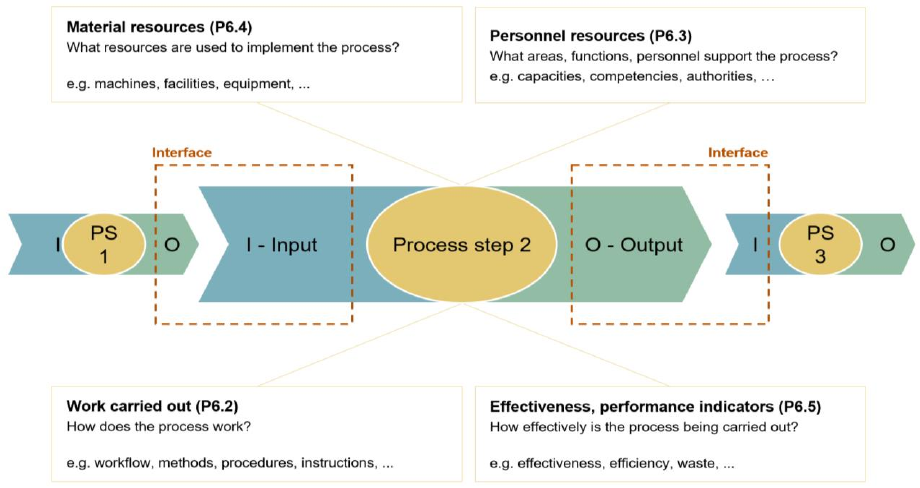
A risk analysis can be carried out on the basis of the Turtle Model.
An example of the Turtle Model using process element P6 is shown below,
but the model can be used for all process elements.
Figure 2-2: The Turtle Model
Copyright by VDA QMC
15
Firstly, it must be described what “input” (see questionnaire sub-element
P6.1) is converted into an “output” (see questionnaire sub-element P6.6) by
the process. In addition, the following questions are considered:
• How does the process work (work carried out, workflow, methods,
procedures, instructions – see questionnaire sub-element P6.2)?
• What areas, functions and personnel support the process (personnel
resources such as capacities, competencies, authorities, qualifica-
tions – see questionnaire sub-element P6.3)?
• Which tools are used to implement the process (material resources
such as machines, tools, test equipment, facilities, other equipment –
see questionnaire sub-element P6.4)?
• How effectively is the process carried out (effectiveness, performance
indicators, efficiency – see process sub-element P6.5)?
As a second step, the potential risks in relation to the content of the Turtle el-
ements are identified. The auditor as well as the audit team should make use
of their process know-how to identify potential product and process risks that
could affect product quality. These risks must then be analyzed and evalu-
ated in the audit to ensures a reasonable degree of risk minimization.
Based on the applied Turtle Model, it is possible to set priorities in a targeted
manner.
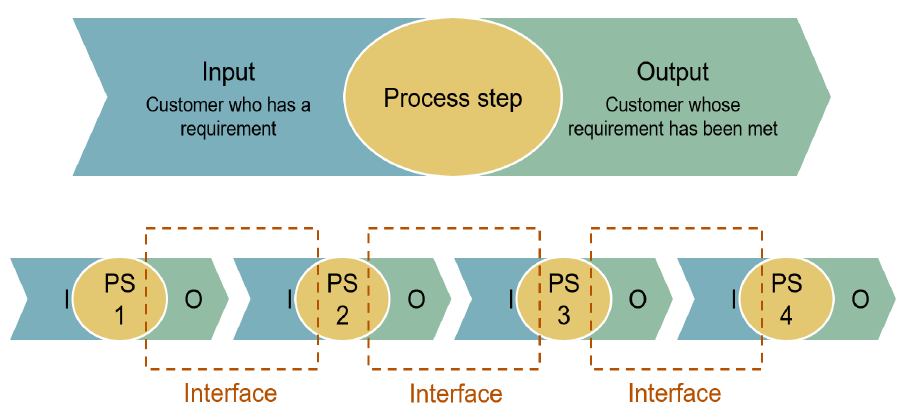
Figure 2-3: Schematic diagram of interlinked processes
The interfaces of the process steps have a significant influence on possible
risks and therefore require a more in-depth analysis.
Copyright by VDA QMC