VDA_6.3_EN_Yellow_Volume_22-05-16.pdf - 第28页
26 5 Potential analysis (P1) 5.1 Definition of a potential a nalysis A potential analy sis is used to evaluate potential new suppliers. For existing suppliers, the potential anal ysis can be used in case of new location …

25
4.6 Suitability of individual process elements/questions for
conducting remote audits (process elements P2-P7)
Table 4-3: Overview of the audit questions for process elements P2-P7 and
their suitability for remote audits
Questions
VDA 6.3
suitable
conditionally
suitable
Questions
VDA 6.3
suitable
conditionally
suitable
P2 - P4
X
P6.4.1*
X
P5.1/P5.2/
P5.3/P5.4*
X
P6.4.2
(X)
P5.5*
X
P6.4.3*
X
P5.6
X
P6.4.4
X
P5.7
X
P6.4.5
X
P6.1.1*
X
P6.5.1
X
P6.1.2
X
P6.5.2
(X)
P6.1.3
X
P6.5.3*
(X)
P6.1.4
X
P6.5.4
X
P6.1.5*
(X)
P6.6.1
X
P6.2.1
X
P6.6.2
X
P6.2.2
(X)
P6.6.3
(X)
P6.2.3*
(X)
P6.6.4*
(X)
P6.2.4*
X
P7.1
X
P6.2.5
X
P7.2
X
P6.3.1
(X)
P7.3*
X
P6.3.2
(X)
P7.4*
(X)
P6.3.3
(X)
P7.5
X
(x) = suitable/suitable to a limited degree, depending on product and process risks
Copyright by VDA QMC
26
5 Potential analysis (P1)
5.1 Definition of a potential analysis
A potential analysis is used to evaluate potential new suppliers. For existing
suppliers, the potential analysis can be used in case of new locations, an in-
troduction of new technologies or new products.
The supplier’s potential to meet the requirements regarding the requested
products and corresponding processes is assessed.
The analysis takes into account the supplier’s experience and skills regarding
the development and production of the scope of products requested, as well
as their ability to fulfill customer-specific requirements for product and pro-
cess implementation.
The assessment is based on existing processes for comparable products.
The result can be used as preparation for a decision to award a contract. It
provides a prognosis of the quality capability of the considered supplier/loca-
tion regarding the implementation of the product and process in the event the
contract is awarded.
A potential analysis can also be carried out independently of a project in case
of supplier changes or relocations.
In the event of relocations (components in series production, completed prod-
uct development phase), the assessment is only based on the questions from
process elements P2 to P4 related to the process development and P2 for the
relocation project.
5.2 Prerequisites
Given that no contractual relationship exists between the customer and the
potential new suppliers during the inquiry and quotation stages, an agreement
should be made regarding confidentiality and access permission.
5.3 Preparation
Obtaining information in preparation for the potential analysis is of particular
importance. In addition to the customer’s own research, an essential way to
obtain information is to ask the prospective supplier to provide a self-assess-
ment.
Copyright by VDA QMC
27
5.4 The process of conducting a potential analysis
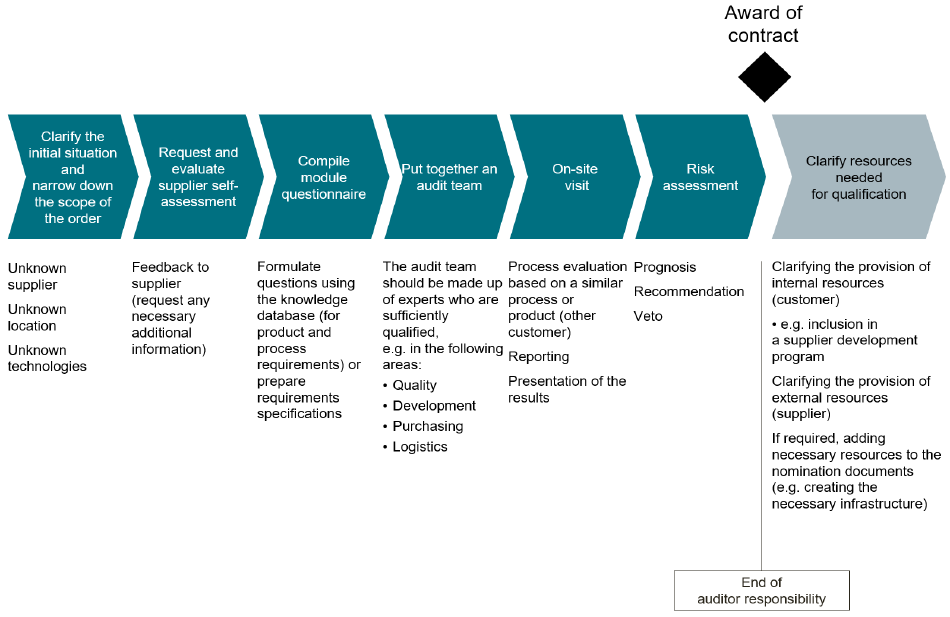
The following diagram illustrates the process of conducting a potential analy-
sis (P1). The evaluation questions in P1 are selected from process elements
P2 to P7. An overview of the questions is provided in section 7.1.
The analysis of the supplier’s processes is based on a comparable prod-
uct/production process using the P1 questionnaire and, if required,
knowledge databases relating to the scope of delivery under consideration.
Figure 5-1: Process of conducting a potential analysis
5.5 Evaluation of a potential analysis
A separate evaluation is required for the potential analysis because the objec-
tive here is less to arrive at a classification in percentage-terms and more to
decide on “suitable” or “not suitable”.
Each question is evaluated in terms of fulfillment of the respective require-
ment and the risk involved.
If a question is not evaluated (shown as n. e.), the reason for this must be
stated. A maximum of 3 questions may be marked n. e. Otherwise, the results
may no longer be comparable.
Copyright by VDA QMC