VDA_6.3_EN_Yellow_Volume_22-05-16.pdf - 第40页
38 Product group Possible process steps Pressed and stamped parts Stamping, drawing, forming Galvanic plating Painting Plastic injection moldings Plastic molding Painting Control devices Fitting compo- nents Soldering As…
37
Level of compliance for partial audits
To classify the level of compliance of a partial audit, the calculated level of
compliance (e.g. E
G(P5P6P7)
or E
G(P4)
) is compared to the benchmarks as given
above (at least 80% for a “B” classification of conditionally quality capable or
at least 90% for “A” quality capable).
Downgrading rules
Results from the process elements, sub-elements of P6 or process steps
have to be considered in the following downgrading rules and documented in
the audit report.
Reasons for downgrading from A to B even though the level of compli-
ance is E
G
or E
G(Pn)
≥ 90%
• At least one process element (P2 to P7) or process step (E
1
to E
n
) is
evaluated as having a level of compliance E
P
or E
n
< 80%
• A level of compliance E
U1
to E
U6
in one of the sub-elements of P6 is <
80%
• 4 points are awarded for at least one *-question
• 0 points are awarded for at least one question in the process audit
Reasons for downgrading to C even though the level of compliance is
E
G
or E
G(Pn)
≥ 80%
• At least one process element (P2 to P7) or process step (E
1
bis E
n
) is
evaluated as having a level of compliance E
P
oder E
n
< 70%.
• 0 points are awarded for at least one *-question
When applying the downgrading rules (process element, sub-element or pro-
cess steps), the individually calculated results E
Pn
, E
Un
and E
n
are rounded to
the nearest percentage point.
6.4 Evaluation of product groups
If required, the overall assessment of quality capability can be broken down
into product groups on the basis of individual process steps. Car manufactur-
ers mainly use this procedure to classify the suppliers’ quality capability. The
evaluation of the suppliers’ quality capability is thus restricted to product
groups. This forms part of the preconditions for future contract awards.
Copyright by VDA QMC
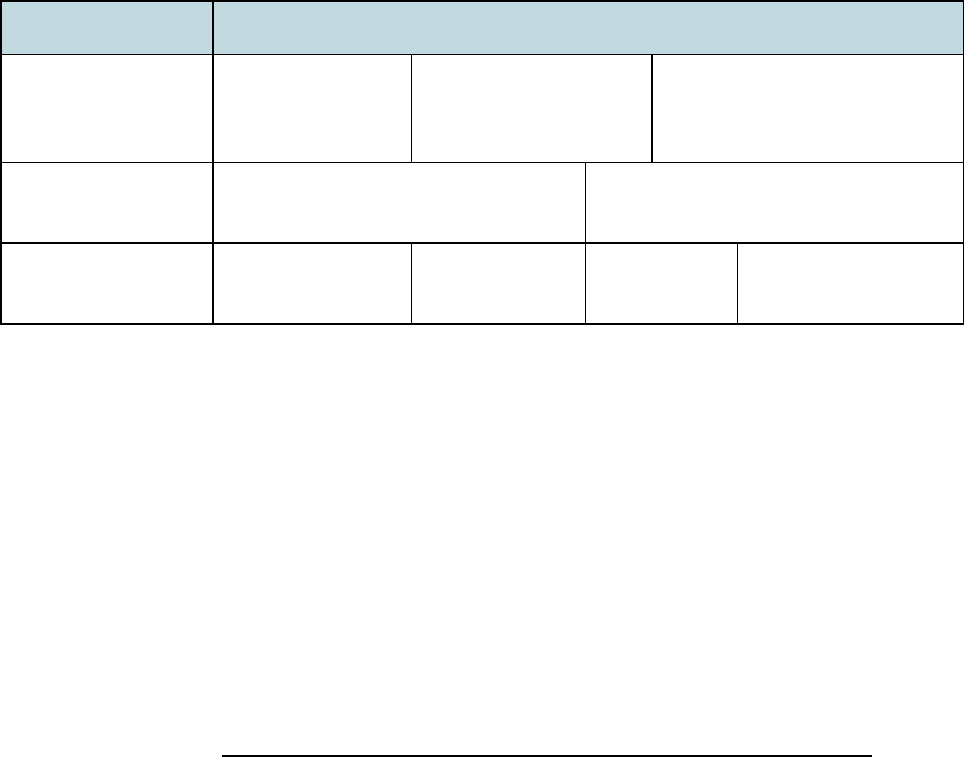
38
Product group
Possible process steps
Pressed and
stamped parts
Stamping,
drawing,
forming
Galvanic plating
Painting
Plastic injection
moldings
Plastic molding
Painting
Control devices
Fitting compo-
nents
Soldering
Assem-
bling
Functional check
Note: To evaluate process steps, additional process requirements should be gener-
ated from the organization’s own knowledge databases.
In the evaluation matrix, the relevant process steps are allocated to the prod-
uct group being evaluated.
The overall level of compliance for each product group E
G(PGn)
is calculated as
follows:
E
G(PGn)
[%] =
Total points awarded for the questions for the evaluated
process elements Pn (for each question in P6, the average
value per question from the process steps for this PG is cal-
culated
++
)
Total possible points for the questions for the evaluated
process elements (
++
)
++
for explanations of “points awarded” and “possible points” see section: 6.2: Exception.
When evaluating product groups, the downgrading rules are applied specifi-
cally to the product group concerned.
Copyright by VDA QMC
39
6.5 Using the questionnaire (process elements P2 to P7)
The questionnaire forms the basis of the auditor’s work. The auditor selects
the relevant process elements for the audit depending on the phase of the
product life cycle (see section 2.2). Additional specific requirements can be
added to the questions depending on the product/process risks identified.
The questions can be used for processes for material products and products
with integrated (embedded) software as well as for auxiliary and process ma-
terials.
Structure of the questionnaire
The questions for the process elements are structured as follows:
• Questions
• Minimum requirements relevant for assessment
• Examples for implementation
The “examples for implementation” provide a selection of potential applica-
tions. They should be selected on a product/process-specific basis and ex-
panded, analyzed and evaluated when necessary.
The evaluation is carried out based on the questions in the “Minimum require-
ments relevant for assessment” list.
For the auditor, the audit consists of two mutually independent activities (see
figure 6.1):
1. The auditor asks the auditee open questions to assess compliance
with the requirements. The risks identified in the preparations for and
during the audit are taken into account.
2. Based on the audit findings, the auditor uses closed questions to as-
sess compliance with the requirements.
Copyright by VDA QMC