200823.TR3000-IRV English Manual.pdf - 第26页
IR AUT O BGA R ework S tation TR3000-IRV Kukjetrading Co., Ltd. 26 In the mode 2,all th e cont rols are made in t he same as in the mode 1. However , whe n a period of time fo r the zone i s completed, i t moves to the…
IR AUTO BGA Rework Station TR3000-IRV
Kukjetrading Co., Ltd.
25
5.3.2 Switch-Over of Temperature Profile
It is for changing the temperature profile number. For instance, if users want to switch over from the file no. 1 to
the file no. 2, do as follows.
① Press FILE on the upper right.
② Select a file name to be switched over to. Select the file no. 2.
③ Touch a “SELECT” key on the lower center. Then, the file no.2 gets selected.
5.3.3 About Operation Mode
As for an operation mode, there are 4 operation modes. Each mode operates as follows.
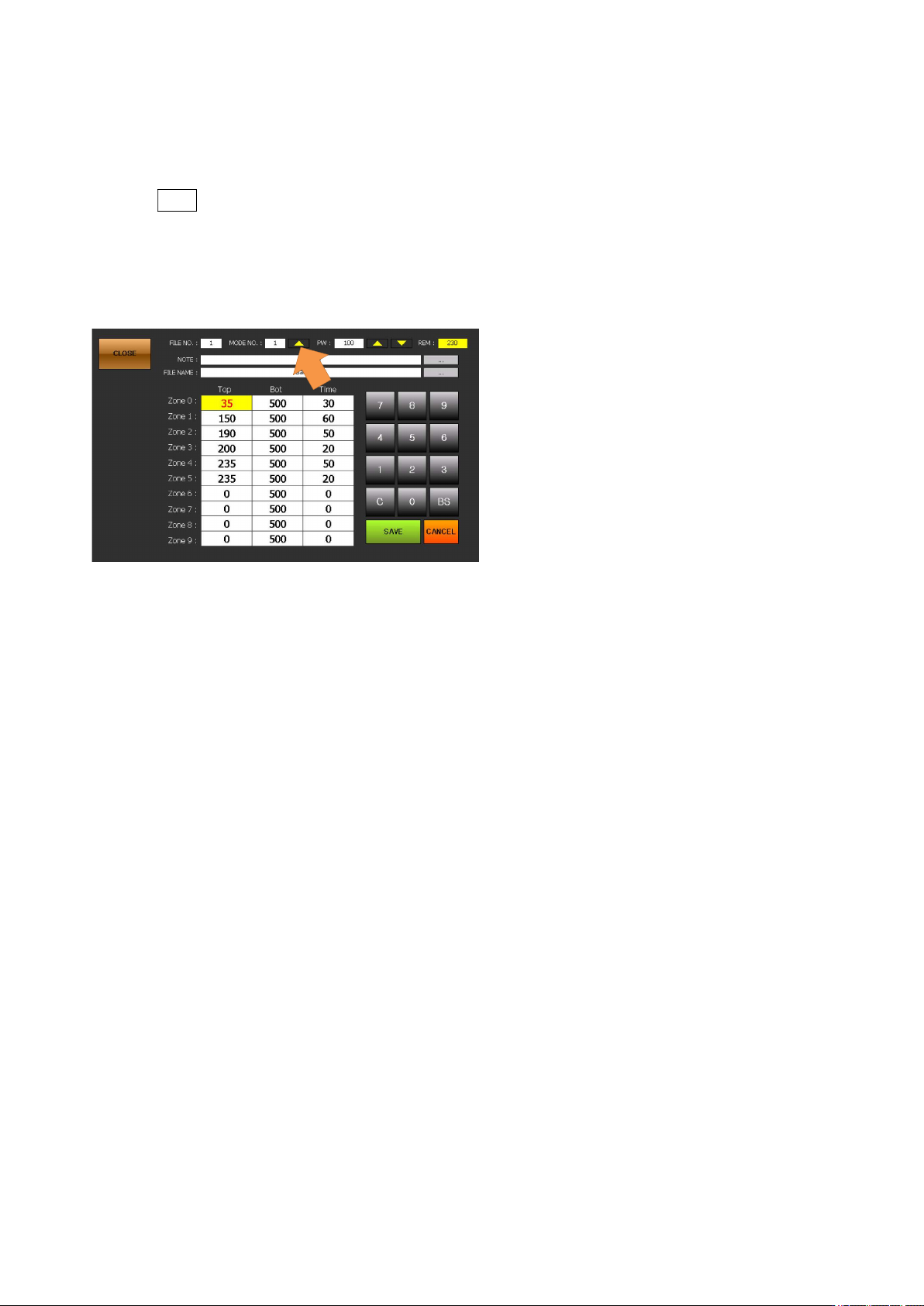
① MODE 1 (Temperature Priority Mode )
In the MODE 1, operation starts when a non-contact infrared sensor measures the surface
temperature of a PCB and then it jumps to a zone which has the corresponding temperature range.
When a PCB is hot, the operation period gets shortened and vice versa.
When the surface temperature of a PCB does not reach the preset temperature for the zone 0, it starts
from the zone 0. In the zone 0, only the bottom heater operates not the upper heater.
Starting from the ZONE 1, the whole process gets progressed in accordance with the temperature
and time which have been set. If it fails to reach the preset temperature even a period of time, which
has been set for the corresponding zone, is over, it waits till it reaches the preset temperature and
then moves to the next zone.
Waiting time for each of zones is up to 15 seconds and if it fails to reach the preset temperature even
after that period, there would be alarming and a heater would get turned off. It could happen when
temperature does not rise since the heater is disconnected or the incorrect temperature and time are
entered.
In the MODE 1, a value for the bottom, which has been set, for each of zones represents the
maximum value, and a temperature for the bottom is controlled in accordance with the control
temperature for the bottom. In other words, even if a value for the bottom is set high, it still gets
controlled by a temperature for the top.
When a temperature for the bottom heater for the zone 0 is set to be 500℃ or higher, values for all
the zones are changed to 500. Also, on the stand-by screen, it is displayed as A(AUTO). In the
AUTO mode, a temperature for the bottom heater for all the zones are controlled by temperature of
the top heater by up to 350℃.
② MODE 2 (Time Preference Mode )

IR AUTO BGA Rework Station TR3000-IRV
Kukjetrading Co., Ltd.
26
In the mode 2,all the controls are made in the same as in the mode 1. However, when a period of
time for the zone is completed, it moves to the next zone even if a temperature does not reach the
goal temperature.
③ MODE 3 (Special Compensation Mode )
MODE 3is used for ground patterns or BGA operation which has a high reflection rate including
glass and metal BGA. This mode is for controlling temperatures by compensating the infrared ray
release.
This mode is effective for circumstances of which there are frequent errors or temperature does not
rise as expected in the general mode.
If it is used for the general PCB, a board can get burn or damaged. Thus, it should be used
only after setting a profile after measuring a temperature with a thermometer.
④ MODE 4
MODE4 is used when the K sensor on the front of the equipment is attached to the surface near
the BGA on the upper part of the PCB to read and control the temperature.
This is useful when working with a PCB where the size of the PCB is small or it is difficult to
secure the detection area of the infrared sensor due to the structure of the PCB.
When attaching a sensor to the bottom of the BGA, the set temperature is the same. However, if
you install it around the BGA, you need to adjust the setting value lower by 5 degrees, and if you
attach it to the bottom of the PCB, you can use it by setting it higher by 10 degrees. For example,
for a setting of 240 degrees, set it to 235 degrees when attaching around the BGA, and to 250
degrees when attaching to the bottom of the PCB.
If the sensor attached to the surface of the PCB is lifted or dropped, the control temperature may
change, so the sensor must be stably attached to a place where there is no foreign matter.
IR AUTO BGA Rework Station TR3000-IRV
Kukjetrading Co., Ltd.
27
6. Operation of Device
6.1 How to Remove Parts
It is for removing parts attached on the PCB.
① Mount a PCB onto a table. Please check a direction for mounting. There must be no reflective metal
parts or holes in the part that the sensor reads.
② Press a center button. Then, a vision head moves to be in alignment with the top heater. Move a table to
be in alignment.
③ Press a “REMOVE” button. Then, a head descends till a vacuum bit touches the surface of a part and
then elevates back to the heating position. If the center is off from center, move a slide table right and left
and front and back to align a vacuum bit with the center of a part.
④ The equipment proceeds by controlling the temperature according to the selected profile.
⑤ When the work is in progress at the highest temperature zone of the selected file, a notification sound is
sent out, and the vacuum button automatically turns on 8 seconds before the zone ends, the head descends,
picks up the part, and then rises again.
⑥ When the head rises, the cooling fan operates and starts cooling.
⑦ The vision head moves to the right, puts the removed part on the parts tray and returns to its original
position.
⑧ After the cooling time elapses, the cooling fan automatically stops.
6.2 Removal of Soldering Residual on PCB (Use a BOTTOM HEATER)
This process is for removal of soldering residual on the PCB. It is used for the ironing operation while the PCB
gets preheated. Also, it can be used for all the operations requiring of preheating.
① Mount a PCB on a table.
② When a “PRE-HEAT” button is pushed, only a bottom heater operates not a top head.
③ The bottom heater maintains at 180℃. At the OPTION, the temperature which has been set for the bottom
heater can be changed. .
④ When the PCB gets preheated, remove any excess lead with a wire solder and an iron first.
⑤ Then, remove any lead residual with a solder wick and an iron.
⑥ Touch a “RST” key to complete the process. .
6.3 How to Soldering
6.3.1 Soldering after Dipping
It is for placing low-viscosity solder (or Gell Flux) onto a dipping jig and then, execute the soldering after
dipping.
① After placing a dipping jig on the left side of a vision head, print a low-viscosity solder cream.
② Place parts on a part tray in accordance with the mounting direction and then, turn an adjusting screw to
place the parts on the center and then unscrew the adjusting screw a bit. If there is too small space between
the parts, they may not get lifted upon absorption by vacuum.
③ Click a “Dipping” button.
④ A vision camera and a top head automatically move to pick up the parts and dip a cream solder and then
move to a position to be waiting for adjusting of the mounting position. On the monitor, the PCB surface
and the ball surface of parts are displayed concurrently.