200823.TR3000-IRV English Manual.pdf - 第28页
IR AUT O BGA R ework S tation TR3000-IRV Kukjetrading Co., Ltd. 28 ⑤ Adjust XY -axis fine adjustin g s crews and a rotation handle to align the PCB surface where the parts would be p laced on to with the pa rts to be pla…
IR AUTO BGA Rework Station TR3000-IRV
Kukjetrading Co., Ltd.
27
6. Operation of Device
6.1 How to Remove Parts
It is for removing parts attached on the PCB.
① Mount a PCB onto a table. Please check a direction for mounting. There must be no reflective metal
parts or holes in the part that the sensor reads.
② Press a center button. Then, a vision head moves to be in alignment with the top heater. Move a table to
be in alignment.
③ Press a “REMOVE” button. Then, a head descends till a vacuum bit touches the surface of a part and
then elevates back to the heating position. If the center is off from center, move a slide table right and left
and front and back to align a vacuum bit with the center of a part.
④ The equipment proceeds by controlling the temperature according to the selected profile.
⑤ When the work is in progress at the highest temperature zone of the selected file, a notification sound is
sent out, and the vacuum button automatically turns on 8 seconds before the zone ends, the head descends,
picks up the part, and then rises again.
⑥ When the head rises, the cooling fan operates and starts cooling.
⑦ The vision head moves to the right, puts the removed part on the parts tray and returns to its original
position.
⑧ After the cooling time elapses, the cooling fan automatically stops.
6.2 Removal of Soldering Residual on PCB (Use a BOTTOM HEATER)
This process is for removal of soldering residual on the PCB. It is used for the ironing operation while the PCB
gets preheated. Also, it can be used for all the operations requiring of preheating.
① Mount a PCB on a table.
② When a “PRE-HEAT” button is pushed, only a bottom heater operates not a top head.
③ The bottom heater maintains at 180℃. At the OPTION, the temperature which has been set for the bottom
heater can be changed. .
④ When the PCB gets preheated, remove any excess lead with a wire solder and an iron first.
⑤ Then, remove any lead residual with a solder wick and an iron.
⑥ Touch a “RST” key to complete the process. .
6.3 How to Soldering
6.3.1 Soldering after Dipping
It is for placing low-viscosity solder (or Gell Flux) onto a dipping jig and then, execute the soldering after
dipping.
① After placing a dipping jig on the left side of a vision head, print a low-viscosity solder cream.
② Place parts on a part tray in accordance with the mounting direction and then, turn an adjusting screw to
place the parts on the center and then unscrew the adjusting screw a bit. If there is too small space between
the parts, they may not get lifted upon absorption by vacuum.
③ Click a “Dipping” button.
④ A vision camera and a top head automatically move to pick up the parts and dip a cream solder and then
move to a position to be waiting for adjusting of the mounting position. On the monitor, the PCB surface
and the ball surface of parts are displayed concurrently.
IR AUTO BGA Rework Station TR3000-IRV
Kukjetrading Co., Ltd.
28
⑤ Adjust XY-axis fine adjusting screws and a rotation handle to align the PCB surface where the parts
would be placed onto with the parts to be placed. With functions including the brightness control for
top/bottom lighting, zoom in/out and focus, make sure the alignment is made accurately.
⑥ Touch a RUN button. A head descends to mount the parts and execute the soldering. .
6.3.2 Soldering without Dipping
It is for applying gell flux onto the mounting surface of the BGA on top of the PCB for soldering.
① Applying gell flux evenly onto the mounting surface of the BGA with a brush or cotton swab. Apply it
with a brush several times.
② Place parts on a part tray in accordance with the mounting direction and then, turn an adjusting screw to
place the parts on the center and then unscrew the adjusting screw a bit.
③ Click a “Pick-up” button.
④ A vision camera and a top head automatically move to pick up the parts and move to a position to be
waiting for adjusting of the mounting position. On the monitor, the PCB surface and the ball surface of
parts are displayed concurrently.
⑤ Adjust XY-axis fine adjusting screws and a rotation handle to align the PCB surface where the parts
would be placed onto with the parts to be placed. With functions including the brightness control for
top/bottom lighting, zoom in/out and focus, make sure the alignment is made accurately.
⑥ Touch a RUN button. A head descends to mount the parts and execute the soldering. .
6.3.3 SOLDERING with No Use of Vision Function
It is for manually placing parts in alignment with a silk line to execute the soldering without using a vision
function.
① Applying Gell flux evenly onto the mounting surface of the BGA with a brush or cotton swab. Apply it
with a brush several times.
② Mount the parts in alignment with a silk line.
③ Touch a RUN button. A head descends to mount the parts and execute the soldering.
6.3.4 Reheating
It is used for the reheating operation due to cold welding, etc. .
<Warning> Main component for liquid Flux is alcohol. So there is a risk of fire if alcohol does not get
removed. Thus, a RST key must be pressed before operation to remove alcohol by operating a cooling
fan.
① Inject a small amount of liquid Flux into a gap of the BGA (Recommended FLUX: KOKI SV-PBF-304P).
② Mount a PCB onto a Table.
③ Click a center button to move a table to be at a position for heating.
④ Click a center button to restore the table back to its original position.
⑤ Press a RST button to operate a cooling fan..
⑥ Press a RUN button. A head descends to mount parts and the soldering gets executed.
6.4 MOUNT(Mounting Test)
It is used for checking whether parts which have been mounted on a PCB are still in alignment.
① When a Dipping or PICK-UP button is pressed, parts on a part tray gets absorbed and then, it waits at a
position where is for adjusting a vision camera position.
IR AUTO BGA Rework Station TR3000-IRV
Kukjetrading Co., Ltd.
29
② After adjusting positions of parts and a PCB to be in alignment, click a “MOUNT” button. Then, a vision
camera moves back to its original position and a head descends to place parts on a PCB and then, elevates
back to its original position.
③ Check a mounting status to see if the parts are in alignment. If they are off from the intended position,
calibrate them.
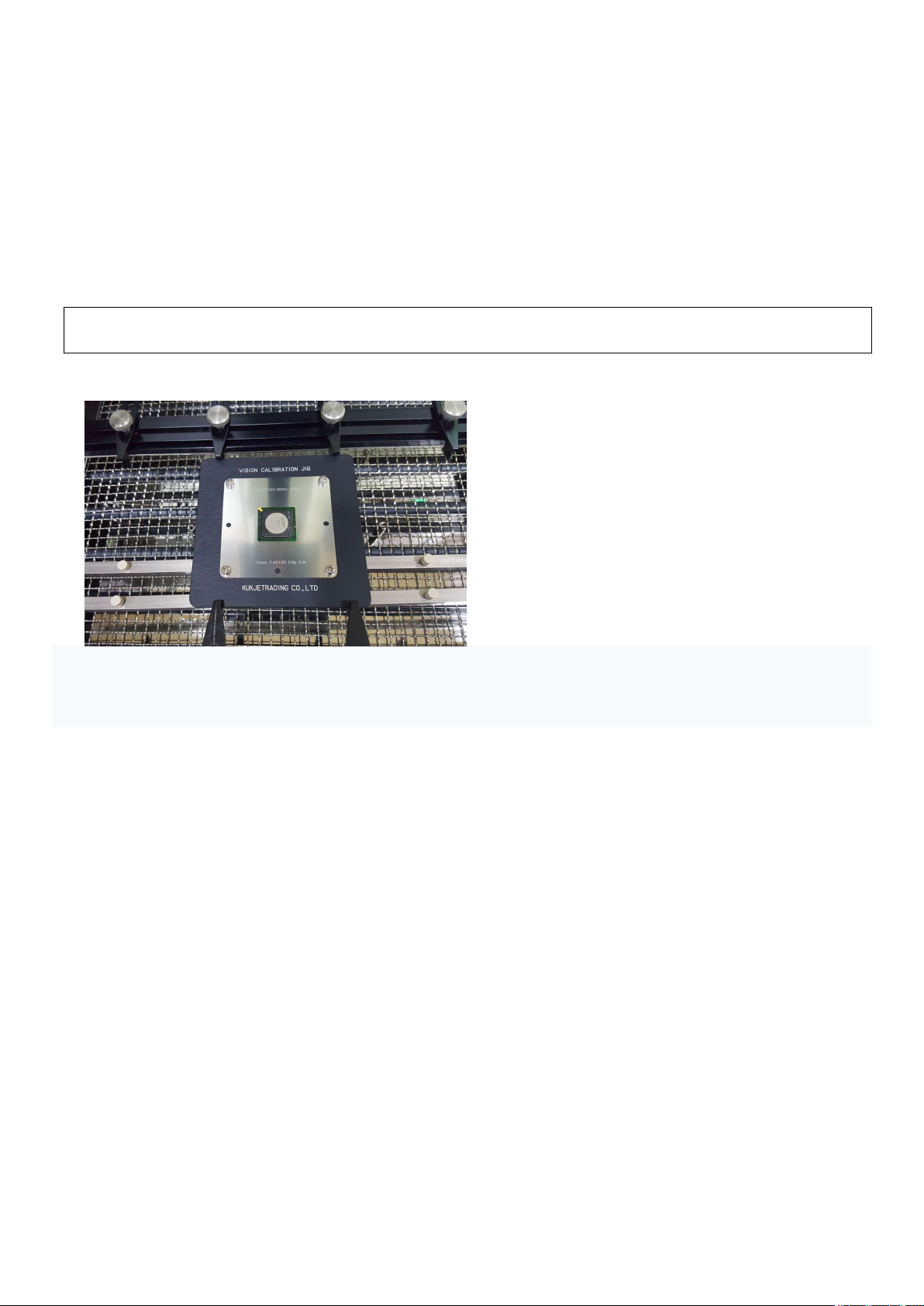
6.5 Vision Calibration
When the device is moved or used for a long period, the location of a vision would not be correct. In the
following case, calibrate the device.
① Place the CALIBRATION JIG on the table and place the BGA in position.
② Press the Center button. The vision camera moves towards the head. While looking at the monitor screen,
align the vacuum bit and the center of the BGA and fix the table.
③ When you press the Pick-up button, the vision camera moves to the left and the head goes down. Vacuum
button turns ON, picks up the BGA, and moves up to the origin. The VISION camera moves to the right and