00191297-02.pdf - 第170页
6 Vision functions User Manual S-23 HM 6.1 The vision systems on the placem ent system Software Vers ion SR.405.xx 05/99 Issue 168 6.1.2 PCB camera systems Fig. 6.1 - 3 PCB camer a system, basic gantry - bottom view Key …
User Manual S-23 HM 6 Vision functions
Software Version SR.405.xx 05/99 Issue 6.1 The vision systems on the placement system
167
6
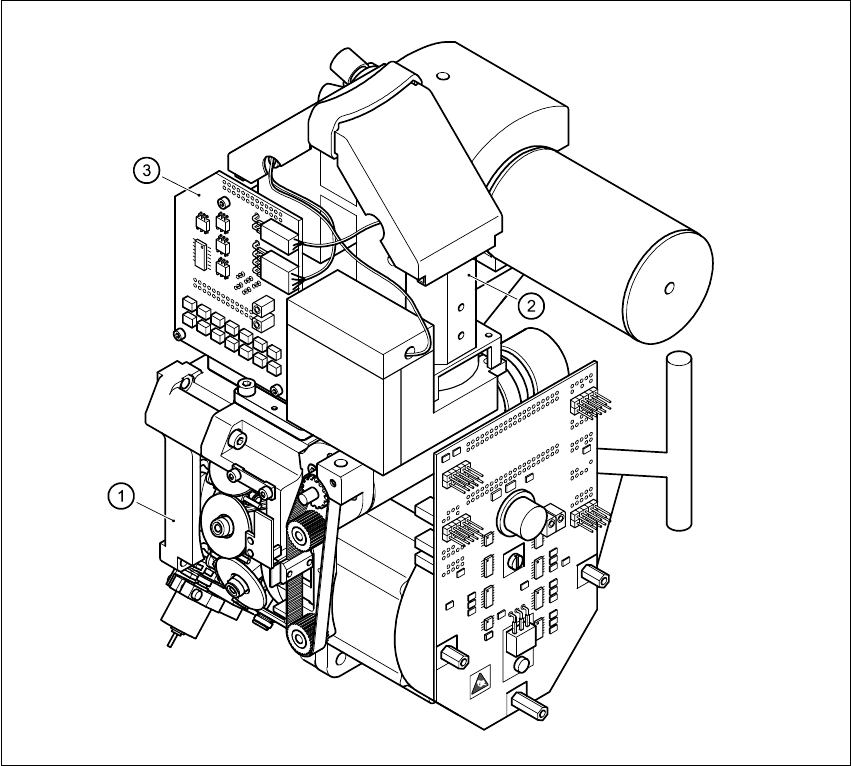
Fig. 6.1 - 2 Component camera system
Key to Fig. 6.1 - 2
(1) 12-nozzle revolver head /DLM1
(2) 24 x 24 component camera
(3) Component illumination control board
6
The component camera system is fastened to the top of the revolver head with four hexagon
socket-head screws and is fixed in position with two parallel pins. 6
The component camera system can be used to optically center and place components ranging
from 0402 up to and including SO32 in size. The components, therefore, can vary between
1.0 mm x 0.5 mm and 18.7 mm x 18.7 mm in size and from 0.3 mm to 6 mm thick. The minimum
lead pitch can be as little as 0.5 mm. 6
6 Vision functions User Manual S-23 HM
6.1 The vision systems on the placement system Software Version SR.405.xx 05/99 Issue
168
6.1.2 PCB camera systems
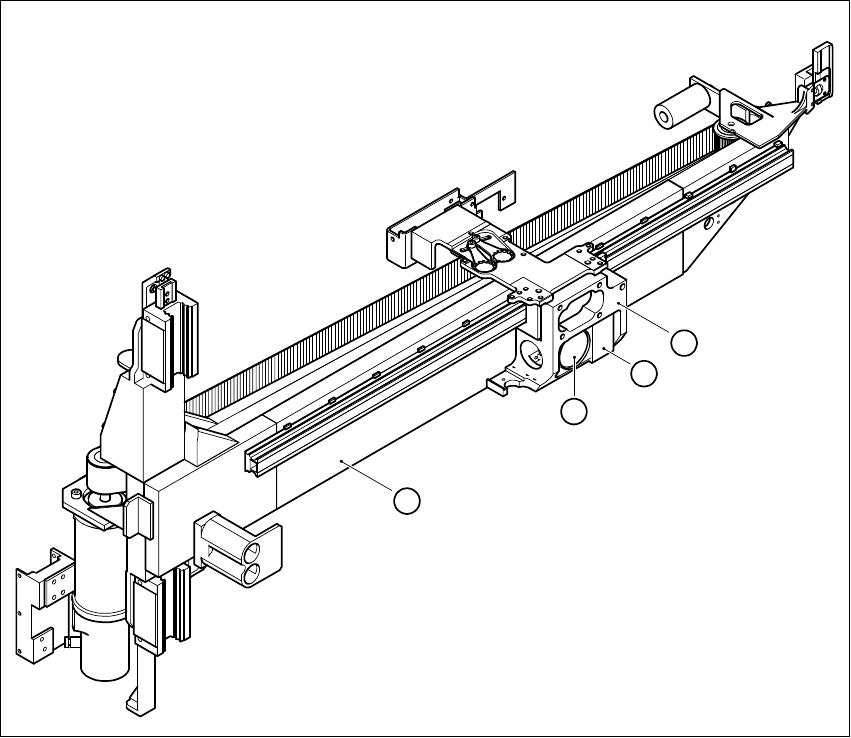
Fig. 6.1 - 3 PCB camera system, basic gantry - bottom view
Key to Fig. 6.1 - 3
(1) PCB camera - lens and illumination
(2) Camera amplifier
(3) Head mount
(4) Gantry
6
4
3
2
1
User Manual S-23 HM 6 Vision functions
Software Version SR.405.xx 05/99 Issue 6.1 The vision systems on the placement system
169
The PCB camera system (see items 1 and 2 in Fig. 6.1 - 3) essentially consists of the following
components: 6
– Lens system
– CCD chip
– CCD camera amplifier
– An illumination plane for illuminating PCB fiducials and ink spots
The PCB camera system is fixed to the revolver head mount on the underside of the gantry. As
standard, it can center PCBs from 50 mm x 50 mm up to 460 mm x 460 mm (2" x 2" to 18" x 18")
in size, with the thickness ranging from 0.5 mm to 4.5 mm. 6
6.1.3 Vision analysis unit
The vision analysis unit (see item 1 in Fig. 6.1 - 4) is plugged into the placement system’s control
unit. 6
It processes and analyzes electrical signals from the component and PCB camera systems. Cor-
rection values are calculated from any deviations from setpoint. These values are then used for
recalculating the placement positions and angle of rotation for placement. 6
The vision analysis unit also performs a component identification process. The precise component
pick-up position, which is particularly important for small components, is also determined in the
vision analysis unit. 6