JX-100_SPE_EN06.pdf - 第17页
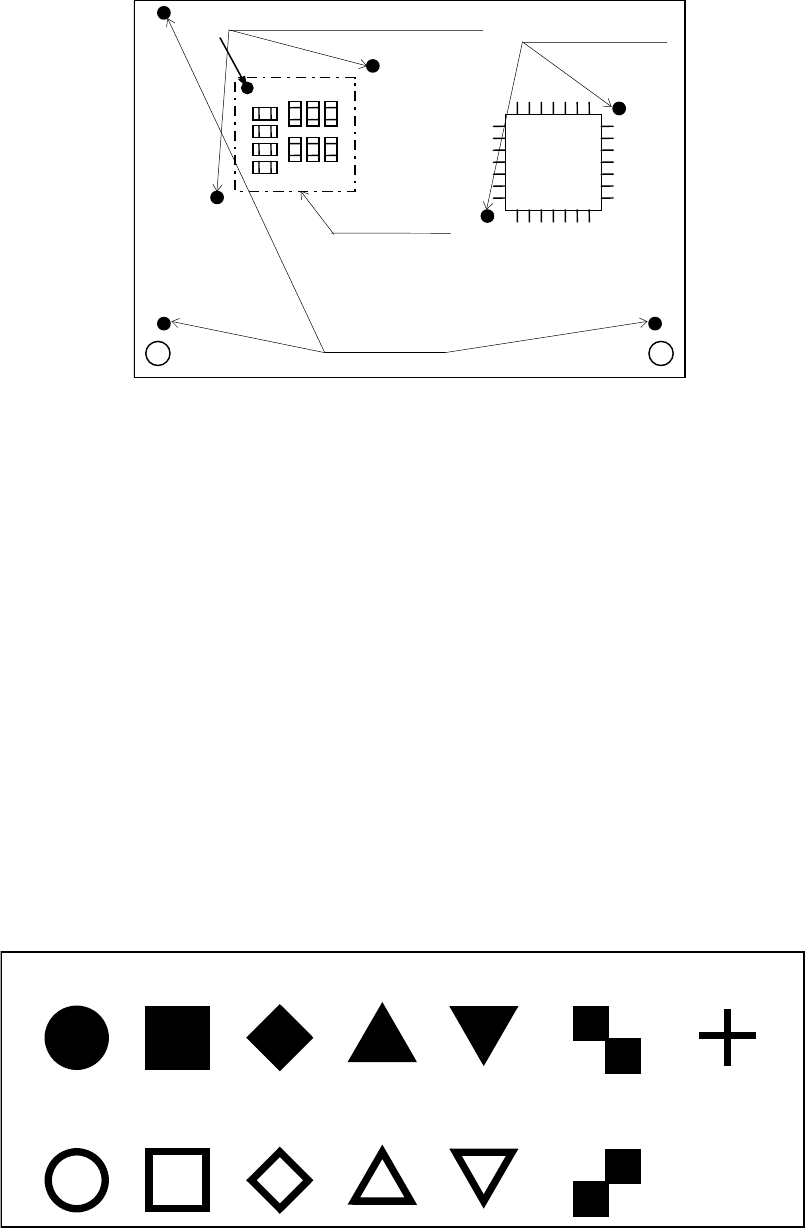
搭 載グループ 基準マーク 部品位置決めマーク エリア部品位置決めマーク Component placement rea positioning marks a Placement group PWB reference marks Component positioning marks Figure 7 Reference marks and component s positioning marks 4.7.5 Shapes of …
4.7 Function correcting the PWB positions
4.7.1 PWB positioning reference
• Shape reference only.
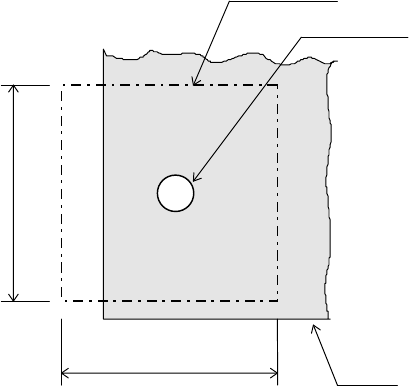
4.7.2 Field of vision for recognizing the PWB reference marks
□6.3 mm (camera’s field of vision for recognition).
Field of vision for PWBs recognition
Recognition mark
PWB
6.3mm
6.3mm
Figure 6 Field of vision for PWB recognition
4.7.3 Window size for recognizing the PWB reference marks
This size can be changed within a maximum of 6.3 mm, subject to securing a clearance
between the recognition mark and its surrounding area.
4.7.4 Kinds of recognition marks and corrective method
- PWB reference mark
Two or three marks (see Note 1and 2) are located on a PWB to correct the entire PWB.
When a machine detects two PWB reference marks, it corrects the positioning, angle
and expansion/contraction of the entire PWB. When detecting three PWB reference
marks, it corrects the perpendicularity in the X and Y direction also.
- Marks used to position the component area
Two marks (their positions can be set as you like) are to be provided to a group of
components placement positions, and they are used to correct each component
placement position in the group.
Note 1: The position is arbitrary, subject to not aligning three (3) reference makes,
if this is the case, on one (1) straight line. (It is recommended that the reference
marks should be made at the four (4) corners of the PWBs.
Note 2: If a board (more than 410 mm in X direction) is fed twice, two or three reference
marks (four or six in total) detected each time are required. (This is only for
JX-100 LED.)
12
搭
載グループ
基準マーク
部品位置決めマーク
エリア部品位置決めマーク
Component placement
rea positioning marks a
Placement group
PWB reference marks
Component
positioning marks
Figure 7 Reference marks and components positioning marks
4.7.5 Shapes of each mark to be recognized
Marks to be recognized conform to the EIAJ ET-7302 “Recognition Marks for Surface
Mounting PWB.”
4.7.5.1 Forms
- The standard marks represent the thirteen (13) forms as shown in the following block,
“forms of recognition marks.”
- For any mark other than those shown in the said block, customers shall make
templates to allow for recognition through a pattern matching.
Note 1: Limited to the standard marks only
;
and any area fiducial mark is excluded
from the subjects.
Note 2: Within a field of vision, there should be no similar form pattern other than
the subjected form patterns.
- For regular triangles, checker patterns and users’ templates, the 90°up-side-down
marks can also be recognized.
Circle Square Diamond
Regular
triangle
Up-side-down
triangle
Checker
pattern
Cross
Inside-blank
circle
Inside-blank
square
Inside-blank
diamond
Inside-blank
up-side-down
triangle
Checker
pattern
Inside-blank
Regular
triangle
Figure 8 Forms of Recognition Marks
13
4.7.5.2 Dimensions and tolerances
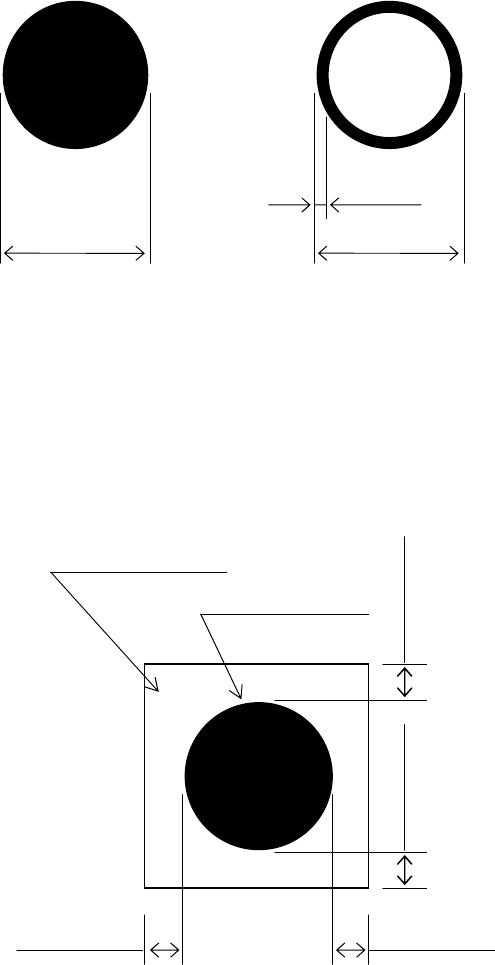
The outside dimensions shall range from 0.5 mm up to 3.0mm, whose tolerance, less
than 10%.
For all the inside-blank forms, the edging line width shall be more than 0.2 mm.
0.2 mm or more
0.5 to 3.0mm
0.5 to 3.0mm
Figure 9 Dimensions and tolerances of recognition marks.
4.7.5.3 Clearance
It is desirable that there is, around each recognition mark, a space having nothing of
such other marks as conductor pattern, solder resist, marking and the like, and that this
space dimensions is a larger square than the mark by 0.5 mm or more from the outer
circumference of the recognition marks.
0.5 mm or more
0.5 mm or more 0.5 mm or more
0.5 mm or more
Recognition mark
Clearance area
Figure 10 Clearances of recognition marks
14