00196614-03_AI_Vakuumpumpe_SXDX12_de_en.pdf - 第86页
Brief Description Differentiation of the C&P20 Head Variants 86 Vacuum Pump Vakuumpumpe 2.9 2 . 9 D if f e r e n t ia t io n o f t h e C & P 2 0 H e a d V a r ia n t s Differentiation of the C&P20 Head Varian…
Brief Description
Vacuum Pump - Special Features
Vacuum Pump Vakuumpumpe 85
2.7
2.7 Vacuum Pump - Special Features
Vacuum Pump - Special Features
The vacuum pump is switched on and off together with the machine, although the software automatically
takes into account a stopping time of 6 minutes on switch-off, to prevent the motor overheating from the
inrush current peaks.
2.8
2.8 C&P20A/P Placement Head - Special Features
C&P20 A/P Placement Head - Special Features
An SX series vacuum pump can supply a maximum of two C&P20A/P heads.
When retrofitting the vacuum pump option, the Venturi vacuum generator for the C&P20 A head ("vac-
uum unit holding circuit C&P20 A“) is replaced with the "aperture ring assembly C&P20" [03046348-xx].
On C&P20A/P heads, only the hold circuit is supplied directly by the vacuum pump.
Irrespective of this, the pressure control valve and the return cylinder are still supplied with compressed
air in the pickup and place positions.
The "vacuum consumption" of the placement machine depends only on the number of placement heads
and the size of the nozzles. The more C&P20A/P heads are connected to the vacuum pump, the lower
the vacuum level will be at the nozzles.
When the placement operation begins, the vacuum increases with each component picked up. An aver-
age vacuum value will soon form, based on the number of nozzles closed at the same time (with picked
up components) and number of nozzles open (components placed).
NOTICE
Maximum of two C&P20 A/P heads per vacuum pump, each machine separate.
The vacuum pump used here can supply a maximum of two C&P20 A/P heads. If using an SX4
with four C&P20 A/P heads, you therefore need two vacuum pumps.
The vacuum pump is connected to the power supply for the SX1/SX2 and may only be operated
when the machine is switched on. Each machine in the line which has been converted for vac-
uum operation must therefore have its own vacuum pump.
NOTICE
Maintenance
Always observe the additional service instructions for the vacuum pump.
Brief Description
Differentiation of the C&P20 Head Variants
86 Vacuum Pump Vakuumpumpe
2.9
2.9 Differentiation of the C&P20 Head Variants
Differentiation of the C&P20 Head Variants
C&P20 Differentiation
Differentiation of the C&P20 head variants
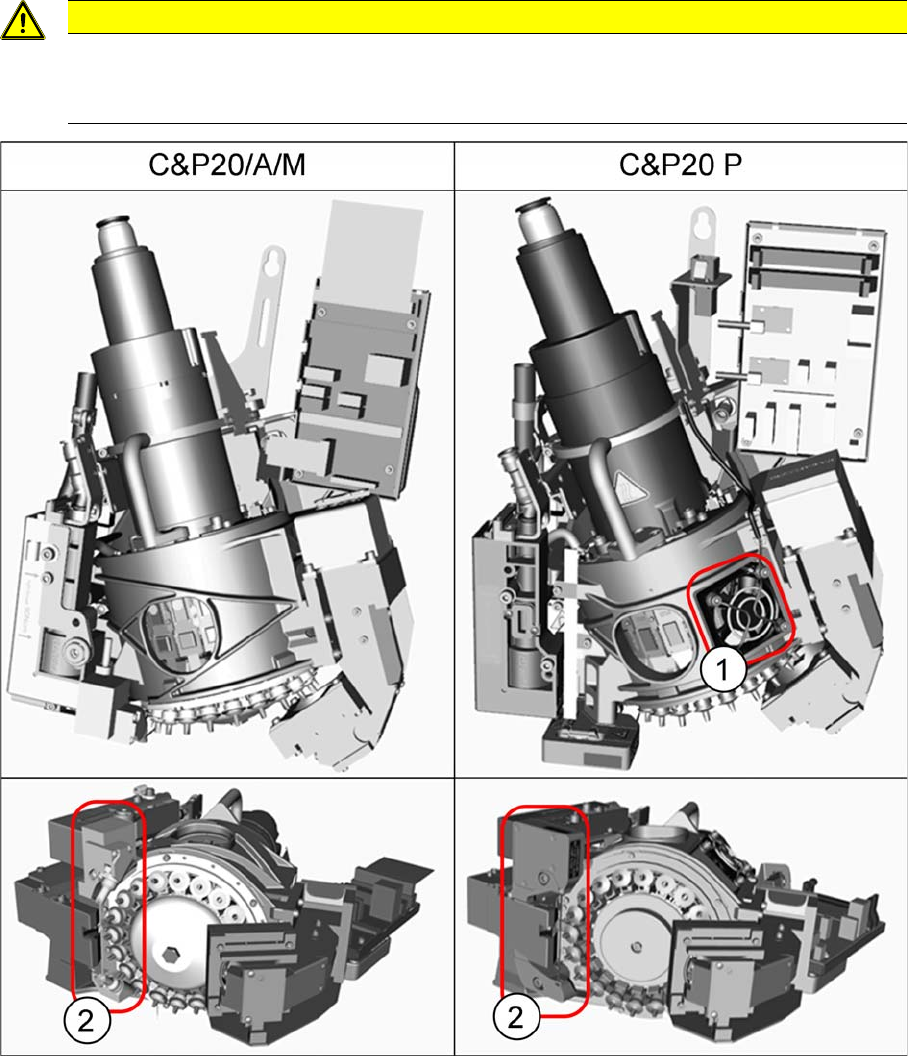
The C&P20/A/M and the C&P20 P head differ in many details. They are easily identified by the following
features:
1. The C&P20 P can be identified by the fan. This fan is not present on the C&P20/A/M heads.
2. The component sensor is flatter and wider on the C&P20 P than on the C&P20/A/M.
CAUTION
Do not confuse the different C&P20 head variants.
► Parts from the C&P20/A/M head can not usually be used for the C&P20 P head (and vice
versa)!
Brief Description
C&P12 Placement Head - Special Features
Vacuum Pump Vakuumpumpe 87
2.10
2.10 C&P12 Placement Head - Special Features
C&P12 Placement Head - Special Features
When retrofitting the vacuum pump option, the Venturi vacuum generator for the C&P6/12 head is re-
placed with the retrofit kit vacuum pump C+P6/12 [00119796-xx].
The holding circuit is therefore operated permanently via the vacuum pump.
The placement circuit continues to generate its vacuum with compressed air according to the Venturi
principle.
When the placement head is in waiting position, the star is between two star positions (half-cycle). In this
intermediate position, the holding and pickup cycles are interconnected via the cross-section, leading to
an increased vacuum consumption.
The "vacuum consumption" of the placement machine depends only on the number of placement heads
and the size of the nozzles.
The more C&P12 heads are connected to the vacuum pump, the lower the vacuum level will be at the
nozzles.
When the placement operation begins, the vacuum increases with each component picked up. An aver-
age vacuum value will soon form, based on the number of nozzles closed at the same time (with picked
up components) and number of nozzles open (components placed).