THDP-TMDP_Instructions-077054003.pdf - 第53页
Adjustment procedures W ARNING: These procedures require the application of high voltage to the inputs of the probes. Only qualified personnel should perform any testing with voltage levels exceeding 30 V rms . All perti…
Equipment required
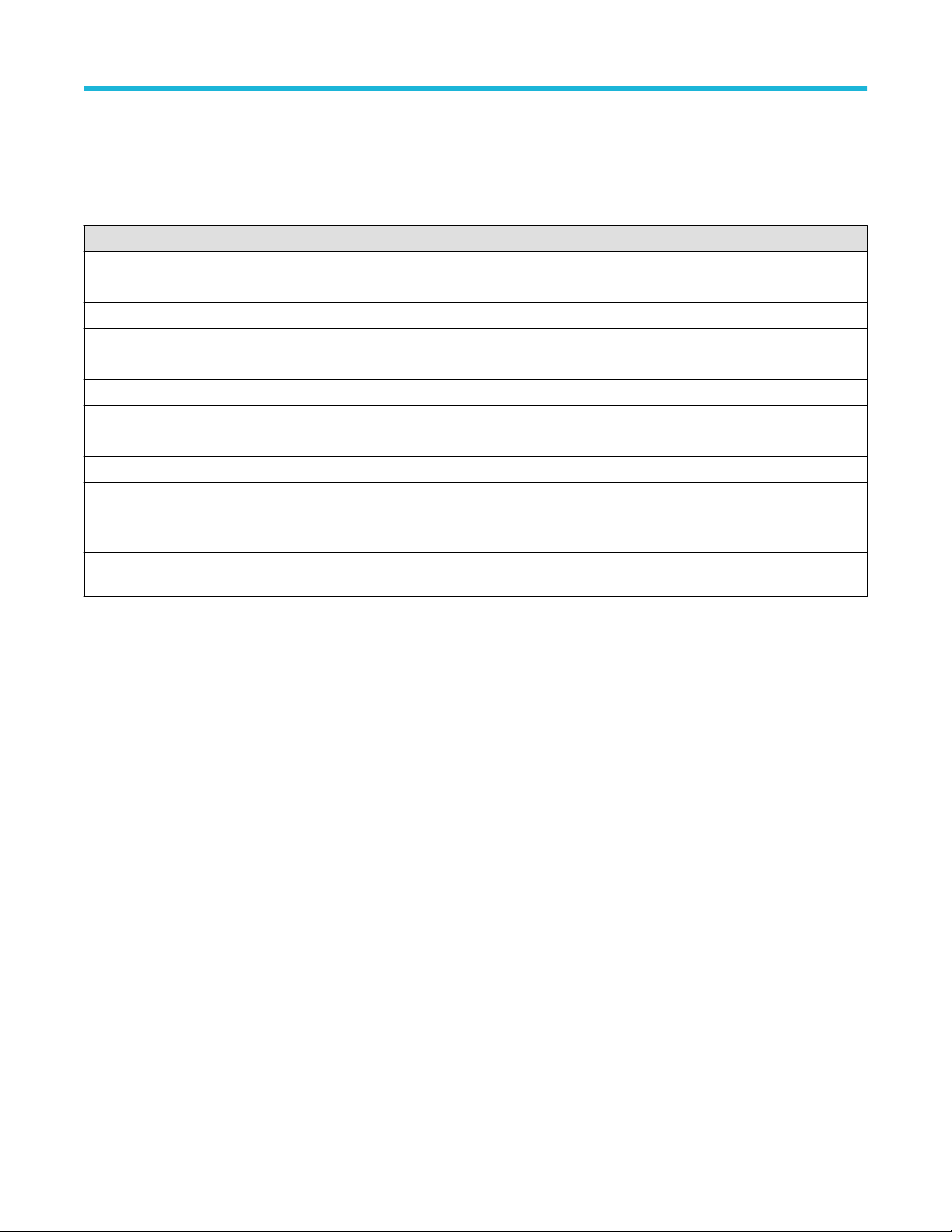
The equipment required to perform the adjustment procedures are shown in the table below
. The types and quantities of connectors may
vary depending on the specific equipment you use.
Table 14: Equipment required for adjustments
Description Minimum requirements Example product
Oscilloscope 500 MHz Tektronix MSO/DSO4000
Generator ±100 V variable, 100 Hz square wave, calibrated Fluke 9100
Probe calibration fixture TekVPI inputs Tektronix part number 067-1701-xx
Digital Multimeter (DMM) 100 mV and 1 V true RMS AC ranges, <±0.3 % accuracy Tektronix DMM4040/4050
Cable Coax, BNC, 50 Ω, 36 in Tektronix part number 012-0482-xx
Adapter BNC female-to-SMA male Tektronix part number 015-1018-xx
Adapter BNC male-to-dual binding post Tektronix part number 103-0035-xx
Adapter BNC male-to-dual banana male Fluke PM9081
Probe hook tips (2) Included with probe accessory kit Tektronix part number AC280–FL
Adjustment tool Insulated, slotted (straight) head Tektronix part number 003-1433-xx
Adjustment tool. Required for
the CMRR adjustment.
Insulated, narrow-slotted (straight) head Tektronix part number 003-1928-xx
Replacement rear-panel
label
Reusable, adhesive-backed label that covers adjustment
access openings
Tektronix part number 335-2913-xx
The original label is backed with a reusable adhesive. If the label does not sufficiently adhere to the probe, order a replacement. Label
removal is not required to access of
fset zero adjustments
Adjustments
52
Adjustment procedures
WARNING: These procedures require the application of high voltage to the inputs of the probes. Only qualified personnel
should perform any testing with voltage levels exceeding 30 V
rms
. All pertinent safety rules and guidelines for elevated voltage
measurements should be followed and adhered to.
Test setup
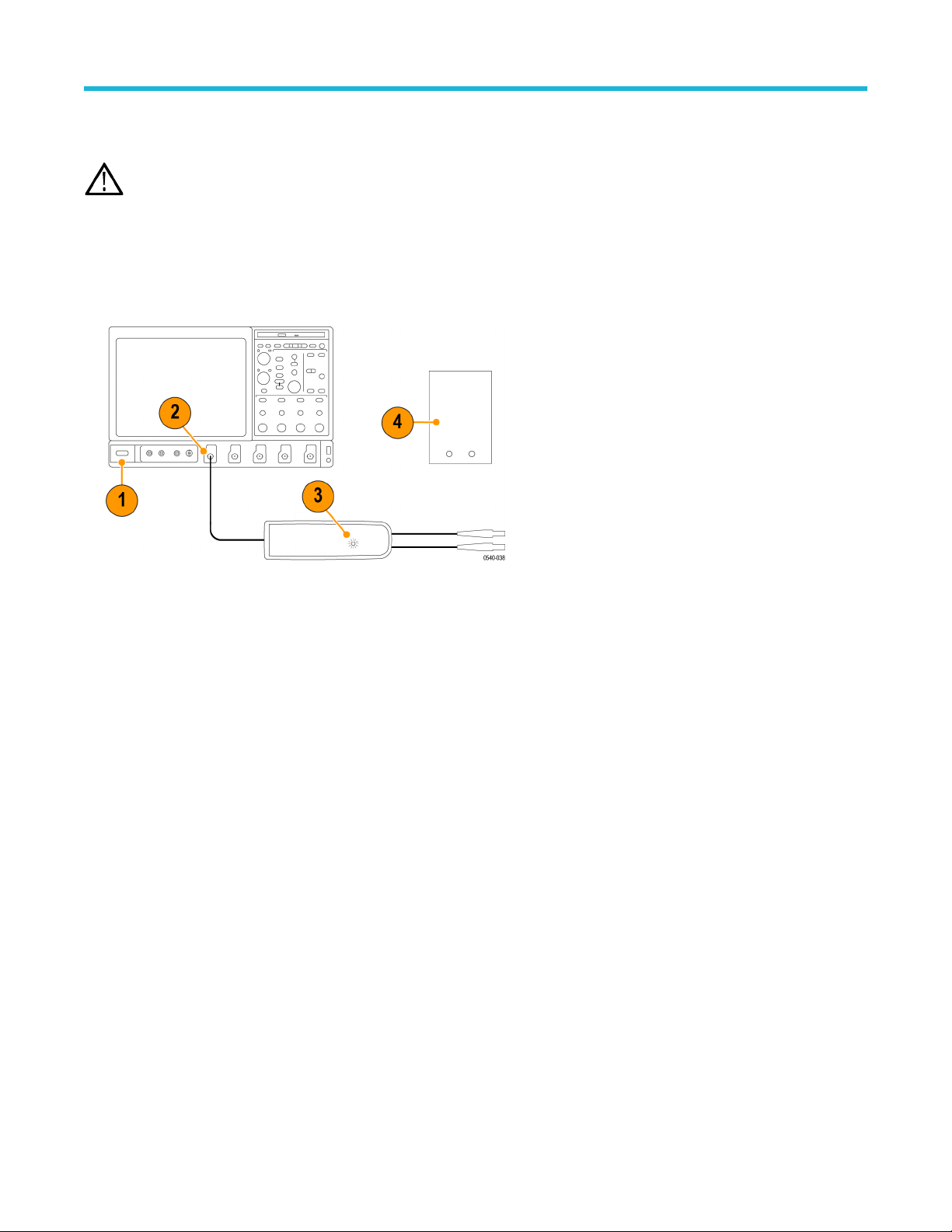
1. T
urn on the oscilloscope.
2. Connect the probe to any channel of the oscilloscope.
3. Verify that the LEDs light on the probe.
4. T
urn on the remaining test equipment and let the probe and equipment warm up for 20 minutes.
Adjustments
High Voltage Differential Probes THDP0100/0200 and TMDP0200 User Manual 53

Offset zero
This is the only procedure that applies to all of the probes and all serial numbers.
Adjustment notes
•
For probes with serial numbers C199999 and below, Offset Zero is the only adjustment that can be done to the probe.
• For probes with serial numbers C020000 and above, Offset Zero is the only adjustment that can be done without removing the back
label.
• The adjustment for each range is independent and does not interact between the ranges.
Procedure
1. Set the oscilloscope offset to 0 volts.
2. Connect the probe inputs together with the hook tips.
3. Press and hold the probe BANDWIDTH LIMIT and RANGE buttons until the OVERRANGE LED on the probe flashes.
4. Release the buttons. The OVERRANGE LED continues to flash, indicating that the digitally-controlled of
fset zero adjustment is
enabled.
5. Use the probe BANDWIDTH LIMIT and RANGE buttons to set the probe offset voltage as close to 0 V as possible, as displayed on the
oscilloscope. The BANDWIDTH LIMIT button decreases the offset voltage and the RANGE button increases it.
6. Press the AUDIBLE OVERRANGE button on the probe to store the adjusted offset value. The OVERRANGE LED stops flashing to
indicate that the offset value is stored and that the adjustment is disabled.
7. Select the remaining attenuation range and repeat steps 3 on page 54 through 6 on page 54.
Adjustments
54