ENA-X and ENA Series Vector Network Analyzers.pdf - 第26页
26 IQ Data Bandw idth Up to 1.5 Ghz / 4 Ghz ( S9 60 50 B/ S96051B ) I ndustry - stan dard PathWave Vector Sig nal Analysis (89600 VS A ) software enable s single - connection multiple measureme nts of active device disto…
25
Noise Figure Measurements with Vector Correction
(S96029B) using E5081A ENA-X
This software application enables high-accuracy noise figure and noise-power measurements of
amplifiers, frequency converters, and mixers, utilizing Keysight’s unique vector-source-correction
technique that uses Keysight N469xD series ECal module as a source-impedance tuner
1
to remove the
effects of imperfect system-source match. This approach yields accuracy that surpasses that provided by
the Y-factor method and other cold-source implementations, especially for in-fixture, on-wafer, and
automated-test environments. S96029B controls N469xD Series ECal modules configured as impedance
tuners for use with the E5081A ENA-X.
A scalar-calibrated method is also available that offers less accuracy but is faster and does not require an
impedance tuner. Unlike E5080B ENA, E5081A ENA-X does not require an external switch to isolate the
source signal during noise figure measurements.
If hardware options 0K1/0K2/0N1/0N2 are not ordered, then only the low and medium receiver gain
settings are available for noise figure measurements. These settings are suitable for devices with gain +
noise figure is > 30 dB. If the hardware options are ordered, in addition to the low and medium gain
settings, the high gain setting is enabled. This makes the noise figure capability suitable for a wider range
of devices. Hardware Options 0K1/0K2/0N1/0N2 are highly recommended if the instrument is to be used
for noise figure characterization.
All E5081A (with and without Option 0K1/0K2/0N1/0N2) include the necessary filters to eliminate out-of-
band noise conversion up to 40 GHz on ports 1 and 2. Below 160 MHz or above 40 GHz, an external
bandpass filter may be required for noise figure measurements.
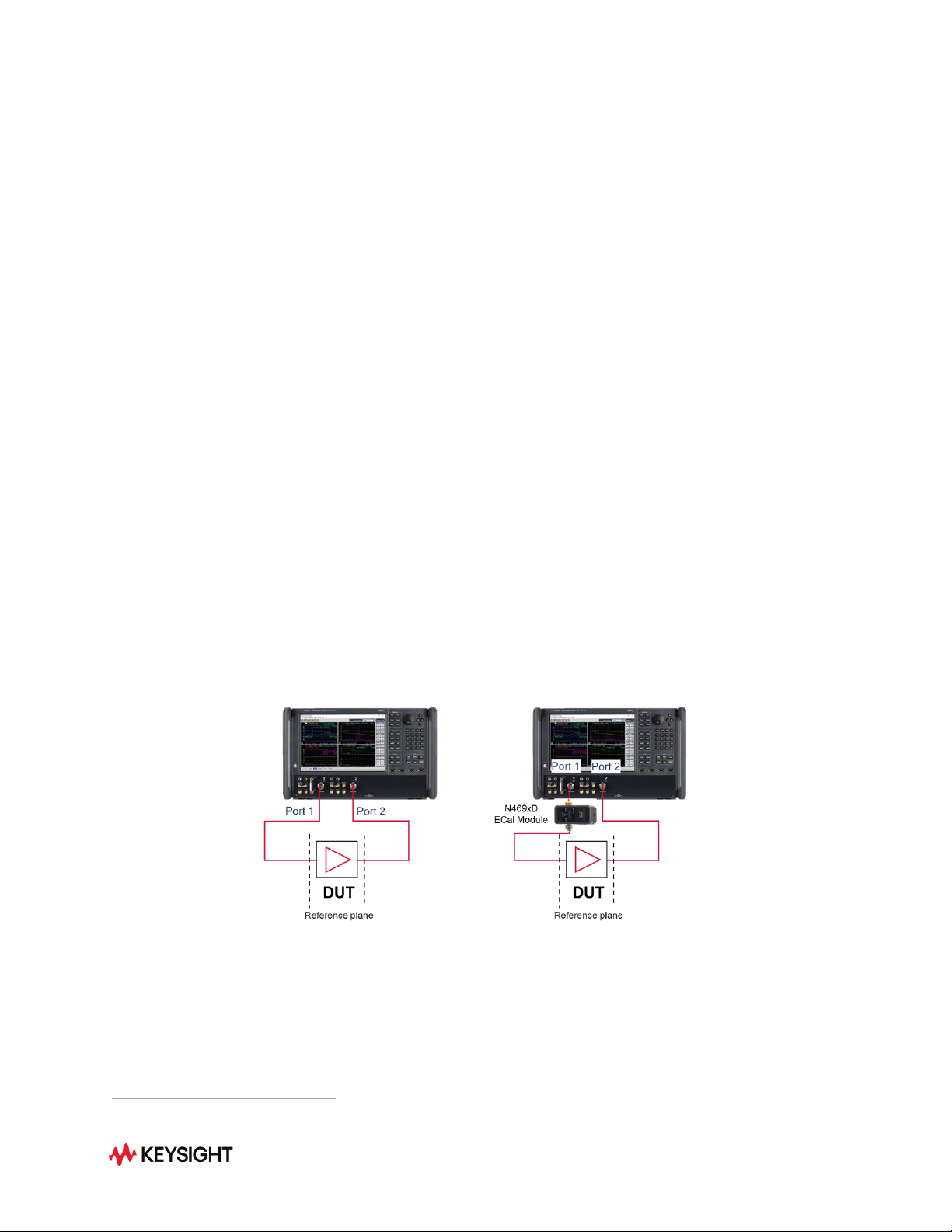
Typical block diagrams of scalar-corrected (left) vector-corrected (right) noise figure measurements with
ENA-X are shown.
For calibration, a standard mechanical cal kit or ECal module is required for the S-parameter portion of
the cal (an ECal used as a tuner cannot be shared for calibration). To calibrate a standard receiver for
noise figure measurements, a power meter/sensor is required. A 346-serires noise source (Keysight 346C
or 346C-K01 recommended) can be used for noise calibration of the instrument’s receiver.
Noise figure measurements with the E5081A are not supported below 50 MHz.
1. 8509x, N443x or N755xA Series ECal modules are not supported.

26
IQ Data Bandwidth Up to 1.5 Ghz / 4 Ghz
(S96050B/S96051B)
Industry-standard PathWave Vector Signal Analysis (89600 VSA) software enables single-connection
multiple measurements of active device distortion analysis using the ENA-X. The VSA IQ data-link feature
in either S960704B/707B modulation distortion or S960904B/907B spectrum analysis application allows
you to send IQ data from the VNA to the VSA software and analyze demodulation EVM, AM-AM, AM-PM,
and more.
Vector signal analysis with S96050B/S96051B is supported with the ENA-X. S96050B software license
supports IQ bandwidth of up to 1.5 GHz, while S96051B supports bandwidth up to 4 GHz. The license is
not required for bandwidth below 200 MHz.
Vector signal analysis with S96050B/S96051B is not supported with the E5080B ENA.
Maximum Bandwidth
Software License
E5080B ENA
E5081A ENA-X
29 MHz
Additional license not required
Yes
Yes
200 MHz
Additional license not required
Not available
Yes
1.5 GHz
S96050B
Not available
Yes
4 GHz
S96051B
Not available
Yes
Impedance Analysis (S96041B)
This software application enables the E5080B ENA to measure impedance parameters of Surface Mount
Devices (SMDs) such as capacitors or inductors up to 10 GHz. The high-frequency impedance analysis
solution consists of E5080B, S96041B and 16198A test fixture with option 010 to mount a small-sized
SMD under test, with either 0402 mm (01005 inch) or 0201 mm (008004 inch) size. S96041B computes
impedance parameters from measured data of E5080B using the 1-port reflection measurement method.
For calibration, S96041B provides two-step calibration for accurate impedance measurements – full 1-
port calibration and enhanced fixture compensation. The 85052DH02 data-based calibration kit is
required to perform full 1-port calibration to define the calibration plane at the 3.5-mm coaxial connector of
16198A’s adapter. Then, fixture effects are removed with the special compensation method. Open/short
fixture compensation eliminates the effects of residual impedance and stray admittance around the
fixture’s electrodes. The whole calibration process eliminates system errors associated with cables and
test fixture and delivers accurate impedance measurements.
Refer to the solution brief (literature number 3121-1166.EN) for more details.
S96041B is not supported with E5081A ENA-X.

27
Modulation Distortion (S960704B/S960707B)
This application software with the E5081A ENA-X and a vector signal generator measures the in-channel
and out-of-channel nonlinear behavior of power amplifiers or frequency converters under modulated
stimulus conditions. It is based on a new frequency-domain measurement method that quickly measures
EVM or ACPR and performs VNA calibration to make accurate measurements.
The software provides a full integrated measurement setup including modulation signal generation and
allows the user to easily configure and make the measurements.
E5081A Option 2K6, 2N6, 2N7, 4K6, 4N6 or 4N7 with built-in upconverter are highly recommended for
modulation distortion analysis using the application. While these internal hardware options are not
required in running the application, without them the setup requires external components and is complex.
The options with built-in upconverter greatly simplify the measurements. Vector signal generators
covering frequencies of 6 GHz or higher are supported with the upconverter.
The maximum bandwidth of modulation distortion analysis is limited by the modulation source. For
example, the maximum bandwidth is 960 MHz when used with N5186A with Option B9X (960 MHz
bandwidth), and 2 GHz with M9383A/B or M9384B
1
.
The signal generators
2
supported by this application are:
•
M9383A PXIe Microwave Signal Generator, 1 MHz to 44 GHz
•
M9383B/84B/M9484C VXG Microwave Signal Generator, 1 MHz to 44 GHz / 54 GHz
•
M9410A/11A/15A/20A/21A VXT PXIe Vector Transceiver
3
•
N5182A/B MXG X-Series RF Vector Signal Generator, 100 kHz/9 kHz to 6 GHz
•
N5186A MXG Vector Signal Generator, 9 kHz to 8.5 GHz
•
N5192A/94A UXG X-Series Vector Adapter Modified Version, 50 MHz to 20 GHz, with U3039ACK
6 GHz Reference Source.
1. The maximum modulation bandwidth of E5081A-2N7/4N7 is frequency dependent. (The maximum bandwidth is 550 MHz for
31.8 GHz to 37 GHz, and 2 GHz for the rest of specified frequency ranges).
2. When Signal Studio is used, a waveform playback license N76xxEMBC is required for the external source. For more
information, refer to Signal Studio Brochure (5989-6448EN).
3. M9420A Option 506 (60 MHz to 6 GHz) is supported. Option 504 (60 MHz to 3.8 GHz) is not supported.
Modulation distortion analysis for frequency converters requires S96083B, vector and scalar mixer/ converter
measurements software. S96082B, scalar mixer/converter measurement software is not sufficient.
This application also includes a VSA IQ data-link feature for sending IQ data from the VNA to Keysight’s
Pathwave 89600 VSA software for demodulation and analysis of EVM, AM-AM/AM-PM, and more. With no
additional license, the data link supports up to 200 MHz of modulation bandwidth with E5081A ENA-X and a
29 MHz bandwidth with E5080B ENA. S96050B/51B software licenses extend the modulation bandwidth to
1.5 GHz/4 GHz with ENA-X.