ENA-X and ENA Series Vector Network Analyzers.pdf - 第29页
29 Gain Compression Measurements ( S96086B ) The Gain Compression Appl ication (GCA) provides in put power, output power, gain, and phase at the compression point of an amplifier or frequen cy converters, over a specifie…

28
Scalar Mixer/Converter Measurements (S96082B)
S96082B provides Frequency Offset Mode (FOM) to set the frequency of the internal source(s)
independently from where the receivers are tuned, and to configure external sources using External
Device Configuration. This functionality is also included with S96029/083/084/086/089/090, both B and
A models.
With a simple setup and calibration, this application delivers the highest accuracy for scalar conversion-
loss/gain measurements by combining one-port and power-meter calibrations to remove mismatch errors.
S96082B provides an intuitive and easy-to-use user interface for setting up mixer and converter
measurements, with single or dual conversion stages. It can control external signal generators for use as
LO signals. Supported external sources include the Keysight ESG, PSG, EXG, and MXG Series, as well
as other SCPI-controlled signal generators.
S96082B is compatible with S96084B, which enables measurements of converters with internal Los.
Vector and Scalar Mixer/Converter Measurements
(S96083B)
This application includes the scalar mixer/converter plus phase (SMC+Phase) measurement class that
provides fully calibrated conversion gain/loss, relative phase, and absolute group delay measurements of
mixers and converters without the need for reference or calibration mixers. Eliminating the calibration
mixer requires a U9391C/F/G comb generator
1
and an external DC power supply capable of sourcing +15
V and 300 mA for U9391C/F or 800 mA for U9391G. A Vector Mixer Characterization (VMC) is also
included for measuring group delay of frequency converting devices. VMC is used to characterize a
calibration mixer supplied by the user.
SMC+Phase with the S96083B provides an intuitive and easy-to-use user interface for setting up mixer
and converter measurements, with single or dual conversion stages. It can control the analyzer’s built-in
source(s) as well as external signal generators for use as LO signals. Supported external sources include
the Keysight ESG, PSG, EXG, and MXG Series, as well as other SCPI-controlled signal generators.
S96083B is a superset of S96082B, so they should not be installed together. S96083B is compatible with
S96084B, which enables measurements of converters with internal Los.
Embedded LO Capability (S96084B)
This application tunes the analyzer’s receivers to the output frequency of the converter under test without
the need for access to internal Los or a common reference signal. S96084B is intended to work with
S96082B and S96083B measurement applications.
1. When a comb generator is used as a phase reference for calibration and the start frequency of the measurement is less than
630 MHz, a user-supplied calibration mixer is required.
29
Gain Compression Measurements (S96086B)
The Gain Compression Application (GCA) provides input power, output power, gain, and phase at the
compression point of an amplifier or frequency converters, over a specified frequency range. GCA’s
SMART Sweep is very fast and easy-to-use. GCA also includes a guided calibration that corrects for
absolute power levels, frequency response, and mismatch errors.
Intermodulation Distortion Measurements (S96087B)
Using E5080B ENA
The Intermodulation Distortion (IMD) application makes it very easy to set up and calibrate swept-IMD
measurements of both amplifiers and frequency converters. It controls the frequency and power of
internal and external sources and tunes the receivers to the main tones as well as the IMD products in a
single measurement channel. You can sweep either the center frequency of the two stimulus signals, the
frequency spacing of the two stimulus signals about a fixed center frequency, the power of one or both
stimulus signals, or the power of the LO signal. The analyzer can measure intermodulation distortion
products of order 2, 3, 5, 7, or 9, and display the associated intercept points.
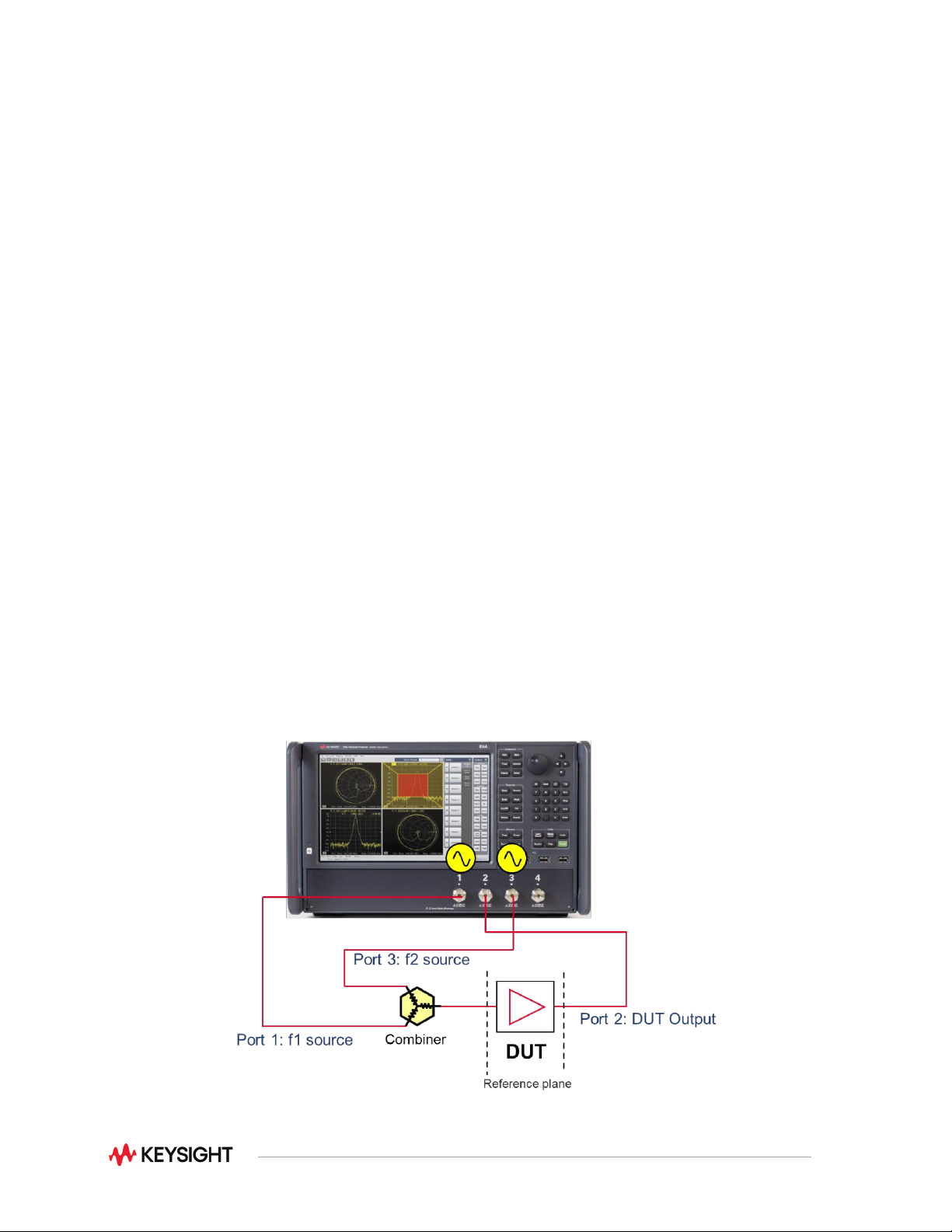
A 4-port E5080B with the internal second source option 4x2 is recommended for IMD measurements with
each built-in source generating one tone. The most common method with the E5080B is to use two
reference receivers for power leveling – the first tone signal (f1) is measured with the VNA’s one receiver
(e.g., a1 receiver of port 1), and the second tone signal (f2) is measured with another receiver (e.g., a3
receiver of port 3).
An external combiner (for example, hybrid power dividers 87302C, 87303C, or 87304C) is required to
combine the tones. Any of the remaining ports can be used as the receive port. A typical configuration for
IMD measurements with the 4-port E5080B-4x2 is shown.
30
Intermodulation Distortion Measurements (S96087B)
Using E5081A ENA-X
The Intermodulation Distortion (IMD) application makes it very easy to set up and calibrate swept-IMD
measurements of both amplifiers and frequency converters. It controls the frequency and power of
internal and external sources and tunes the receivers to the main tones as well as the IMD products in a
single measurement channel. You can sweep either the center frequency of the two stimulus signals, the
frequency spacing of the two stimulus signals about a fixed center frequency, the power of one or both
stimulus signals, or the power of the LO signal. The analyzer can measure intermodulation distortion
products of order 2, 3, 5, 7, or 9, and display the associated intercept points.
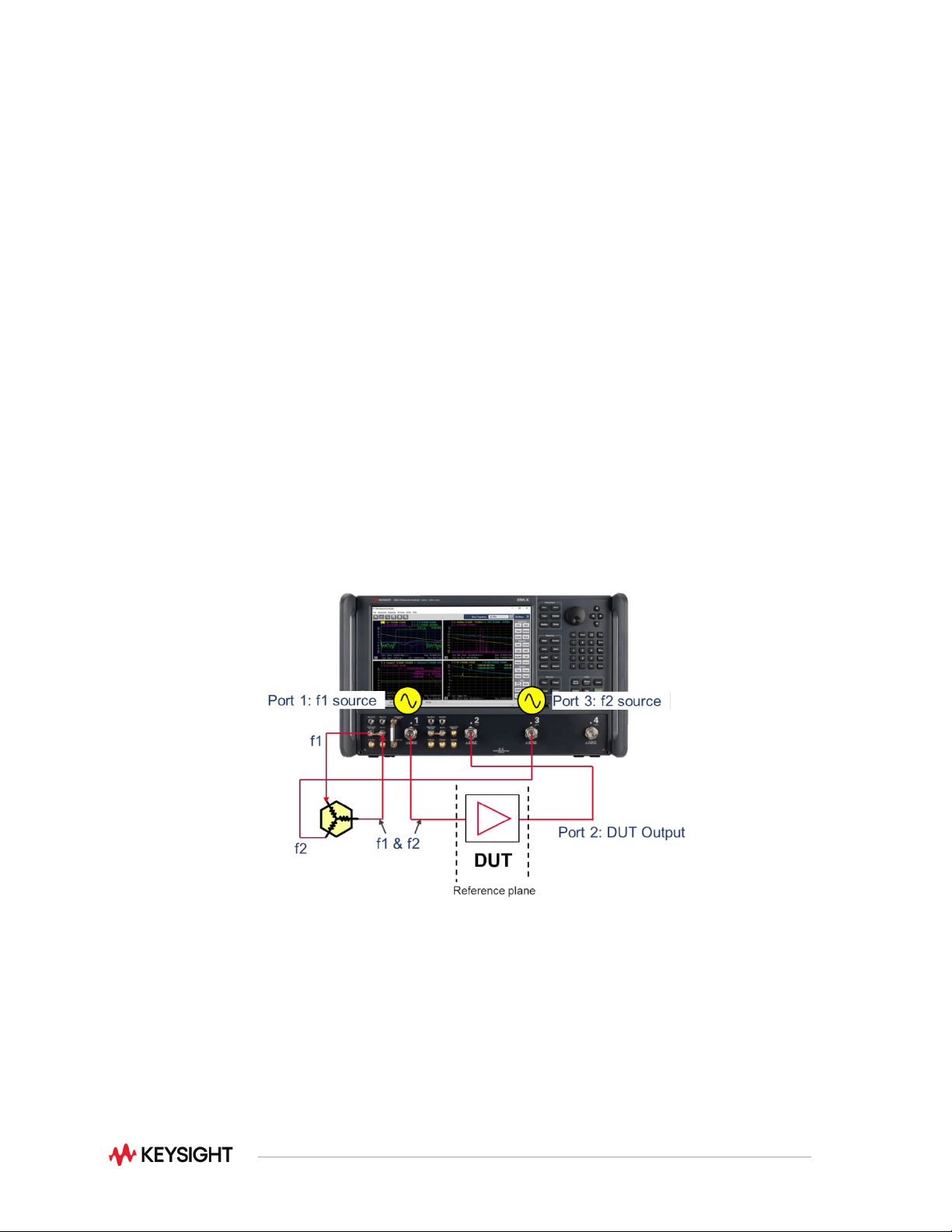
A 4-port E5081A is recommended for IMD measurements with each built-in source generating one tone.
The recommended method with the E5081A is to use one reference receiver for power leveling – both
first (f1) and second (f2) tone signals are measured with the VNA’s one receiver. Unlike the E5080B,
E5081A’s internal couplers can be directly accessed, so the couplers can be placed as close as possible
to input of the DUT. This configuration improves measurement accuracy of reflection measurements by
eliminating insertion loss associated with a combiner.
An external combiner (for example, hybrid power dividers 87302C, 87303C, or 87304C) is required to
combine the tones. Any of the remaining ports can be used as the receive port. A typical configuration for
IMD measurements with the 4-port E5081A is shown.