ENA-X and ENA Series Vector Network Analyzers.pdf - 第30页
30 Intermodulation Distortion Meas urements ( S96087B ) Using E5081A ENA - X The Intermodul ation Distortion (IMD) app lication makes it very eas y to set up and calibrate swept - IMD measurements of bot h amplifiers and…
29
Gain Compression Measurements (S96086B)
The Gain Compression Application (GCA) provides input power, output power, gain, and phase at the
compression point of an amplifier or frequency converters, over a specified frequency range. GCA’s
SMART Sweep is very fast and easy-to-use. GCA also includes a guided calibration that corrects for
absolute power levels, frequency response, and mismatch errors.
Intermodulation Distortion Measurements (S96087B)
Using E5080B ENA
The Intermodulation Distortion (IMD) application makes it very easy to set up and calibrate swept-IMD
measurements of both amplifiers and frequency converters. It controls the frequency and power of
internal and external sources and tunes the receivers to the main tones as well as the IMD products in a
single measurement channel. You can sweep either the center frequency of the two stimulus signals, the
frequency spacing of the two stimulus signals about a fixed center frequency, the power of one or both
stimulus signals, or the power of the LO signal. The analyzer can measure intermodulation distortion
products of order 2, 3, 5, 7, or 9, and display the associated intercept points.
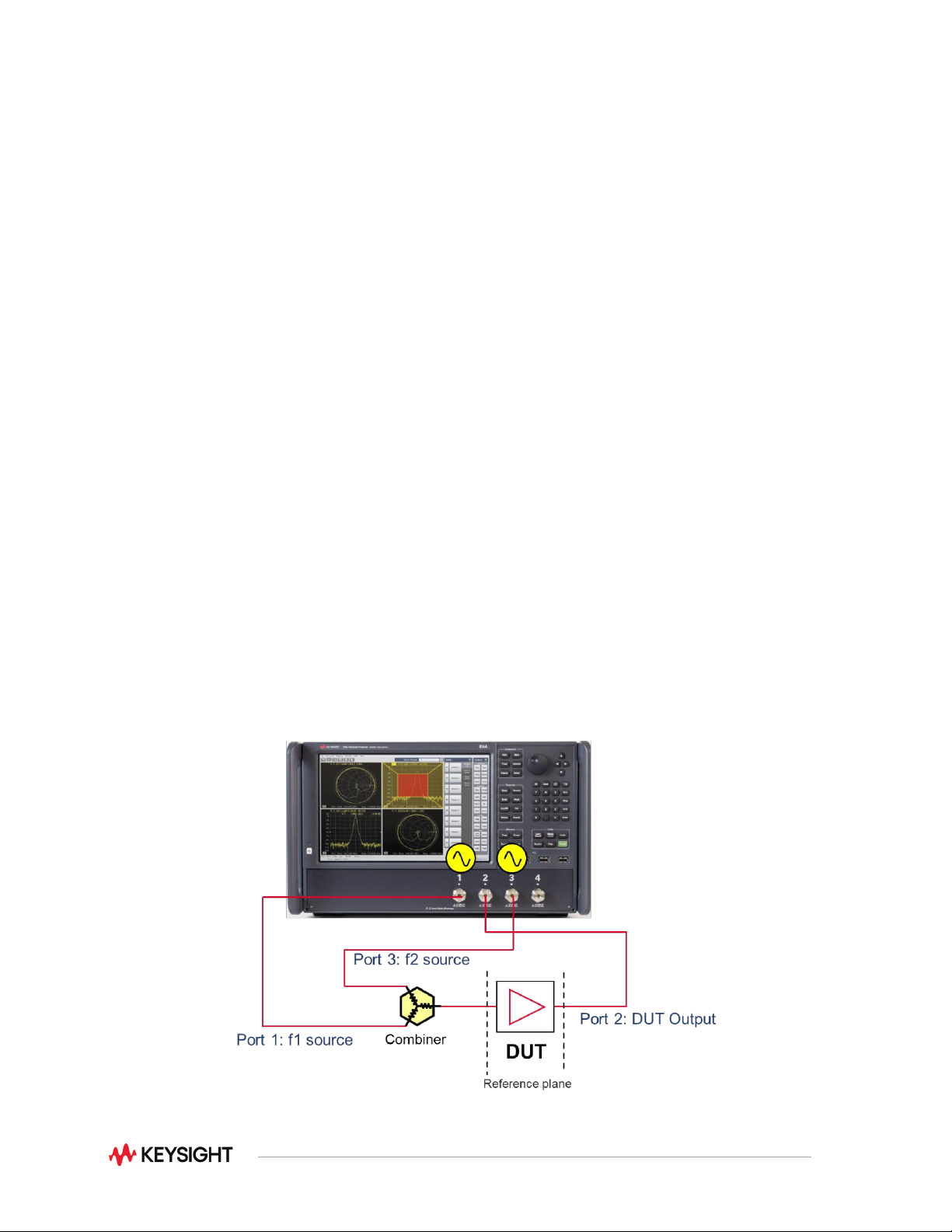
A 4-port E5080B with the internal second source option 4x2 is recommended for IMD measurements with
each built-in source generating one tone. The most common method with the E5080B is to use two
reference receivers for power leveling – the first tone signal (f1) is measured with the VNA’s one receiver
(e.g., a1 receiver of port 1), and the second tone signal (f2) is measured with another receiver (e.g., a3
receiver of port 3).
An external combiner (for example, hybrid power dividers 87302C, 87303C, or 87304C) is required to
combine the tones. Any of the remaining ports can be used as the receive port. A typical configuration for
IMD measurements with the 4-port E5080B-4x2 is shown.
30
Intermodulation Distortion Measurements (S96087B)
Using E5081A ENA-X
The Intermodulation Distortion (IMD) application makes it very easy to set up and calibrate swept-IMD
measurements of both amplifiers and frequency converters. It controls the frequency and power of
internal and external sources and tunes the receivers to the main tones as well as the IMD products in a
single measurement channel. You can sweep either the center frequency of the two stimulus signals, the
frequency spacing of the two stimulus signals about a fixed center frequency, the power of one or both
stimulus signals, or the power of the LO signal. The analyzer can measure intermodulation distortion
products of order 2, 3, 5, 7, or 9, and display the associated intercept points.
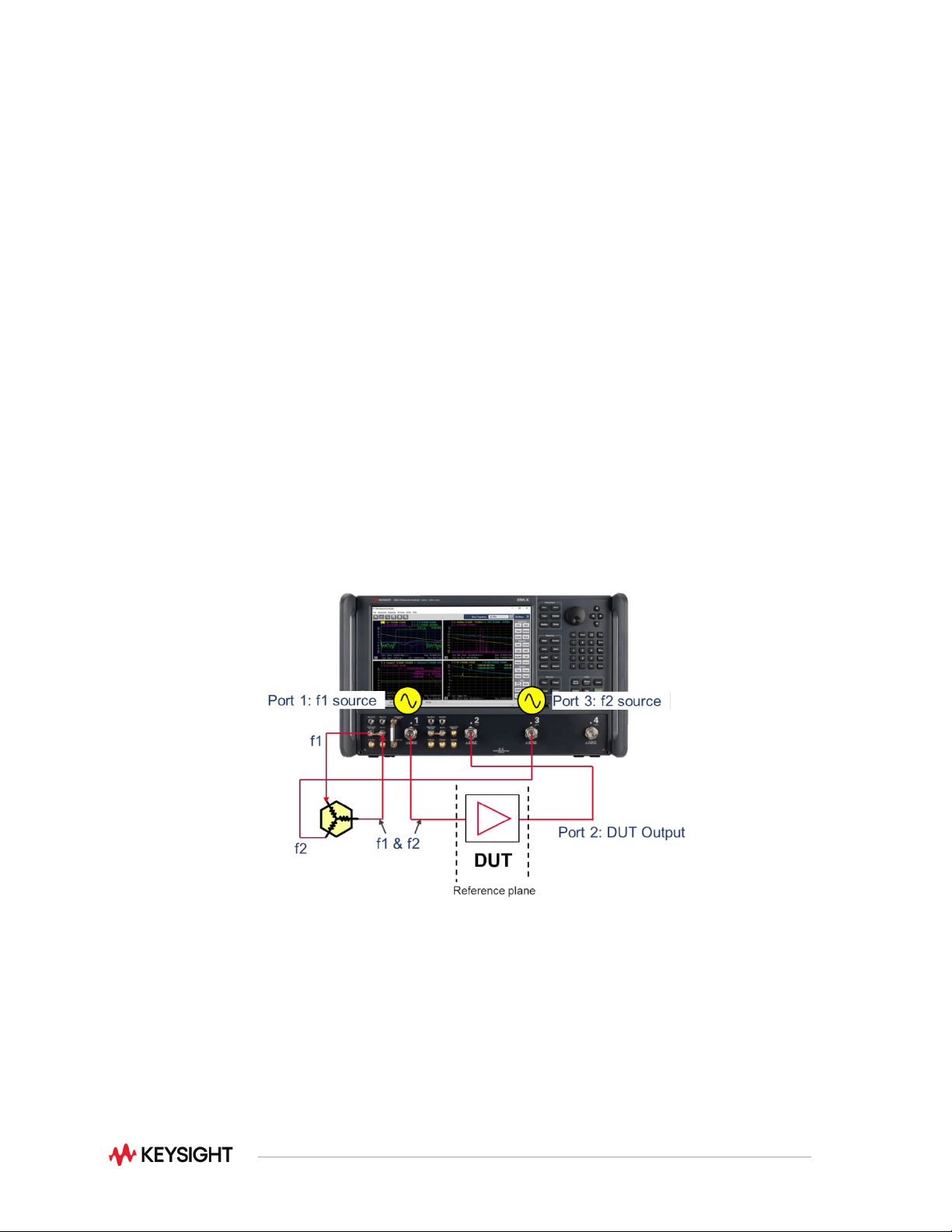
A 4-port E5081A is recommended for IMD measurements with each built-in source generating one tone.
The recommended method with the E5081A is to use one reference receiver for power leveling – both
first (f1) and second (f2) tone signals are measured with the VNA’s one receiver. Unlike the E5080B,
E5081A’s internal couplers can be directly accessed, so the couplers can be placed as close as possible
to input of the DUT. This configuration improves measurement accuracy of reflection measurements by
eliminating insertion loss associated with a combiner.
An external combiner (for example, hybrid power dividers 87302C, 87303C, or 87304C) is required to
combine the tones. Any of the remaining ports can be used as the receive port. A typical configuration for
IMD measurements with the 4-port E5081A is shown.

31
Source Phase Control (S96088B)
This application allows users to set calibrated, arbitrary phase differences between two internal sources
with the E5080B’s option 4x2 or E5081A’s 4-port options. The phase difference can be fixed or swept
between two specified phase values. S96088B also controls the relative power level between the sources
using the receiver-leveling feature. S96088B is targeted for active-load control, where the analyzer
provides a precise, electronically settable impedance to the output port of a device, while gain and output
power are measured. This capability can be combined with external load-pull software to create traditional
load-pull power contours. Not available with the E5080B option 2x0/4x0 or E5081A option 2xx with a
single internal source.
Differential and I/Q Device Measurements (S96089B)
In systems with a single source, the S96089B software can be used to characterize the harmonics of an
active device, such as an amplifier. The source is set to the fundamental frequency and the receivers can
easily be set to a multiple to measure the fundamental (x1), second (x2), third (x3), or higher harmonics.
Power sweeps can be used to characterize the harmonic levels versus power.
In systems with more than one source, the S96089B combines source-phase control of the internal or
external sources with frequency-offset mode, enabling simplified test of I/Q modulators/converters and
differential mixers, and harmonic measurements of differential amplifiers. The phase difference between
sources can be fixed (for example, at 90 or 180 degrees), or swept between two specified phase values.
Providing accurate control of the relative phase between sources eliminates the need for hybrid couplers
and baluns to create quadrature or differential signals. After achieving the desired phase alignment, the
instrument's receivers can be tuned to all frequencies needed to characterize the DUT. On an I/Q
modulator for example, measurements can be made of both the desired and suppressed conversion
bands, along with LO leakage, harmonics and other spurious signals. Phase sweeps can be used to
determine a DUT’s phase imbalance versus frequency.
In all cases, users can specify measurements with individual receivers or multiple receivers combined
with a wide range of mathematical operators. Power measurements can employ match correction for
increased accuracy.