YG12_英文保养手册.pdf - 第32页
Chapter 1 Maintenance Contents 1. Maintaining machine per formance 1- 1 1.1 Essential conditions and working environment 1- 1 1.2 Importance of periodic inspections and cleaning 1- 1 2. Preparing for maintenance tasks 1-…
xxv
Safety instructions
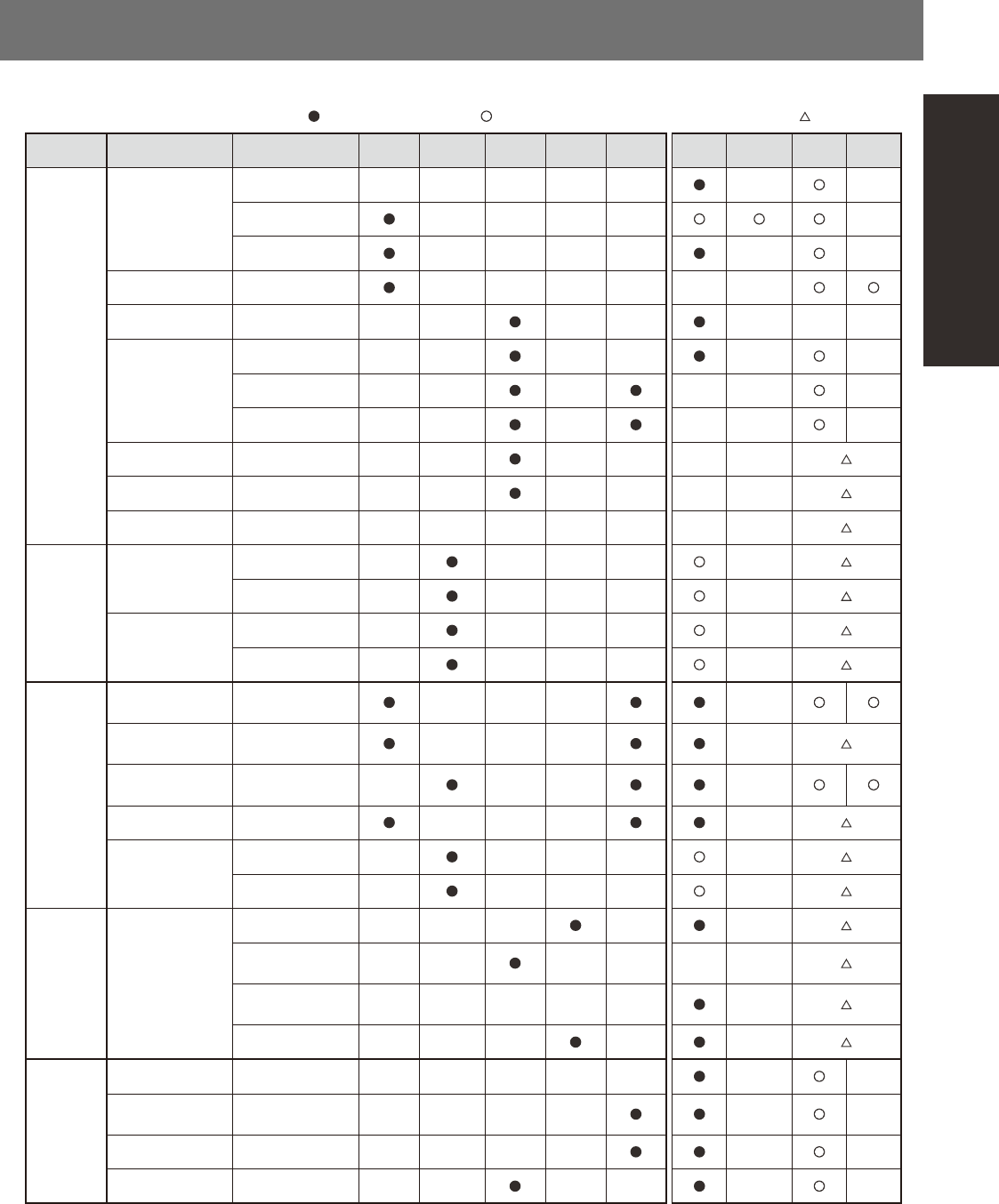
6. Maintenance list
n
Maintenance list
: Perform maintenance. : Replace or adjust if necessary after inspection : Contact us.
Section Unit name Check items Weekly Monthly 3 Mon. 6 Mon. Others
Clean-
ing
Lubri-
cation
Replace-
ment
Adjust-
ment
Head
assembly
parts
Nozzle
Air path
Bimonthly
Spring action
Pick-up condition
Leaf spring Holding condition
Spline shaft Air path
Ejector unit
Filter
Vacuum pressure
Blow valve
Z-axis Holding condition
SC-axis Holding condition
R-axis spline belt Holding condition 1 year
X and Y
axes
X-axis
Ball screw
Bimonthly
Guide
Bimonthly
Y-axis
Ball screw
Bimonthly
Guide
Bimonthly
Conveyor
units
Board sensor
Condition and
operation
Board clamp
Condition and
operation
Board transport
unit
Conveyor belt
Push-up Ball screw
Bimonthly
W-axis
(Conveyor width
auto adjustment)
Ball screw
6 Mon.
Guide 6 Mon.
Vision
system
Lighting
unit
Vision systems
Camera lighting
unit
Fiducial camera
SC-axis flexible
cable
Multi-vision camera
(OP)
1 year
Scan camera
Others
Blow station Main filter 1 year
Nozzle station
(option)
ANC sensor
board
1 year
Controller Filter
Air/mist filter Filter

Chapter 1 Maintenance
Contents
1. Maintaining machine performance 1-1
1.1 Essential conditions and working environment 1-1
1.2 Importance of periodic inspections and cleaning 1-1
2. Preparing for maintenance tasks 1-2
2.1 Consumable parts and replaceable parts (for repairs) 1-2
2.1.1 Consumable parts 1-2
2.1.2 Replaceable parts (for repairs) 1-4
2.2 Maintenance tools 1-5
2.2.1 Cleaning tools 1-5
2.2.2 Lubricating tools and grease 1-7
2.3 Required tools 1-9

1-1
1
Maintenance
1. Maintaining machine performance
The most important condition essential for maintaining the performance of the machine you purchased is
using it under good environmental conditions. Performing daily maintenance and periodic inspections is also
absolutely essential.
1.1 Essential conditions and working environment
n
Air
• Use a supply air pressure of at least 0.45MPa (YS12) or 0.60MPa (YG12).
• Use an air hose with an inner diameter (I.D.) of at least 8mm.
• Use clean air obtained via an air dryer and air filter.
n
Power
Power supply : 200/208/220/240/380/400/416VAC (±10%), 3-phase AC line
Frequency : 50 Hz or 60 Hz
Power supply capacity : 4.9kVA(YS12) , 3.9kVA(YG12)
Average power consumption : 1.1kW(YS12) , 0.9kW(YG12)
Power supply connection : Power cable conductor cross-section area: 2.5 mm
2
minimum
n
Environment
Noise : Complies with EN61000-6-2 standard.
Humidity : 20 to 90% (no condensation), optimal range: 50 to 60%
Temperature : Functions guaranteed within 15 to 35°C. Machine precision guaranteed within 20 to 28°C.
Atmosphere : No dust or powder. No significant noise generation.
Installation : Flat level location sturdy enough so no vibration occurs during operation.
Wooden floors in particular are unsuitable.
Required floor flatness : When using feeder exchange carriages on the front and rear sides of the machine, the
flatness of the floor must be within 10mm, including the area directly under the machine.
Floor load-bearing strength : 850kg/m
2
or more
n
NOTE
Keep the humidity at 40% or higher to prevent electrostatic charges. When using an industrial humidifier, use water
that is equal to pure water.
1.2 Importance of periodic inspections and cleaning
Periodic inspections and cleaning are extremely important maintenance tasks. Failure to perform inspections
and cleaning will prevent the machine from delivering full performance and may lead to component mounting
problems or equipment breakdowns.
Examples:
• Dirty nozzles might cause mistakes in component recognition and cause mounting errors.
• Dirty air paths may cause numerous pickup and mounting errors.
• Inadequate feeder and feeder plate inspections may cause pickup errors.
• Dirty optical system (camera, lighting, etc.) may cause recognition errors.
• Poor greasing of axes may cause abnormal noises.
• Poor inspections such as of valves may cause errors in PCB clamping and conveying.
As these examples show, failure to make inspections may lead to equipment problems. We strongly recommend
you perform periodic inspections and cleaning to ensure the machine is used under optimal conditions.