00193922-01.pdf - 第154页
4 Setting up and commissioning User Manual SIPLACE HF Series 4.3 Delivery configuration and transport Sof tware Version S R.505.xx 05/2004 US E dition 154 Æ Mak e sure that th e forks are evenly loaded when you l ift the…
User Manual SIPLACE HF Series 4 Setting up and commissioning
Software Version SR.505.xx 05/2004 US Edition 4.3 Delivery configuration and transport
153
Forks across the PCB conveyor 4
4
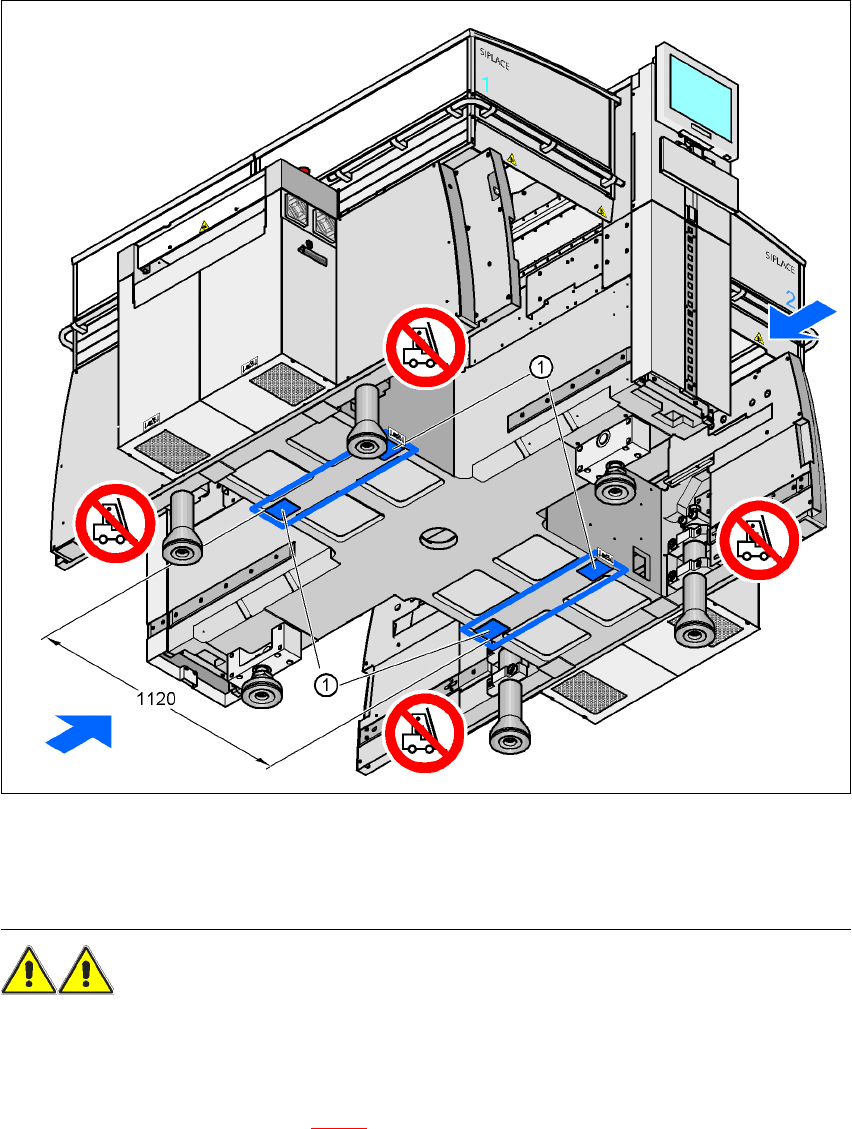
Fig. 4.3 - 3 Contact surfaces - Forks across the direction of PCB transport
(1) Contact surfaces for the forks of the fork-lift
WARNING
Please note the following points
before
you raise the placement machine in order to avoid irre-
versible damage to the machine:
– The distance between the forks must be between 800 and 900 mm. The attachment surfaces
for the fork-lift are shown in Fig. 4.3 - 3
. The maximum distance between the contact surfaces
is 1120 mm. NEVER increase the distance between the forks so that the machine is lifted on
the side parts of the machine frame, since this would deform the machine frame.

4 Setting up and commissioning User Manual SIPLACE HF Series
4.3 Delivery configuration and transport Software Version SR.505.xx 05/2004 US Edition
154
Æ Make sure that the forks are evenly loaded when you lift the machine. A firm support between
the forks and placement machine will prevent the machine tilting when it is raised. This will also
prevent a one-sided load on the machine feet, which would deform the fixing of the machine
feet. We recommend that a second person watch the machine as it is raised, and make sure
that the machine does not tip to one side when lifted with the fork-lift.
4.3.4.4 Points that MUST be noted when transporting the machine
WARNING
When you are transporting the machine, make sure that
all
the feet are clear of the floor. If they
are not clear, the feet will drag along the floor or bump into obstacles. This could damage the
machine foot fixing in the machine frame.

User Manual SIPLACE HF Series 4 Setting up and commissioning
Software Version SR.505.xx 05/2004 US Edition 4.4 Infrastructure at the installation location
155
4.4 Infrastructure at the installation location
4.4.1 Recommendations concerning the quality of the foundation
The foundation for the placement machine should be firm and flat since dynamic forces can create
vibrations when the placement machine is used. The size of the vibrations depends on the con-
struction of the foundation. The following are suitable provided that the floor loading parameters,
etc, are not exceeded:
– Reinforced concrete ceiling constructions, e.g. ceilings in production halls
– Reinforced concrete floor slabs, e.g. concrete floors in production halls without a basement
– Rooms with double floors, provided that a stable foundation is included in the space between
them. The same set-up conditions apply to this intermediate foundation, which can be made
from steel girders or concrete.
4.4.1.1 Machine weight and floor loading
4.4.1.2 Vibration limits
The placement machine is not sensitive to ground vibration, but the following vibration limits
should still be observed.
4
Weight of basic machine 3800 kg (HF), 3850 kg (HF/3)
Weight (fully equipped) 4700 kg (HF), 4750 (HF/3)
Footprint 6.01 m² (HF), 6.48 m² (HF/3)
Number of machine feet 6
Load per unit area of the foundation Min. 1561 kg/m² (HF)
Min. 1590 kg/m² (HF/3)
Specific floor loading per foot
6 machine feet
3 machine feet
75.3 N/cm²
150.6 N/cm²
Parameters Values
Third-octave spectral value of the vibration speed
5 - 100 Hz v < 250 µm/s
v
max
value on the time curve v
max
< 1.5 mm/s