2500_Users_Manual-.pdf - 第255页
1929-1 CONTACT SET RETAINING BLOCK (1 of 2) SCREW (2 per side) VIEW FROM BELOW CROSS SECTION CROSS SECTION PLANE TILT CONTACT SET BEFORE REMOVING OR INSERTING Repair and Replacement Procedures Figure 7-21 Removing or ins…
1927-1
PRINTED
CIRCUIT
BOARD
1928-1
SCREW
RETAINING BLOCK
CONTACT SET
Repair
and
Replacement
Procedures
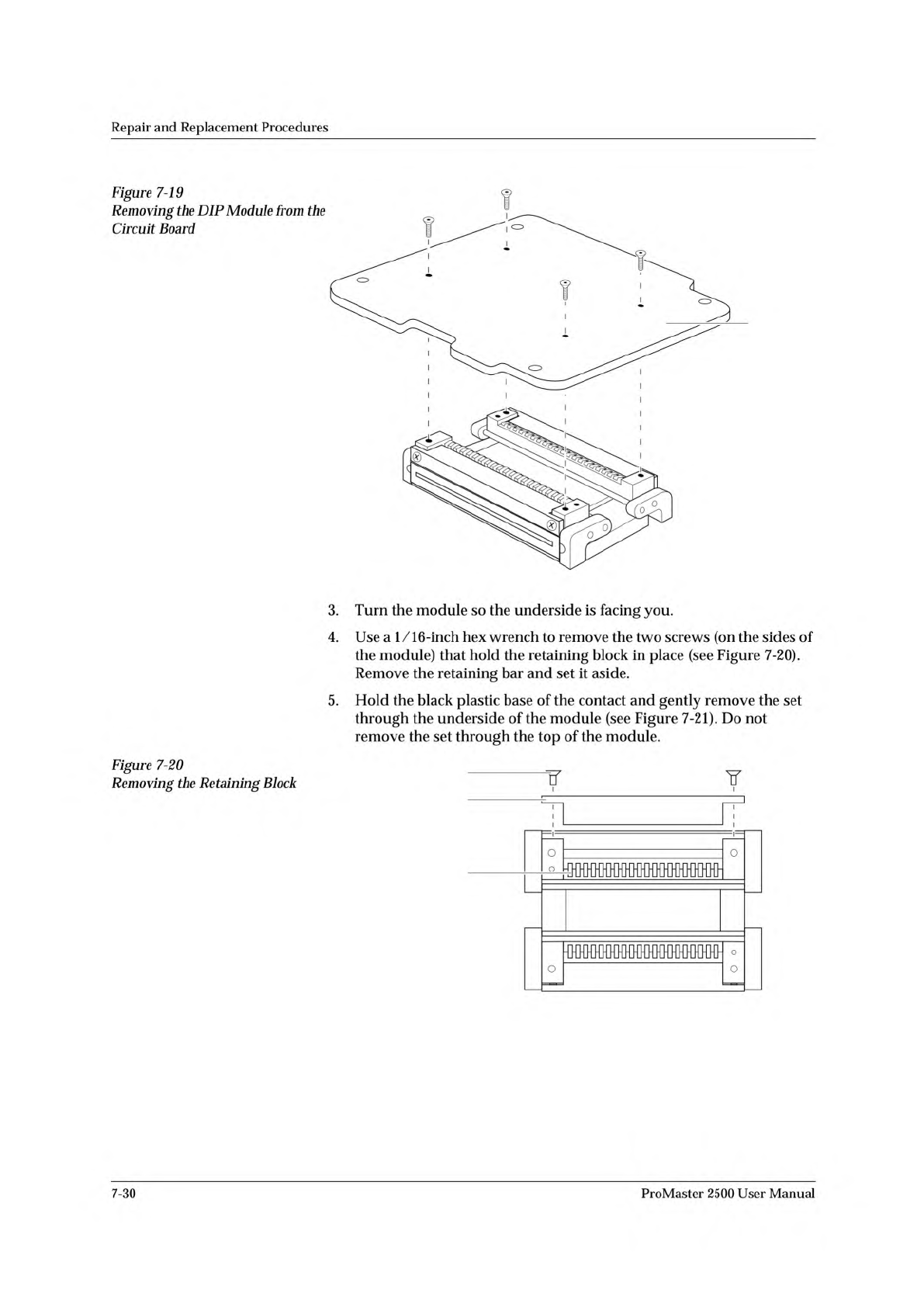
Figure
7-19
Removing
the
DIP
Module
from
the
Circuit
Board
3.
Turn
the
module
so
the
underside
is
facing
you.
4.
Use
a
1/
16-inch
hex
wrench
to
remove
the
two
screws
(on
the
sides
of
the
module)
that
hold
the
retaining
block
in
place
(see
Figure
7-20).
Remove
the
retaining
bar
and
set
it
aside.
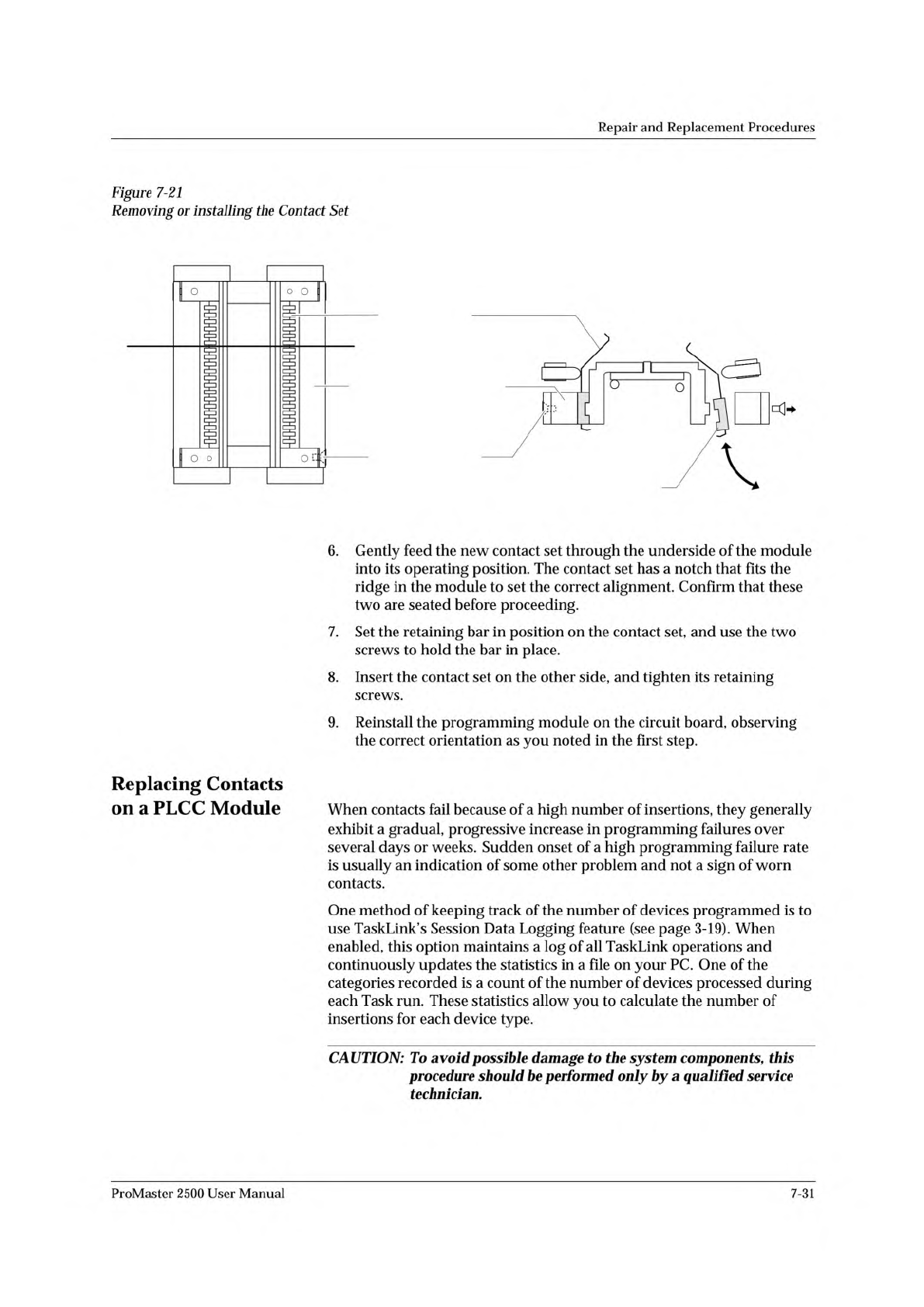
5.
Hold
the
black
plastic
base
of
the
contact
and
gently
remove
the
set
through
the
underside
of
the
module
(see
Figure
7-21).
Do
not
remove
the
set
through
the
top
of
the
module.
Figure
7-20
Removing
the
Retaining
Block
I
o
o
o
O
I
o
7-30
ProMaster
2500
User
Manual
1929-1
CONTACT SET
RETAINING BLOCK (1 of 2)
SCREW (2 per side)
VIEW FROM BELOW
CROSS SECTION
CROSS SECTION PLANE
TILT CONTACT SET BEFORE
REMOVING OR INSERTING
Repair
and
Replacement
Procedures
Figure
7-21
Removing
or
installing
the
Contact
Set
Replacing
Contacts
on
a
PLCC
Module
6.
Gently
feed
the
new
contact
set
through
the
underside
of
the
module
into
its
operating
position.
The
contact
set
has
a
notch
that
fits
the
ridge
in
the
module
to
set
the
correct
alignment.
Confirm
that
these
two
are
seated
before
proceeding.
7.
Set
the
retaining
bar
in
position
on
the
contact
set,
and
use
the
two
screws
to
hold
the
bar
in
place.
8.
Insert
the
contact
set
on
the
other
side,
and
tighten
its
retaining
screws.
9.
Reinstall
the
programming
module
on
the
circuit
board,
observing
the
correct
orientation
as
you
noted
in
the
first
step.
When
contacts
fail
because
of
a
high
number
of
insertions,
they
generally
exhibit
a
gradual,
progressive
increase
in
programming
failures
over
several
days
or
weeks.
Sudden
onset
of
a
high
programming
failure
rate
is
usually
an
indication
of
some
other
problem
and
not
a
sign
of
worn
contacts.
One
method
of
keeping
track
of
the
number
of
devices
programmed
is
to
use
TaskLink's
Session
Data
Logging
feature
(see
page
3-19).
When
enabled,
this
option
maintains
a
log
of
all
TaskLink
operations
and
continuously
updates
the
statistics
in
a
file
on
your
PC.
One
of
the
categories
recorded
is
a
count
of
the
number
of
devices
processed
during
each
Task
run.
These
statistics
allow
you
to
calculate
the
number
of
insertions
for
each
device
type.
CAUTION:
To
avoid
possible
damage
to
the
system
components,
this
procedure
should
加
performed
only
by
a
qualified
service
technician.
o
I
—Bo.
o
ProMaster
2500
User
Manual
7-31
1649-1
CONFIGURATION BLOCK
CONFIGURATION CONNECTOR
CONTACT SET
(1 of 4)
2
0
A
1
X
4
X
BLOCK ALIGNMENT
PIN (1 of 2)
PROGRAMMING
BLOCK ASSEMBLY
CIRCUIT BOARD
SCREW HOLE (1 of 2)
CONFIGURATION
CONNECTOR (1 of 4)
1669-2
Repair
and
Replacement
Procedures
Figure
7-22
Removing
the
Configuration
Blocks
Figure
7-23
Removing
the
Programming
Block
When
you
have
determined
that
the
contacts
need
replacing,
perform
the
operations
described
in
the
steps
below.
You
will
need
the
following
items
to
complete
this
procedure:
•
1/16-inch
hex
driver
•
0.050-inch
hex
driver
•
Four
new
contact
sets
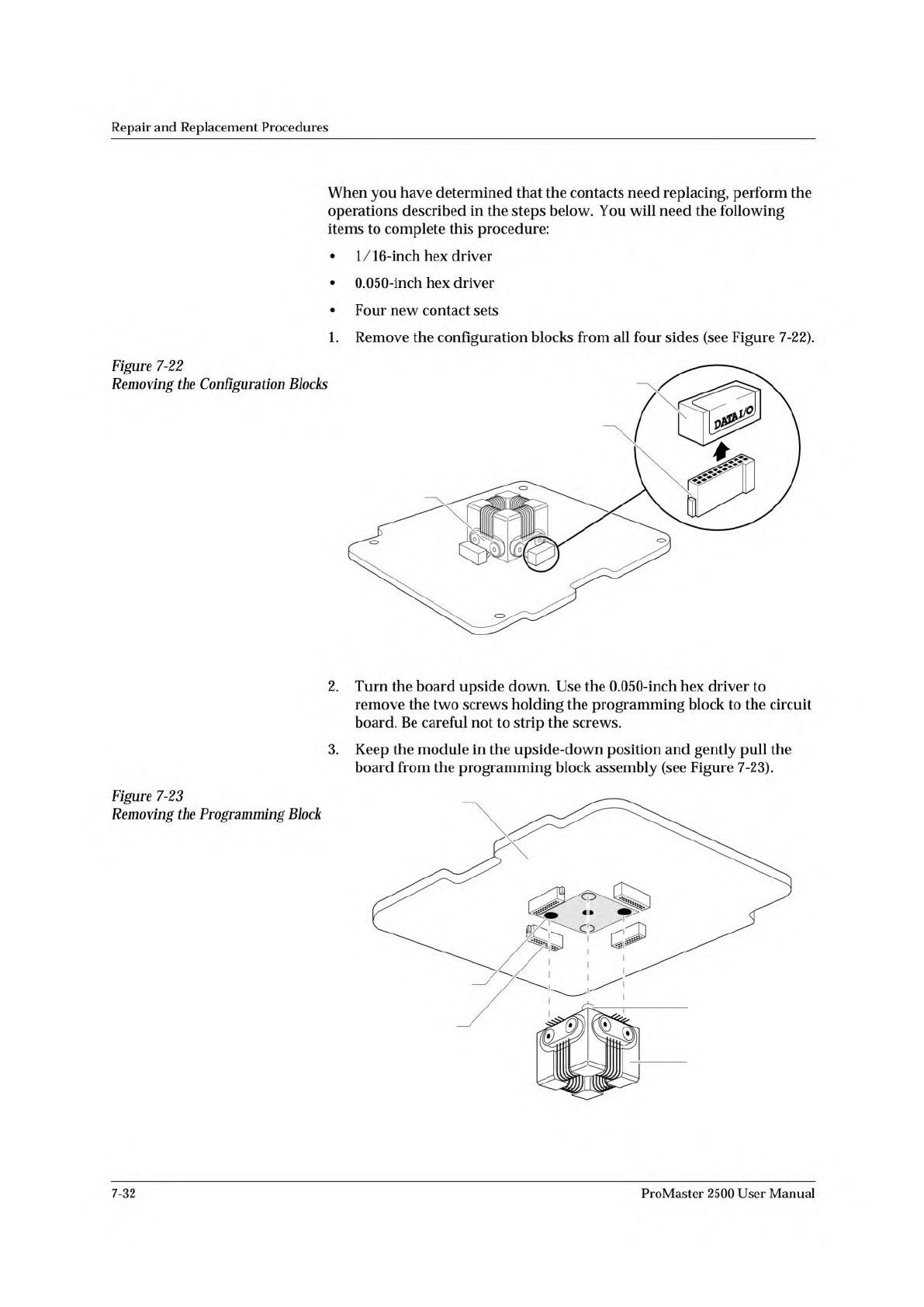
1.
Remove
the
configuration
blocks
from
all
four
sides
(see
Figure
7-22).
2.
Turn
the
board
upside
down.
Use
the
0.050-inch
hex
driver
to
remove
the
two
screws
holding
the
programming
block
to
the
circuit
board.
Be
careful
not
to
strip
the
screws.
3.
Keep
the
module
in
the
upside-down
position
and
gently
pull
the
board
from
the
programming
block
assembly
(see
Figure
7-23).
7-32
ProMaster
2500
User
Manual