2500_Users_Manual-.pdf - 第343页
00050 7FDD4F 90000BFFFFBFFFFBFFFFBFFFFBFFFFBFFFFBFFFFBFFFF7F400F 90010BFFFFBFFFFBFFFFBFFFFBFFFFBFFFFBFFFFBFFFF7F3FFF 90020BFFFFBFFFFBFFFFBFFFFBFFFFBFFFFBFFFFBFFFF7F3FEF 90030BFFFFBFFFFBFFFFBFFFFBFFFFBFFFFBFFFFBFFFF7F3FDF…
Translation
Formats
The
Data
Bus
Width
represents
the
width
of
the
target
system's
bus
(in
bits).
The
Data
Width
Base
represents
the
smallest
addressable
entity
used
by
the
target
microprocessor.
The
Data
Bus
Width
and
Data
Width
Base
are
not
used
by
the
programmer
during
download.
During
upload,
the
Data
Bus
Width
will
be
set
to
the
current
Data
Word
Width,
and
the
Data
Width
Base
will
be
set
to
8.
The
Transfer
Address
is
not
used
by
the
programmer.
Data
records
follow
the
Start-of-file
record.
Each
begins
with
2
byte
counts:
the
first
expresses
the
number
of
16-bit
bytes
in
the
record,
not
including
the
checksum
and
itself;
the
second
expresses
the
number
of
8-bit
data
bytes
in
the
record.
Next
comes
a
32-bit
address,
which
specifies
the
storage
location
of
the
following
data
byte.
Data
bytes
follow;
after
the
last
data
byte
is
a
checksum
of
every
byte
in
the
record
except
the
first
byte,
which
is
the
word
count.
The
End-of-file
record
consists
of
a
one
byte
word
count,
which
is
always
zero.
Leader
and
trailer
nulls,
normally
50
each,
are
suppressed
in
this
translation
format.
D-32
ProMaster
2500
User
Manual
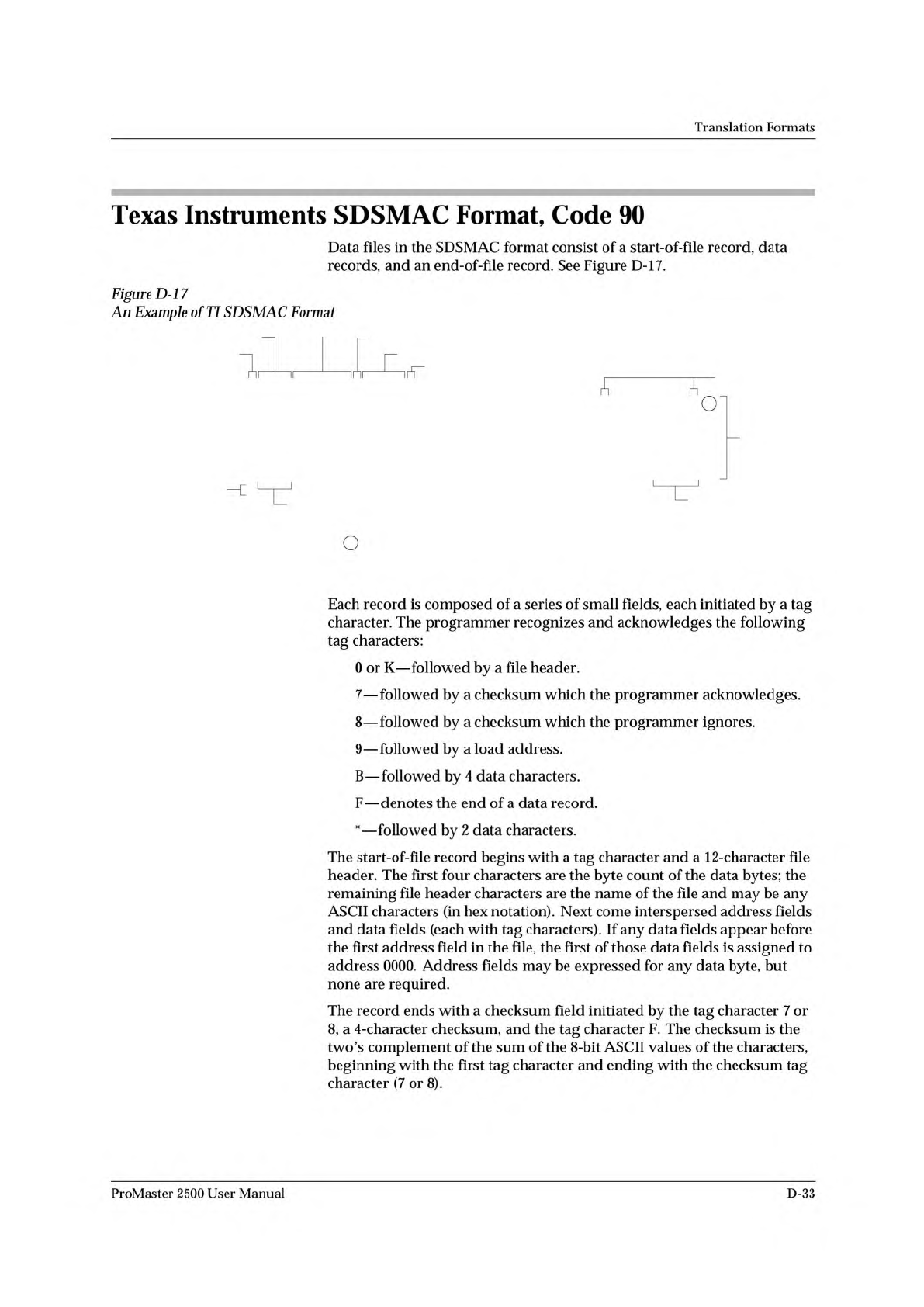
00050 7FDD4F
90000BFFFFBFFFFBFFFFBFFFFBFFFFBFFFFBFFFFBFFFF7F400F
90010BFFFFBFFFFBFFFFBFFFFBFFFFBFFFFBFFFFBFFFF7F3FFF
90020BFFFFBFFFFBFFFFBFFFFBFFFFBFFFFBFFFFBFFFF7F3FEF
90030BFFFFBFFFFBFFFFBFFFFBFFFFBFFFFBFFFFBFFFF7F3FDF
90040BFFFFBFFFFBFFFFBFFFFBFFFFBFFFFBFFFFBFFFF7F3FCF
:
Checksum
Tag Character
Tag Character
Tag Character
Byte Count
Filename
Load Address
End-of-File Record
Tag Characters
Data
Records
Checksum
LEGEND
Nonprinting Carriage Return, with optional
line feed and nulls determined by null count.
0089-4
Translation
Formats
Texas
Instruments
SDSMAC
Format,
Code
90
Data
files
in
the
SDSMAC
format
consist
of
a
start-of-file
record,
data
records,
and
an
end-of-file
record.
See
Figure
D-17.
Figure
D-l
7
An
Example
of
TI
SDSMAC
Format
Each
record
is
composed
of
a
series
of
small
fields,
each
initiated
by
a
tag
character.
The
programmer
recognizes
and
acknowledges
the
following
tag
characters:
0
or
K
—
followed
by
a
file
header.
7
—
followed
by
a
checksum
which
the
programmer
acknowledges.
8
—
followed
by
a
checksum
which
the
programmer
ignores.
9
—
followed
by
a
load
address.
B
—
followed
by
4
data
characters.
F
—
denotes
the
end
of
a
data
record.
*
—
followed
by
2
data
characters.
The
start-of-file
record
begins
with
a
tag
character
and
a
12-character
file
header.
The
first
four
characters
are
the
byte
count
of
the
data
bytes;
the
remaining
file
header
characters
are
the
name
of
the
file
and
may
be
any
ASCII
characters
(in
hex
notation).
Next
come
interspersed
address
fields
and
data
fields
(each
with
tag
characters).
If
any
data
fields
appear
before
the
first
address
field
in
the
file,
the
first
of
those
data
fields
is
assigned
to
address
0000.
Address
fields
may
be
expressed
for
any
data
byte,
but
none
are
required.
The
record
ends
with
a
checksum
field
initiated
by
the
tag
character
7
or
8,
a
4-character
checksum,
and
the
tag
character
F.
The
checksum
is
the
two's
complement
of
the
sum
of
the
8-bit
ASCII
values
of
the
characters,
beginning
with
the
first
tag
character
and
ending
with
the
checksum
tag
character
(7
or
8).
ProMaster
2500
User
Manual
D-33
Translation
Formats
Data
records
follow
the
same
format
as
the
start-of-flle
record
but
do
not
contain
a
file
header.
The
end-of-file
record
consists
of
a
colon
(:)
only.
The
output
translator
sends
a
CTRL-S
after
the
colon.
D-34
ProMaster
2500
User
Manual