2500_Users_Manual-.pdf - 第414页
* * PROMA STER 2500 MAIN MENU * * ENTER THE NUM BER OF THE DESIRED FUNCTION 1 - OPERATION S 3 - SYSTEM SETUP 2 - FILE UTIL ITIES 4 - DIAGNOSTICS * * * OPERATIONS MENU * * * 1 - PROGRAM/TEST & LABEL 4 - LABEL ONLY 2 -…
1-DOT MATRIX, 2-THERMAL
ENTER TYPE OF MARKER (2): _
F
Local
Mode
Local
mode
is
an
operating
mode
for
the
ProMaster
2500
where
the
operator
is
communicating
using
the
2500's
keyboard
and
display.
This
mode
can
be
used
for
initial
system
setup,
running
diagnostic
tests
or
cycling
devices.
This
chapter
describes
the
parameters
that
can
be
changed
using
the
2500's
keyboard.
Switching
Between
Local
and
Remote
Modes
The
2500
normally
operates
with
TaskLink
in
Remote
mode.
To
switch
to
Local
mode,
press
LOWER
CASE
+
L
(for
Local)
on
the
2500's
keyboard.
The
2500
powers
up
in
the
mode
it
was
in
when
last
turned
off.
Return
to
Remote
mode
by
pressing
LOWER
CASE
+
R
(for
Remote)
on
the
2500's
keyboard.
System
Configuration
The
ProMaster
2500
can
be
configured
to
operate
with
either
a
dot
matrix
or
a
thermal
printer.
The
handler
was
configured
correctly
at
the
factory
for
the
type
of
printer
that
was
installed
during
assembly.
If
a
handler
with
a
thermal
printer
begins
operating
as
though
it
were
configured
for
the
dot
matrix
printer
option,
complete
the
following
steps
to
reconfigure
it
for
the
thermal
printer.
1.
Press
LOWER
CASE
+
L
to
put
the
2500
in
local
mode.
2.
From
the
Main
Menu,
press
LOWER
CASE
+
W.
ProMaster
2500
User
Manual
F-l
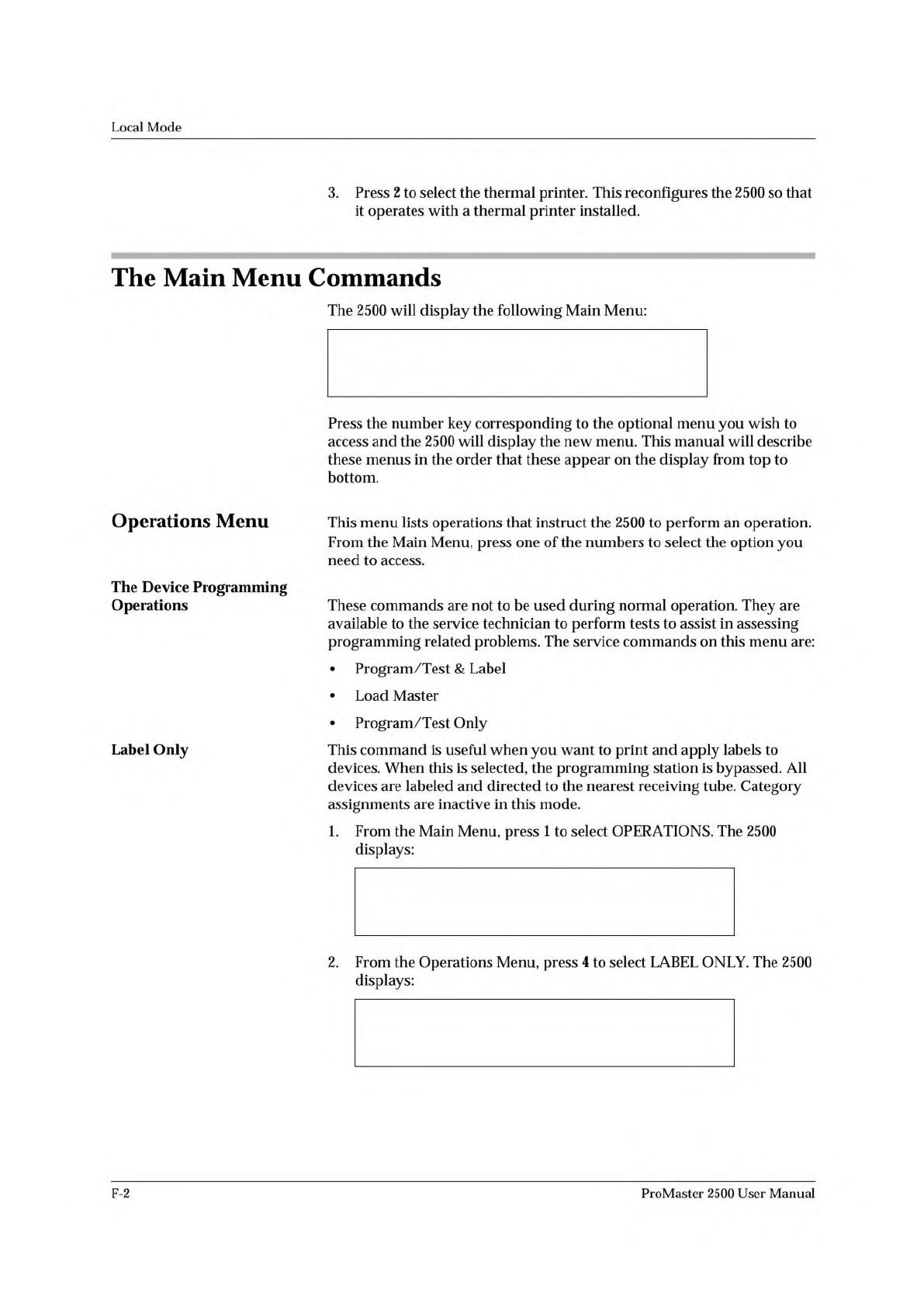
* * PROMASTER 2500 MAIN MENU * *
ENTER THE NUMBER OF THE DESIRED FUNCTION
1 - OPERATIONS 3 - SYSTEM SETUP
2 - FILE UTILITIES 4 - DIAGNOSTICS
* * * OPERATIONS MENU * * *
1 - PROGRAM/TEST & LABEL 4 - LABEL ONLY
2 - LOAD MASTER 5 - PRINT ONLY
3 - PROGRAM/TEST ONLY 6 - PURGE
LABEL ONLY
TEMPORARY FILE1 FILE2 FILE3
FILE4 FILE5 FILE6 FILE7
ENTER FILE NAME:
Local
Mode
3.
Press
2
to
select
the
thermal
printer.
This
reconfigures
the
2500
so
that
it
operates
with
a
thermal
printer
installed.
The
Main
Menu
Commands
The
2500
will
display
the
following
Main
Menu:
Press
the
number
key
corresponding
to
the
optional
menu
you
wish
to
access
and
the
2500
will
display
the
new
menu.
This
manual
will
describe
these
menus
in
the
order
that
these
appear
on
the
display
from
top
to
bottom.
Operations
Menu
This
menu
lists
operations
that
instruct
the
2500
to
perform
an
operation.
From
the
Main
Menu,
press
one
of
the
numbers
to
select
the
option
you
need
to
access.
The
Device
Programming
Operations
These
commands
are
not
to
be
used
during
normal
operation.
They
are
available
to
the
service
technician
to
perform
tests
to
assist
in
assessing
programming
related
problems.
The
service
commands
on
this
menu
are:
•
Program/Test
&
Label
•
Load
Master
•
Program/Test
Only
Label
Only
This
command
is
useful
when
you
want
to
print
and
apply
labels
to
devices.
When
this
is
selected,
the
programming
station
is
bypassed.
All
devices
are
labeled
and
directed
to
the
nearest
receiving
tube.
Category
assignments
are
inactive
in
this
mode.
1.
From
the
Main
Menu,
press
1
to
select
OPERATIONS.
The
2500
displays:
2.
From
the
Operations
Menu,
press
4
to
select
LABEL
ONLY.
The
2500
displays:
F-2
ProMaster
2500
User
Manual
↓
↑ ← →
↓
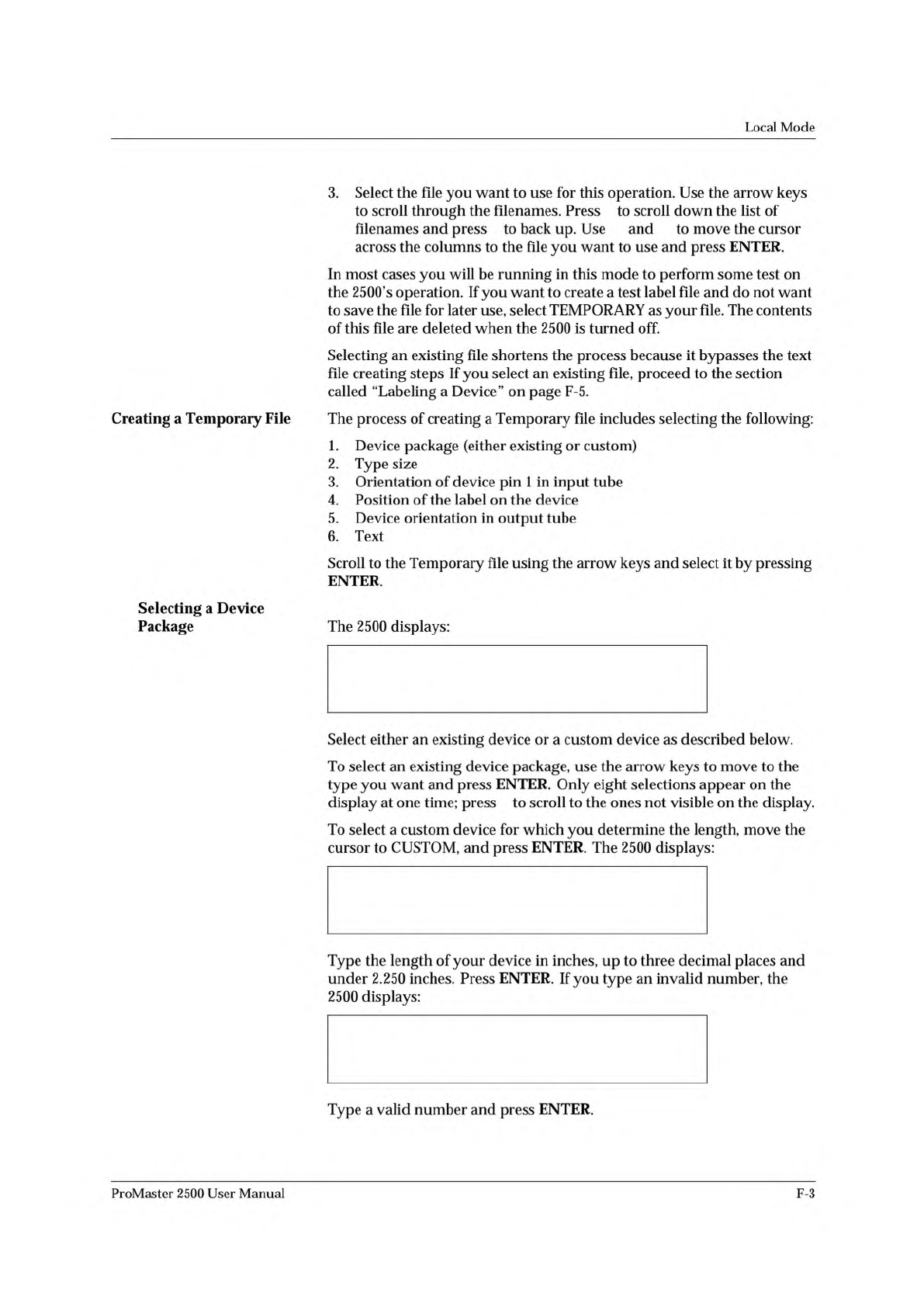
PROGRAM/TEST LABEL TEMPORARY FILE
CUSTOM PLCC 20 PLCC 28 PLCC 32
PLCC 44 PLCC 52 PLCC 68 PLCC 84
MOVE TO SELECTION THEN PRESS ENTER
PROGRAM/TEST LABEL TEMPORARY FILE
ENTER PART LENGTH: _
EXAMPLE: 1.234 OR .28 OR 1
PROGRAM/TEST LABEL TEMPORARY FILE
ENTER PART LENGTH: _
LENGTH CAN NOT EXCEED 2.250
Local
Mode
3.
Select
the
file
you
want
to
use
for
this
operation.
Use
the
arrow
keys
to
scroll
through
the
filenames.
Press
to
scroll
down
the
list
of
filenames
and
press
to
back
up.
Use
and
to
move
the
cursor
across
the
columns
to
the
file
you
want
to
use
and
press
ENTER.
In
most
cases
you
will
be
running
in
this
mode
to
perform
some
test
on
the
2500's
operation.
If
you
want
to
create
a
test
label
file
and
do
not
want
to
save
the
file
for
later
use,
select
TEMPORARY
as
your
file.
The
contents
of
this
file
are
deleted
when
the
2500
is
turned
off.
Selecting
an
existing
file
shortens
the
process
because
it
bypasses
the
text
file
creating
steps
If
you
select
an
existing
file,
proceed
to
the
section
called
“Labeling
a
Device”
on
page
F-5.
Creating
a
Temporary
File
The
process
of
creating
a
Temporary
file
includes
selecting
the
following:
1.
Device
package
(either
existing
or
custom)
2.
Type
size
3.
Orientation
of
device
pin
1
in
input
tube
4.
Position
of
the
label
on
the
device
5.
Device
orientation
in
output
tube
6.
Text
Scroll
to
the
Temporary
file
using
the
arrow
keys
and
select
it
by
pressing
ENTER.
Selecting
a
Device
Package
The
2500
displays:
Select
either
an
existing
device
or
a
custom
device
as
described
below.
To
select
an
existing
device
package,
use
the
arrow
keys
to
move
to
the
type
you
want
and
press
ENTER.
Only
eight
selections
appear
on
the
display
at
one
time;
press
to
scroll
to
the
ones
not
visible
on
the
display.
To
select
a
custom
device
for
which
you
determine
the
length,
move
the
cursor
to
CUSTOM,
and
press
ENTER.
The
2500
displays:
Type
the
length
of
your
device
in
inches,
up
to
three
decimal
places
and
under
2.250
inches.
Press
ENTER.
If
you
type
an
invalid
number,
the
2500
displays:
Type
a
valid
number
and
press
ENTER.
ProMaster
2500
User
Manual
F-3