2500_Users_Manual-.pdf - 第444页
Figure 5-3. Beam Air Holes 5-11 Figure 5-4. Power Supplies 5-14 Figure 5-5. Missing Character Dots in Label Printout 5-22 Figure 5-6. Adjusting Label Calibration 5-25 Figure 5-7. Print Shift (affects vertical position) 5…
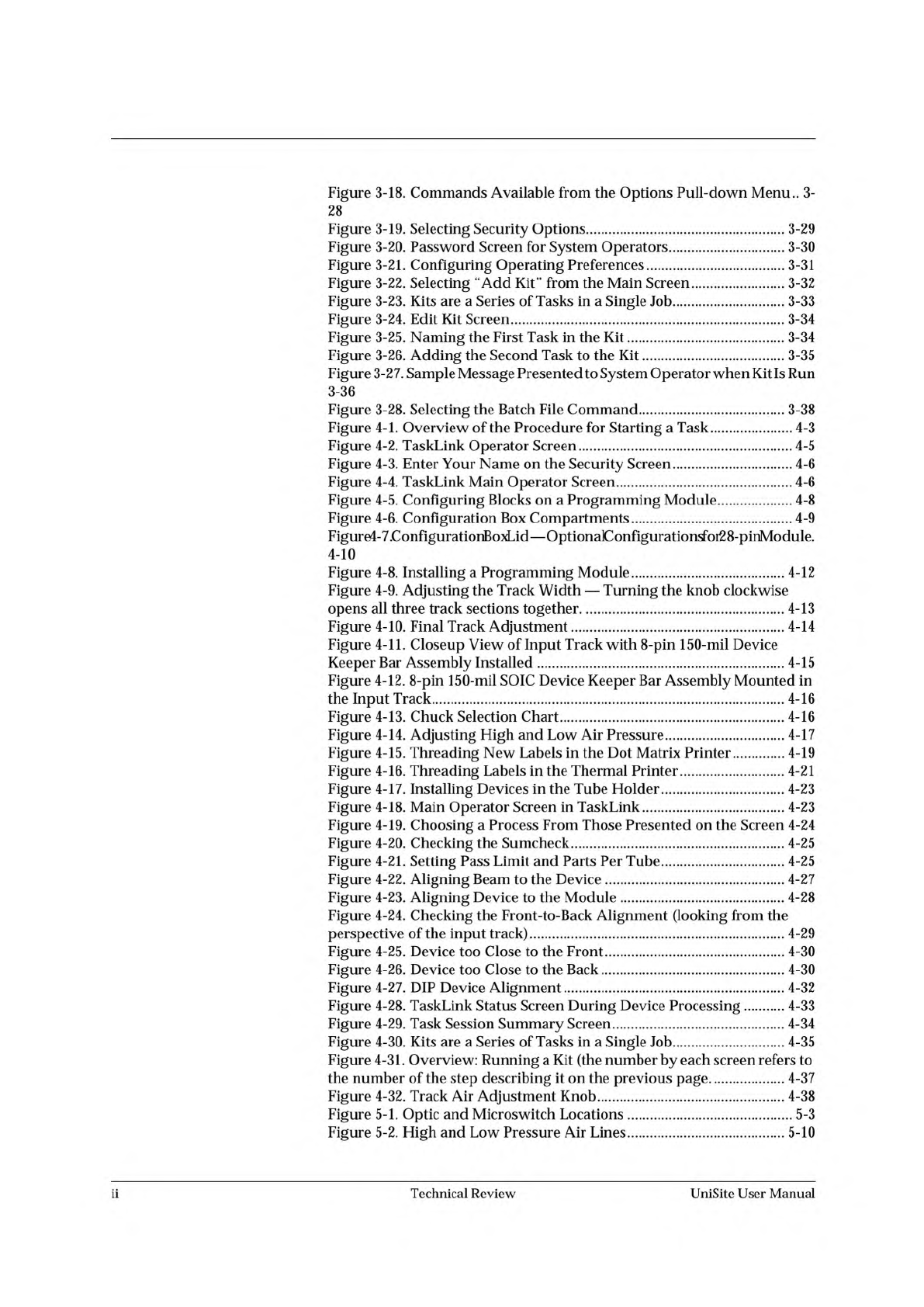
Figure
3-18.
Commands
Available
from
the
Options
Pull-down
Menu..
3-
28
Figure
3-19.
Selecting
Security
Options
3-29
Figure
3-20.
Password
Screen
for
System
Operators
3-30
Figure
3-21.
Configuring
Operating
Preferences
3-31
Figure
3-22.
Selecting
“Add
Kit”
from
the
Main
Screen
3-32
Figure
3-23.
Kits
are
a
Series
of
Tasks
in
a
Single
Job
3-33
Figure
3-24.
Edit
Kit
Screen
3-34
Figure
3-25.
Naming
the
First
Task
in
the
Kit
3-34
Figure
3-26.
Adding
the
Second
Task
to
the
Kit
3-35
Figure
3-27.
Sample
Message
Presented
to
System
Operator
when
Kit
Is
Run
3-36
、
Figure
3-28.
Selecting
the
Batch
File
Command
3-38
Figure
4-1.
Overview
of
the
Procedure
for
Starting
a
Task
4-3
Figure
4-2.
TaskLink
Operator
Screen
4-5
Figure
4-3.
Enter
Your
Name
on
the
Security
Screen
4-6
Figure
4-4.
TaskLink
Main
Operator
Screen
4-6
Figure
4-5.
Configuring
Blocks
on
a
Programming
Module
4-8
Figure
4-6.
Configuration
Box
Compartments
4-9
Figure4-7.ConfigurationBoji.id
—
OptionalConfigurationsfoi28-pinModule.
4-10
Figure
4-8.
Installing
a
Programming
Module
4-12
Figure
4-9.
Adjusting
the
Track
Width
—
Turning
the
knob
clockwise
opens
all
three
track
sections
together
4-13
Figure
4-10.
Final
Track
Adjustment
4-14
Figure
4-11.
Closeup
View
of
Input
Track
with
8-pin
150-mil
Device
Keeper
Bar
Assembly
Installed
4-15
Figure
4-12.
8-pin
150-mil
SOIC
Device
Keeper
Bar
Assembly
Mounted
in
the
Input
Track
4-16
Figure
4-13.
Chuck
Selection
Chart
4-16
Figure
4-14.
Adjusting
High
and
Low
Air
Pressure
4-17
Figure
4-15.
Threading
New
Labels
in
the
Dot
Matrix
Printer
4-19
Figure
4-16.
Threading
Labels
in
the
Thermal
Printer
4-21
Figure
4-17.
Installing
Devices
in
the
Tube
Holder
4-23
Figure
4-18.
Main
Operator
Screen
in
TaskLink
4-23
Figure
4-19.
Choosing
a
Process
From
Those
Presented
on
the
Screen
4-24
Figure
4-20.
Checking
the
Sumcheck
4-25
Figure
4-21.
Setting
Pass
Limit
and
Parts
Per
Tube
4-25
Figure
4-22.
Aligning
Beam
to
the
Device
4-27
Figure
4-23.
Aligning
Device
to
the
Module
4-28
Figure
4-24.
Checking
the
Front-to-Back
Alignment
(looking
from
the
perspective
of
the
input
track)
4-29
Figure
4-25.
Device
too
Close
to
the
Front
4-30
Figure
4-26.
Device
too
Close
to
the
Back
4-30
Figure
4-27.
DIP
Device
Alignment
4-32
Figure
4-28.
TaskLink
Status
Screen
During
Device
Processing
4-33
Figure
4-29.
Task
Session
Summary
Screen
4-34
Figure
4-30.
Kits
are
a
Series
of
Tasks
in
a
Single
Job
4-35
Figure
4-31.
Overview:
Running
a
Kit
(the
number
by
each
screen
refers
to
the
number
of
the
step
describing
it
on
the
previous
page
4-37
Figure
4-32.
Track
Air
Adjustment
Knob
4-38
Figure
5-1.
Optic
and
Microswitch
Locations
5-3
Figure
5-2.
High
and
Low
Pressure
Air
Lines
5-10
Technical
Review
UniSite
User
Manual
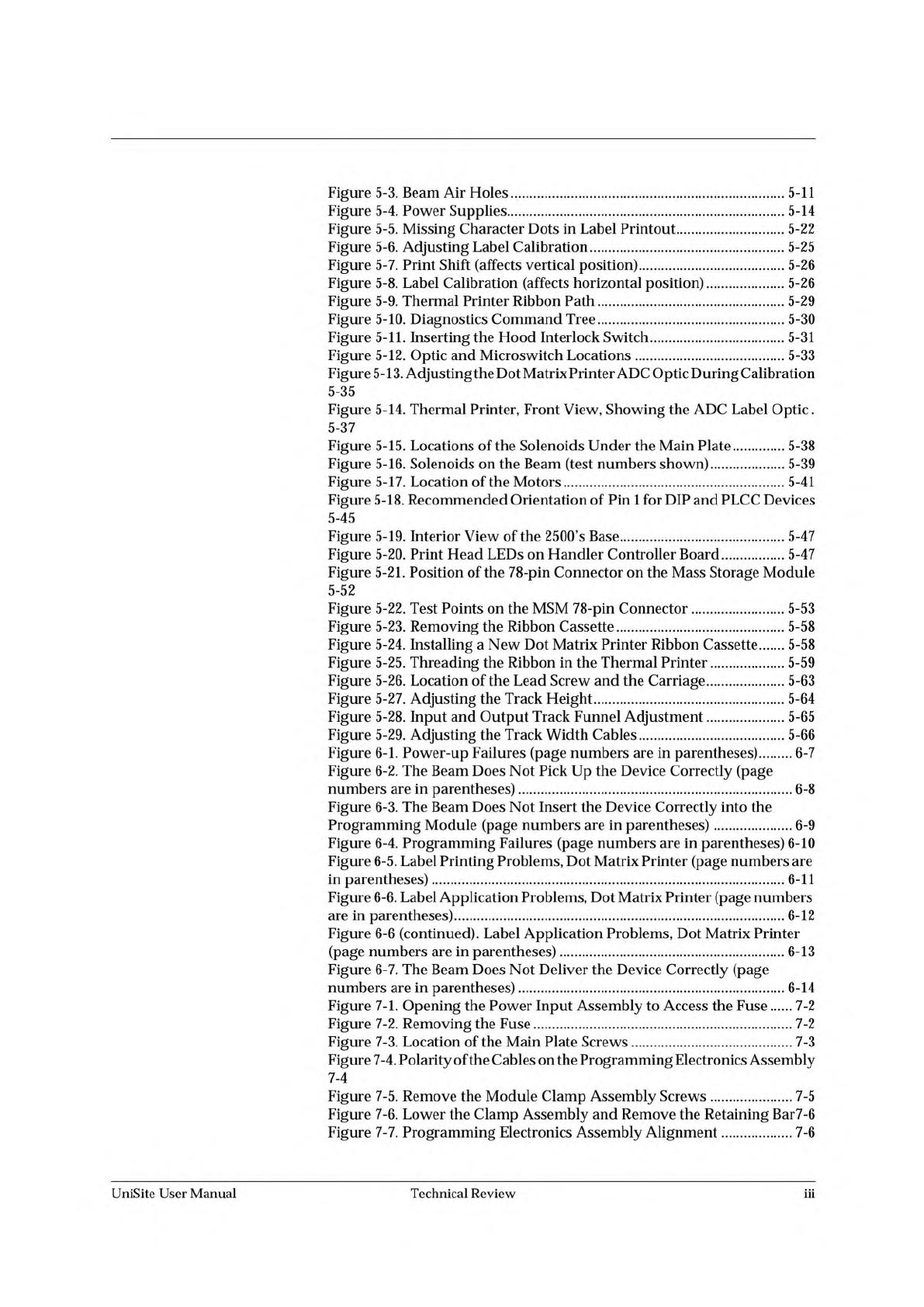
Figure
5-3.
Beam
Air
Holes
5-11
Figure
5-4.
Power
Supplies
5-14
Figure
5-5.
Missing
Character
Dots
in
Label
Printout
5-22
Figure
5-6.
Adjusting
Label
Calibration
5-25
Figure
5-7.
Print
Shift
(affects
vertical
position)
5-26
Figure
5-8.
Label
Calibration
(affects
horizontal
position)
5-26
Figure
5-9.
Thermal
Printer
Ribbon
Path
5-29
Figure
5-10.
Diagnostics
Command
Tree
5-30
Figure
5-11.
Inserting
the
Hood
Interlock
Switch
5-31
Figure
5-12.
Optic
and
Microswitch
Locations
5-33
Figure
5-13.
Adjusting
the
Dot
Matrix
Printer
ADC
Optic
During
Calibration
5-35
、
「
Figure
5-14.
Thermal
Printer,
Front
View,
Showing
the
ADC
Label
Optic
.
5-37
、
Figure
5-15.
Locations
of
the
Solenoids
Under
the
Main
Plate
5-38
Figure
5-16.
Solenoids
on
the
Beam
(test
numbers
shown)
5-39
Figure
5-17.
Location
of
the
Motors
5-41
Figure
5-18.
Recommended
Orientation
of
Pin
1
for
DIP
and
PLCC
Devices
5-45
Figure
5-19.
Interior
View
of
the
2500,s
Base
5-47
Figure
5-20.
Print
Head
LEDs
on
Handler
Controller
Board
5-47
Figure
5-21.
Position
of
the
78-pin
Connector
on
the
Mass
Storage
Module
5-52
Figure
5-22.
Test
Points
on
the
MSM
78-pin
Connector
5-53
Figure
5-23.
Removing
the
Ribbon
Cassette
5-58
Figure
5-24.
Installing
a
New
Dot
Matrix
Printer
Ribbon
Cassette
5-58
Figure
5-25.
Threading
the
Ribbon
in
the
Thermal
Printer
5-59
Figure
5-26.
Location
of
the
Lead
Screw
and
the
Carriage
5-63
Figure
5-27.
Adjusting
the
Track
Height
5-64
Figure
5-28.
Input
and
Output
Track
Funnel
Adjustment
5-65
Figure
5-29.
Adjusting
the
Track
Width
Cables
5-66
Figure
6-1.
Power-up
Failures
(page
numbers
are
in
parentheses)
6-7
Figure
6-2.
The
Beam
Does
Not
Pick
Up
the
Device
Correctly
(page
numbers
are
in
parentheses)
6-8
Figure
6-3.
The
Beam
Does
Not
Insert
the
Device
Correctly
into
the
Programming
Module
(page
numbers
are
in
parentheses)
6-9
Figure
6-4.
Programming
Failures
(page
numbers
are
in
parentheses)
6-10
Figure
6-5.
Label
Printing
Problems,
Dot
Matrix
Printer
(page
numbers
are
in
parentheses)
6-11
Figure
6-6.
Label
Application
Problems,
Dot
Matrix
Printer
(page
numbers
are
in
parentheses)
6-12
Figure
6-6
(continued).
Label
Application
Problems,
Dot
Matrix
Printer
(page
numbers
are
in
parentheses)
6-13
Figure
6-7.
The
Beam
Does
Not
Deliver
the
Device
Correctly
(page
numbers
are
in
parentheses)
6-14
Figure
7-1.
Opening
the
Power
Input
Assembly
to
Access
the
Fuse
7-2
Figure
7-2.
Removing
the
Fuse
7-2
Figure
7-3.
Location
of
the
Main
Plate
Screws
7-3
Figure
7-4.
Polarity
of
the
Cables
on
the
Programming
Electronics
Assembly
7-4
'
'
Figure
7-5.
Remove
the
Module
Clamp
Assembly
Screws
7-5
Figure
7-6.
Lower
the
Clamp
Assembly
and
Remove
the
Retaining
Bar
7-6
Figure
7-7.
Programming
Electronics
Assembly
Alignment
7-6
UniSite
User
Manual
Technical
Review
iii

Figure
7-8.
Input
and
Output
Orbital
Assemblies
7-8
Figure
7-9.
Note
the
Wire
Colors
and
Positions
7-9
Figure
7-10.
Align
the
Slit
in
the
Collar
with
the
Slit
in
the
Spindle
…
7-10
Figure
7-11.
Removing
the
Print
Drive
Motor
(Dot
Matrix
Printer
shown;
Thermal
Printer
similar)
7-12
Figure
7-12.
Removing
the
Print
Head
7-13
Figure
7-13.
Remove
the
Track
Springs
7-15
Figure
7-14.
Remove
the
Track
Springs
7-16
Figure
7-15.
Removing
the
Air
Cylinder
7-18
Figure
7-16.
Right
Lead
Screw
Bearing
Assembly
7-22
Figure
7-17.
Beam
Cable
and
Switch
Locations
7-26
Figure
7-18.
Baffle
Plate
Reinstallation
7-27
Figure
7-19.
Removing
the
DIP
Module
from
the
Circuit
Board
7-29
Figure
7-20.
Removing
the
Retaining
Block
7-29
Figure
7-21.
Removing
or
installing
the
Contact
Set
7-30
Figure
7-22.
Removing
the
Configuration
Blocks
7-31
Figure
7-23.
Removing
the
Programming
Block
7-31
Figure
7-24.
Removing
the
Device
Ejector
Pin
and
Spring
7-32
Figure
7-25.
Removing
the
Contact
Set
7-32
Figure
7-26.
Replacing
the
Defective
Pins
7-34
Figure
7-27.
Pin
Insulation
Block
in
the
Programming
Module
7-35
Figure
7-28.
PLCC
Programming
Module
(Exploded
View)
7-37
Figure
7-29.
Test
Site
Clamp
Assembly
7-39
Figure
7-30.
Carriage
Assembly
7-41
Figure
7-31.
Input
Assembly
7-43
Figure
7-32.
Output
Tube
Clamp
Assembly
7-48
Figure
7-33.
Beam
Assembly
7-50
Figure
7-34.
Main
Plate
Assembly
7-55
Figure
7-35.
Thermal
Printer
Assembly
7-59
Figure
C-l.
ProMaster
2500
Wiring
Diagram
C-2
Figure
C-2.
ProMaster
2500
Handler
Controller
Board
Layout
(not
to
scale)
C-3
Figure
D-l.
An
Example
of
ASCII
Binary
Format
D-5
Figure
D-2.
An
Example
of
TI
SDSMAC
Format
D-7
Figure
D-3.
An
Example
of
Formatted
Binary
Format
D-10
Figure
D-4.
An
Example
of
Formatted
Binary
Format
D-ll
Figure
D-5.
An
Example
of
Spectrum
Format
D-l
2
Figure
D-6.
An
Example
of
ASCII
Octal
and
Hex
Formats
D-19
Figure
D-7.
An
Example
of
RCA
Cosmac
Format
D-21
Figure
D-8.
An
Example
of
Fairchild
Fairbug
D-22
Figure
D-9.
An
Example
of
MOS
Technology
Format
D-23
Figure
D-10.
An
Example
of
Motorola
EXORciser
Format
D-24
Figure
D-ll.
An
Example
of
Intel
Intellec
8/MDS
Format
D-25
Figure
D-l
2.
An
Example
of
Signetics
Absolute
Object
Format
D-26
Figure
D-13.
An
Example
of
Tektronix
Hex
Format
D-27
Figure
D-14.
An
Example
of
Motorola
EXORmacs
Format
D-28
Figure
D-15.
An
Example
of
Intel
MCS-86
Hex
Object
D-29
Figure
D-16.
An
Example
of
HP
64000
Absolute
Format
D-31
Figure
D-l
7.
An
Example
of
TI
SDSMAC
Format
D-33
Figure
D-18.
An
Example
of
JEDEC
Full
Format
D-38
Figure
D-19.
An
Example
of
JEDEC
Kernel
Mode
Format
D-46
Figure
D-20.
An
Example
of
Tektronix
Extended
Format
D-47
Figure
D-21.
An
Example
of
Motorola
S3
Format
D-49
iv
Technical
Review
UniSite
User
Manual