3OM-1064-001.pdf - 第18页
Check whether the component pick-up position is normal. *1 When the component pick-up position deviates from the correct one, it may have come out of the component recognition range or the vacuum nozzle may have interrup…
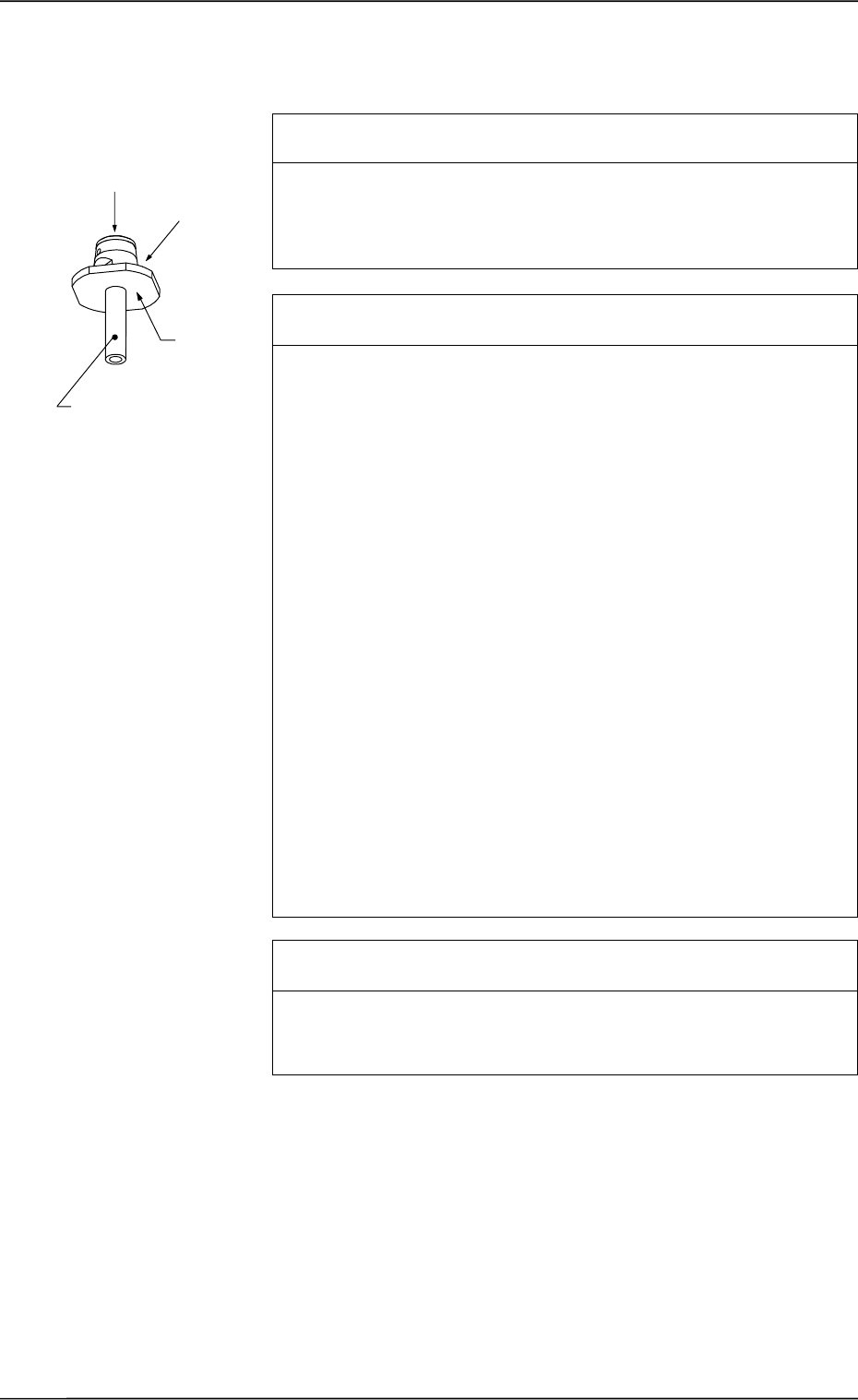
Check whether the internal part of the vacuum nozzle is stained
or clogged. *1
If clogged, the vacuum nozzle may not be able to pick up a compo-
nent.
Refer to “Nozzle Stocker” in “6. Monthly Maintenance of Section 1
in Volume 4” and inspect the nozzles. If necessary, clean them.
Check whether the frequently error-caused vacuum nozzle is
stained. *2
Dirty diffusion plate will cause a component recognition error or false
recognition.
If sebum or oil, etc., adheres to the surface of the diffusion plate of
the vacuum nozzle, note the followings and clean the surface.
(Otherwise, component recognition may become impossible.)
Prohibited Items
• Use of Organic Solvents, Rag, etc.
• Any Practice which may nick the diffusion plate
Recommended Cleaning: Use an ultrasonic cleaner and wash
the diffusion plate in water for 10 to
15 minutes or less.
Blow off moisture on the vacuum
nozzle, using compressed air.
If the nozzle is still dirty, consult our
sales personnel for details.
Note: Do not use any organic sol-
vent, a rag, etc.
Wipe off dirt accumulated on the nozzle end with a lens cleaning
cloth.
Refer to “Nozzle Stocker” in “6. Monthly Maintenance of Section 1
in Volume 4” for details.
Check whether the data for the frequently error-caused nozzle is
proper. *3
When the data for the nozzle length is not proper, components cannot
be picked up.
Check the data for the nozzle length in the nozzle data.
1.1.5 Frequently-Caused Pick-Up Errors on Specific Vacuum
Nozzle
Diffusion
Plate
*2
*1
Nozzle End
0005-002 1-9 Tg0248-PM-ER
1. Cause and Remedy of Simple Trouble

Check whether the component pick-up position is normal. *1
When the component pick-up position deviates from the correct one,
it may have come out of the component recognition range or the
vacuum nozzle may have interrupted image capture, causing a com-
ponent recognition error.
Or, vacuum may have leaked out during component picks, causing
an error such as deactivation of a vacuum sensor.
Perform the teaching operation on the pick-up location at the “PICK-
UP LOCATION” display. (Hierarchical Sequence: “TEACH OFF-
SET” Display → “PICK-UP LOCATION” Display).
Check whether the component recognition is performed normally.
*2
Confirm that there is no problem in the component recognition.
Refer to “1.2.3 Deterioration of Accuracy at Component Recognition
Camera Section of Section 1” for details and check whether the com-
ponent recognition is performed normally.
Check whether the selected components are deformed, making
it impossible for the vacuum sensor to detect them. *3
When the surface of components is not flat or is rough, the vacuum
leaks out, making it impossible for the vacuum sensor to detect such
components.
When it is designated to detect components by the vacuum sensor in
the component library, cancel the designation.
Check whether the vacuum sensor works normally. *4
Check how the vacuum sensor works.
Confirm that the vacuum sensor turns OFF when no component is
picked up and it turns ON when a component is picked up.
Check Procedure
(1) Open the “MANUAL SUBSYSTEM OPERATION” display. (Hi-
erarchical Sequence: “MANUAL MODE” Display → “MANUAL
SUBSYSTEM OPERATION” Display) Select the [BEAM-A AIR
SUPPLY] and [BEAM-B AIR SUPPLY] keys and press the
[MOVE] button to set to “OFF”.
(2) Select the [L**-AXIS VACUUM/BLOW] key and press the
[MOVE] button to set to “OFF”.
(3) Press the [I/O (DIO) DIAGNOSTIC] key. (Hierarchical Sequence:
“MAIN MENU” Display → “SPECIAL SEL.” Display → “DE-
VICE CHECK” Display → “INPUT CHECK” Display)
Then, press the [INP2-10] key and press the [NEXT PAGE] key to
open the 4th and 5th pages.
Confirm that the “L**-AXIS VACUUM SENSOR” is “OFF”.
(4) Open the “ZEROING OPERATION” display and zero the X/Y
beams. (Hierarchical Sequence: “MANUAL MODE” Display →
“ZEROING OPERATION” Display).
1.1.6 Normal Component Picks but Occurrence of Pick-Up
Errors
0005-002 1-10 Tg0248-PM-ER
1. Cause and Remedy of Simple Trouble

(5) Open the “MANUAL AXIS OPERATION” display and move the
X/Y beams until they can be reached by hands. (Hierarchical Se-
quence: “MANUAL MODE” Display
“MANUAL AXIS OP-
ERATION” Display).
(6) Set the [OPERATION/SET UP] switch on the checked side to the
“SET UP” side.
(7) Press the [READY] button on the checked side and release the
electromagnetic locks of the supply cover and the safety bar.
(8) Open the supply cover on the checked side.
(9) Make a component picked up by hand and check how the vacuum
sensor is changed over.
Open the display described in Step (3) and confirm that the “L**-
AXIS VACUUM SENSOR” is changed from “OFF” to “ON”.
Otherwise, check whether an error occurs with another vacuum
nozzle or change over the vacuum nozzle and check for an error.
Check whether the vacuum filter of the placement head is clogged
when an error is found in the sensor after a nozzle change opera-
tion.
Notes: (a) When the vacuum nozzle is attached, the threshold level
of the vacuum sensor is automatically set.
To set the threshold level again, open the “MANUAL
NOZZLE CHANGE OPERATION” display and change
the nozzle manually.
Do not attach any vacuum nozzle by hand.
Refer to “9. MANUAL NOZZLE CHANGE OPERA-
TION Display of Section 4 in Volume 1” for details.
(b) When the sensor does not switch over normally even
though the vacuum filter is normal, it may be broken down.
In this case, consult our sales personnel for details.
Refer to “Head” in “6. Monthly Maintenance of Section
1 in Volume 4”and inspect the vacuum filter.
(c) Use a vacuum nozzle (inside diameter of pick-up hole: φ
2 mm or more) to inspect the vacuum filter.
0005-002 1-11 Tg0248-PM-ER
1. Cause and Remedy of Simple Trouble